Online Panel Research (eBook)
John Wiley & Sons (Verlag)
978-1-118-76351-3 (ISBN)
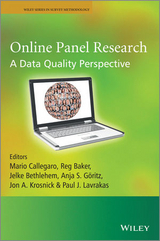
Provides new insights into the accuracy and value of online panels for completing surveys
Over the last decade, there has been a major global shift in survey and market research towards data collection, using samples selected from online panels. Yet despite their widespread use, remarkably little is known about the quality of the resulting data.
This edited volume is one of the first attempts to carefully examine the quality of the survey data being generated by online samples. It describes some of the best empirically-based research on what has become a very important yet controversial method of collecting data. Online Panel Research presents 19 chapters of previously unpublished work addressing a wide range of topics, including coverage bias, nonresponse, measurement error, adjustment techniques, the relationship between nonresponse and measurement error, impact of smartphone adoption on data collection, Internet rating panels, and operational issues.
The datasets used to prepare the analyses reported in the chapters are available on the accompanying website: www.wiley.com/go/online_panel
?? Covers controversial topics such as professional respondents, speeders, and respondent validation.
?? Addresses cutting-edge topics such as the challenge of smartphone survey completion, software to manage online panels, and Internet and mobile ratings panels.
?? Discusses and provides examples of comparison studies between online panels and other surveys or benchmarks.
?? Describes adjustment techniques to improve sample representativeness.
?? Addresses coverage, nonresponse, attrition, and the relationship between nonresponse and measurement error with examples using data from the United States and Europe.
?? Addresses practical questions such as motivations for joining an online panel and best practices for managing communications with panelists.
?? Presents a meta-analysis of determinants of response quantity.
?? Features contributions from 50 international authors with a wide variety of backgrounds and expertise.
This book will be an invaluable resource for opinion and market researchers, academic researchers relying on web-based data collection, governmental researchers, statisticians, psychologists, sociologists, and other research practitioners.
Provides new insights into the accuracy and value of online panels for completing surveys Over the last decade, there has been a major global shift in survey and market research towards data collection, using samples selected from online panels. Yet despite their widespread use, remarkably little is known about the quality of the resulting data. This edited volume is one of the first attempts to carefully examine the quality of the survey data being generated by online samples. It describes some of the best empirically-based research on what has become a very important yet controversial method of collecting data. Online Panel Research presents 19 chapters of previously unpublished work addressing a wide range of topics, including coverage bias, nonresponse, measurement error, adjustment techniques, the relationship between nonresponse and measurement error, impact of smartphone adoption on data collection, Internet rating panels, and operational issues. The datasets used to prepare the analyses reported in the chapters are available on the accompanying website: www.wiley.com/go/online_panel Covers controversial topics such as professional respondents, speeders, and respondent validation. Addresses cutting-edge topics such as the challenge of smartphone survey completion, software to manage online panels, and Internet and mobile ratings panels. Discusses and provides examples of comparison studies between online panels and other surveys or benchmarks. Describes adjustment techniques to improve sample representativeness. Addresses coverage, nonresponse, attrition, and the relationship between nonresponse and measurement error with examples using data from the United States and Europe. Addresses practical questions such as motivations for joining an online panel and best practices for managing communications with panelists. Presents a meta-analysis of determinants of response quantity. Features contributions from 50 international authors with a wide variety of backgrounds and expertise. This book will be an invaluable resource for opinion and market researchers, academic researchers relying on web-based data collection, governmental researchers, statisticians, psychologists, sociologists, and other research practitioners.
Mario Callegaro, Survey Research Scientist, Quantitative Marketing, Google Inc., UK Reg Baker, President & Chief Operating Officer, Market Strategies International, USA Paul J. Lavrakas, Nielsen Media Research, Research Psychologist/Research Methodologist, USA Jon A. Krosnick, Professor of Political Science, Communication, Psychology, Stanford University, USA Jelke Bethlehem, Department of Quantitative Economics, University of Amsterdam, The Netherlands Anja Göritz, University of Erlangen-Nuremberg, Department of Economics and Social Psychology, Germany
About the Editors
Reg Baker is the former President and Chief Operating Officer of Market Strategies International, a full-service research company specializing in healthcare, energy, financial services, telecommunications, and information technology. Prior to joining Market Strategies, he was Vice President for Research Operations at NORC where he oversaw the national field staff, the company's CATI centers, and its technology infrastructure.
Over the course of his almost 40-year career, Reg has focused on the methodological, operational and management challenges of new survey technologies including CATI, CAPI, Web, and now mobile. He writes, presents and consults on these and related issues to diverse national and international audiences and has worked with a wide variety of clients in both the private and public sectors, including substantial research with academic survey methodologists on web survey methods. He was the Chair of the AAPOR Task Force on Online Panels and Co-Chair of the AAPOR Task Force on Non-Probability Sampling. He serves as a consultant to the ESOMAR Professional Standards Committee and has worked on numerous project teams for that association, producing a variety of quality and ethical guidelines including its “28 Questions to Help Buyers of Online Samples” and its “Guideline for Conducting Mobile Marketing Research.” He also is an adjunct instructor in the Master of Science in Marketing Research Program at Michigan State University and is a member of the Executive Editorial Board of the International Journal of Market Research. He continues to consult with Market Strategies and other private and public organizations, including the U.S. Bureau of the Census.
He blogs off and on as The Survey Geek.
Jelke Bethlehem, PhD, is Senior Advisor in the Methodology Team of the Division of Process Development, IT and Methodology at Statistics Netherlands. He is also Professor of Survey Methodology at Leiden University. He studied mathematical statistics at the University of Amsterdam. His PhD was about nonresponse in surveys. He worked for over 30 years at Statistics Netherlands. His research topics were disclosure control, nonresponse, weighting adjustment, and web surveys. In the 1980s and 1990s he was in charge of the development of Blaise, a software system for computer-assisted survey data collection. He has participated in a number of European research projects financed by the European Union.
Dr. Bethlehem's current research interests include web surveys, computer-assisted survey information collection, and graphical techniques in statistics. He is the author of other books published by Wiley: Applied Survey Methods, Handbook of Nonresponse in Household Surveys and Handbook of Web Surveys.
Mario Callegaro is Survey Research Scientist in the Quantitative Marketing team at Google UK. He works on web survey design and focuses on measuring customer satisfaction. He also consults with numerous internal teams regarding survey design, sampling, questionnaire design, and online survey programming and implementation.
Mario holds a BA in Sociology from the University of Trento, Italy, and an MS and PhD in Survey Research and Methodology from the University of Nebraska, Lincoln. Prior to joining Google, Mario was working as survey research scientist for Gfk-Knowledge Networks.
Mario has published over 30 peer-reviewed papers and book chapters and made over 100 conference presentations nationally and internationally in the areas of web surveys, telephone and cell phone surveys; question wording, polling and exit polls; event history calendar; longitudinal surveys, and survey quality. He is associate editor of Survey Research Methods, a member of the editorial board of the International Journal of Market Research, and reviewer for other survey research-oriented journals. His latest book entitled Web Survey Methodology (with Katja Lozar Manfreda and Vasja Vehovar) is forthcoming with Sage.
Anja S. Göritz is a Full Professor of Occupational and Consumer Psychology at the University of Freiburg in Germany. Anja holds a graduate degree in Psychology from the University of Leipzig and a PhD in Organizational and Social Psychology from the University of Erlangen-Nürnberg, Germany. Her research focuses on web-based data collection, market psychology and human–computer interaction. She also consults with international clients regarding design, programming and implementation of web surveys.
Anja has taught graduate and post-graduate courses on research methods and web-based data collection. Moreover, she has regularly been an instructor in the Advanced Training Institute “Performing Web-Based Research” of the American Psychological Association. In 2000, she built and has since maintained Germany's first university-based online panel with more than 20000 panelists. Anja programmed a number of open-source tools for web-based data collection and released them into the public domain.
Anja has published over 60 peer-reviewed papers and book chapters and made over 100 presentations at national and international academic conventions. In 2008, she chaired the program of the General Online Research Conference. She is an associate editor of Social Science Computer Review and a member of the editorial board of International Journal of Internet Science.
Jon A. Krosnick is Frederic O. Glover Professor in Humanities and Social Sciences and Professor of Communication, Political Science, and Psychology at Stanford University. A leading international authority on questionnaire design and survey research methods, Professor Krosnick has taught courses for professionals on survey methods for 25 years around the world, and has served as a methodology consultant to government agencies, commercial firms, and academic scholars. His books include Introduction to Survey Research, Polling, and Data Analysis and The Handbook of Questionnaire Design (forthcoming, Oxford University Press), which reviews 100 years of research on how different ways of asking questions can yield different answers from survey respondents and on how to design questions to measure most accurately. His recent research has focused on how other aspects of survey methodology (e.g., collecting data by interviewing face-to-face vs. by telephone or on paper questionnaires) can be optimized to maximize accuracy.
Dr. Krosnick is also a world-recognized expert on the psychology of attitudes, especially in the area of politics. He is co-principal investigator of the American National Election Study, the nation's preeminent academic research project exploring voter decision-making and political campaign effects. For 30 years, Dr. Krosnick has studied how the American public's political attitudes are formed, change, and shape thinking and action. His publications explore the causes of people's decisions about whether to vote, for whom to vote, whether to approve of the President's performance, whether to take action to influence government policy-making on a specific issue, and much more.
Dr. Krosnick's scholarship has been recognized with the Phillip Brickman Memorial Prize, the Pi Sigma Alpha Award, the Erik Erikson Early Career Award for Excellence and Creativity, a fellowship at the Center for Advanced Study in the Behavioral Sciences, and membership as a fellow of the American Academy of Arts and Sciences.
As an expert witness in court, he has testified evaluating the quality of surveys presented as evidence by opposing counsel and has conducted original survey research to inform courts in cases involving unreimbursed expenses, uncompensated overtime work, exempt/non-exempt misclassification, patent/trademark violation, health effects of accidents, consequences of being misinformed about the results of standardized academic tests, economic valuation of environmental damage, change of venue motions, and other topics.
At Stanford, Dr. Krosnick directs the Political Psychology Research Group (PPRG). PPRG is a cross-disciplinary team of scholars who conduct empirical studies of the psychology of political behavior and studies seeking to optimize research methodology for studying political psychology. The group's studies employ a wide range of research methods, including surveys, experiments, and content analysis, and the group often conducts collaborative research studies with leading news media organizations, including ABC News, The Associated Press, the Washington Post, and Time Magazine. Support for the group's work has come from U.S. Government agencies (e.g., the National Science Foundation, the Bureau of Labor Statistics), private foundations (e.g., the Bill and Melinda Gates Foundation, the Robert Wood Johnson Foundation), and Institutes at Stanford (e.g., the Woods Institute for the Environment). Dr. Krosnick also directs the Summer Institute in Political Psychology, an annual event that brings 60 students and professionals from around the world to Stanford for intensive training in political psychology theory and methods.
Paul J. Lavrakas, PhD, a research psychologist, is a methodological research consultant for several private sector and not-for-profit organizations, and also does select volunteer service projects. He also is a Visiting Scholar, teaching research method courses, at Northern Arizona University.
He was a Nielsen Vice President and their chief methodologist (2000–2007); Professor of Journalism/Communications (Northwestern, 1978–1996; Ohio State, 1996–2000); and founding...
| Erscheint lt. Verlag | 14.4.2014 |
|---|---|
| Reihe/Serie | Wiley Series in Survey Methodology |
| Wiley Series in Survey Methodology | Wiley Series in Survey Methodology |
| Sprache | englisch |
| Themenwelt | Mathematik / Informatik ► Mathematik ► Statistik |
| Mathematik / Informatik ► Mathematik ► Wahrscheinlichkeit / Kombinatorik | |
| Naturwissenschaften | |
| Technik | |
| Schlagworte | accuracy • attempts • Collection • completing • Data • Evaluation & Research Methods • Evaluierung u. Researchmethoden • examine • First • Insights • known • last decade • Little • major global • Methoden der Daten- u. Stichprobenerhebung • New • Online • Online Panels • Panels • quality • remarkably • Research • Research Methodologies • Samples • Shift • Sociology • Soziologie • Soziologische Forschungsmethoden • Statistics • Statistik • Survey • Survey Research Methods & Sampling • Surveys • towards • use • widespread |
| ISBN-10 | 1-118-76351-3 / 1118763513 |
| ISBN-13 | 978-1-118-76351-3 / 9781118763513 |
| Informationen gemäß Produktsicherheitsverordnung (GPSR) | |
| Haben Sie eine Frage zum Produkt? |
 EPUB (Adobe DRM)
Kopierschutz: Adobe-DRM
Adobe-DRM ist ein Kopierschutz, der das eBook vor Mißbrauch schützen soll. Dabei wird das eBook bereits beim Download auf Ihre persönliche Adobe-ID autorisiert. Lesen können Sie das eBook dann nur auf den Geräten, welche ebenfalls auf Ihre Adobe-ID registriert sind.
Details zum Adobe-DRM
Dateiformat: EPUB (Electronic Publication)
EPUB ist ein offener Standard für eBooks und eignet sich besonders zur Darstellung von Belletristik und Sachbüchern. Der Fließtext wird dynamisch an die Display- und Schriftgröße angepasst. Auch für mobile Lesegeräte ist EPUB daher gut geeignet.
Systemvoraussetzungen:
PC/Mac: Mit einem PC oder Mac können Sie dieses eBook lesen. Sie benötigen eine
eReader: Dieses eBook kann mit (fast) allen eBook-Readern gelesen werden. Mit dem amazon-Kindle ist es aber nicht kompatibel.
Smartphone/Tablet: Egal ob Apple oder Android, dieses eBook können Sie lesen. Sie benötigen eine
Geräteliste und zusätzliche Hinweise
Buying eBooks from abroad
For tax law reasons we can sell eBooks just within Germany and Switzerland. Regrettably we cannot fulfill eBook-orders from other countries.
aus dem Bereich