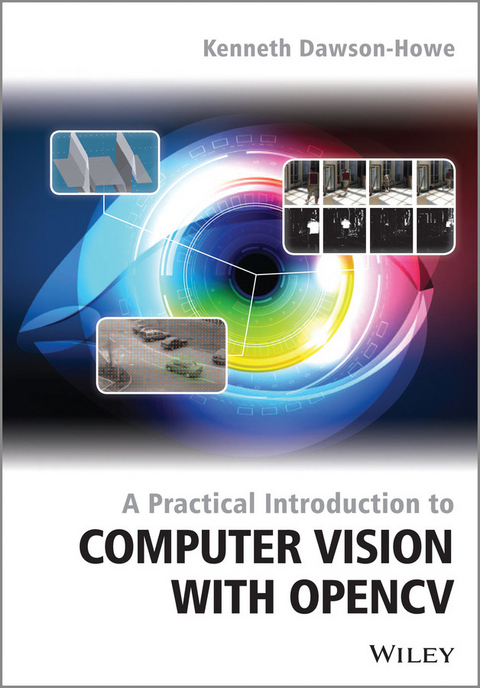
A Practical Introduction to Computer Vision with OpenCV (eBook)
John Wiley & Sons (Verlag)
978-1-118-84878-4 (ISBN)
Explains the theory behind basic computer vision and provides a bridge from the theory to practical implementation using the industry standard OpenCV libraries
Computer Vision is a rapidly expanding area and it is becoming progressively easier for developers to make use of this field due to the ready availability of high quality libraries (such as OpenCV 2). This text is intended to facilitate the practical use of computer vision with the goal being to bridge the gap between the theory and the practical implementation of computer vision. The book will explain how to use the relevant OpenCV library routines and will be accompanied by a full working program including the code snippets from the text. This textbook is a heavily illustrated, practical introduction to an exciting field, the applications of which are becoming almost ubiquitous. We are now surrounded by cameras, for example cameras on computers & tablets/ cameras built into our mobile phones/ cameras in games consoles; cameras imaging difficult modalities (such as ultrasound, X-ray, MRI) in hospitals, and surveillance cameras. This book is concerned with helping the next generation of computer developers to make use of all these images in order to develop systems which are more intuitive and interact with us in more intelligent ways.
- Explains the theory behind basic computer vision and provides a bridge from the theory to practical implementation using the industry standard OpenCV libraries
- Offers an introduction to computer vision, with enough theory to make clear how the various algorithms work but with an emphasis on practical programming issues
- Provides enough material for a one semester course in computer vision at senior undergraduate and Masters levels
- Includes the basics of cameras and images and image processing to remove noise, before moving on to topics such as image histogramming; binary imaging; video processing to detect and model moving objects; geometric operations & camera models; edge detection; features detection; recognition in images
- Contains a large number of vision application problems to provide students with the opportunity to solve real problems. Images or videos for these problems are provided in the resources associated with this book which include an enhanced eBook
Kenneth Dawson-Howe, School of Computer Science and Statistics, Trinity College Dublin, Ireland
Dr. Dawson-Howe is a Lecturer in the School of Computer Science and Statistics and part of the Graphics, Vision and Visualisation (GV2) Research Group at Trinity College Dublin. He currently teaches the course Computer Vision/Vision Systems to final year undergraduate and Masters students. He has been teaching courses in the area of computer vision for over 20 years. He is co-author of the Dictionary of Computer Vision & Image Processing published by Wiley in 2005 (2nd Edition to publish December 2013).
Explains the theory behind basic computer vision and provides a bridge from the theory to practical implementation using the industry standard OpenCV libraries Computer Vision is a rapidly expanding area and it is becoming progressively easier for developers to make use of this field due to the ready availability of high quality libraries (such as OpenCV 2). This text is intended to facilitate the practical use of computer vision with the goal being to bridge the gap between the theory and the practical implementation of computer vision. The book will explain how to use the relevant OpenCV library routines and will be accompanied by a full working program including the code snippets from the text. This textbook is a heavily illustrated, practical introduction to an exciting field, the applications of which are becoming almost ubiquitous. We are now surrounded by cameras, for example cameras on computers & tablets/ cameras built into our mobile phones/ cameras in games consoles; cameras imaging difficult modalities (such as ultrasound, X-ray, MRI) in hospitals, and surveillance cameras. This book is concerned with helping the next generation of computer developers to make use of all these images in order to develop systems which are more intuitive and interact with us in more intelligent ways. Explains the theory behind basic computer vision and provides a bridge from the theory to practical implementation using the industry standard OpenCV libraries Offers an introduction to computer vision, with enough theory to make clear how the various algorithms work but with an emphasis on practical programming issues Provides enough material for a one semester course in computer vision at senior undergraduate and Masters levels Includes the basics of cameras and images and image processing to remove noise, before moving on to topics such as image histogramming; binary imaging; video processing to detect and model moving objects; geometric operations & camera models; edge detection; features detection; recognition in images Contains a large number of vision application problems to provide students with the opportunity to solve real problems. Images or videos for these problems are provided in the resources associated with this book which include an enhanced eBook
Kenneth Dawson-Howe, School of Computer Science and Statistics, Trinity College Dublin, Ireland Dr. Dawson-Howe is a Lecturer in the School of Computer Science and Statistics and part of the Graphics, Vision and Visualisation (GV2) Research Group at Trinity College Dublin. He currently teaches the course Computer Vision/Vision Systems to final year undergraduate and Masters students. He has been teaching courses in the area of computer vision for over 20 years. He is co-author of the Dictionary of Computer Vision & Image Processing published by Wiley in 2005 (2nd Edition to publish December 2013).
A Practical Introduction to Computer Vision with OpenCV 3
Contents 9
Preface 15
1 Introduction 19
1.1 A Difficult Problem 19
1.2 The Human Vision System 20
1.3 Practical Applications of Computer Vision 21
1.4 The Future of Computer Vision 23
1.5 Material in This Textbook 24
1.6 Going Further with Computer Vision 25
2 Images 27
2.1 Cameras 27
2.1.1 The Simple Pinhole Camera Model 27
2.2 Images 28
2.2.1 Sampling 29
2.2.2 Quantisation 29
2.3 Colour Images 31
2.3.1 Red–Green–Blue (RGB) Images 32
2.3.2 Cyan–Magenta–Yellow (CMY) Images 35
2.3.3 YUV Images 35
2.3.4 Hue Luminance Saturation (HLS) Images 36
2.3.5 Other Colour Spaces 38
2.3.6 Some Colour Applications 38
2.4 Noise 40
2.4.1 Types of Noise 41
2.4.2 Noise Models 43
2.4.3 Noise Generation 44
2.4.4 Noise Evaluation 44
2.5 Smoothing 45
2.5.1 Image Averaging 45
2.5.2 Local Averaging and Gaussian Smoothing 46
2.5.3 Rotating Mask 48
2.5.4 Median Filter 49
3 Histograms 53
3.1 1D Histograms 53
3.1.1 Histogram Smoothing 54
3.1.2 Colour Histograms 55
3.2 3D Histograms 57
3.3 Histogram/Image Equalisation 58
3.4 Histogram Comparison 59
3.5 Back-projection 61
3.6 k-means Clustering 62
4 Binary Vision 67
4.1 Thresholding 67
4.1.1 Thresholding Problems 68
4.2 Threshold Detection Methods 69
4.2.1 Bimodal Histogram Analysis 70
4.2.2 Optimal Thresholding 70
4.2.3 Otsu Thresholding 72
4.3 Variations on Thresholding 74
4.3.1 Adaptive Thresholding 74
4.3.2 Band Thresholding 75
4.3.3 Semi-thresholding 76
4.3.4 Multispectral Thresholding 76
4.4 Mathematical Morphology 77
4.4.1 Dilation 78
4.4.2 Erosion 80
4.4.3 Opening and Closing 81
4.4.4 Grey-scale and Colour Morphology 83
4.5 Connectivity 84
4.5.1 Connectedness: Paradoxes and Solutions 84
4.5.2 Connected Components Analysis 85
5 Geometric Transformations 89
5.1 Problem Specification and Algorithm 89
5.2 Affine Transformations 91
5.2.1 Known Affine Transformations 92
5.2.2 Unknown Affine Transformations 93
5.3 Perspective Transformations 94
5.4 Specification of More Complex Transformations 96
5.5 Interpolation 96
5.5.1 Nearest Neighbour Interpolation 97
5.5.2 Bilinear Interpolation 97
5.5.3 Bi-Cubic Interpolation 98
5.6 Modelling and Removing Distortion from Cameras 98
5.6.1 Camera Distortions 99
5.6.2 Camera Calibration and Removing Distortion 100
6 Edges 101
6.1 Edge Detection 101
6.1.1 First Derivative Edge Detectors 103
6.1.2 Second Derivative Edge Detectors 110
6.1.3 Multispectral Edge Detection 115
6.1.4 Image Sharpening 116
6.2 Contour Segmentation 117
6.2.1 Basic Representations of Edge Data 117
6.2.2 Border Detection 120
6.2.3 Extracting Line Segment Representations of Edge Contours 123
6.3 Hough Transform 126
6.3.1 Hough for Lines 127
6.3.2 Hough for Circles 129
6.3.3 Generalised Hough 130
7 Features 133
7.1 Moravec Corner Detection 135
7.2 Harris Corner Detection 136
7.3 FAST Corner Detection 139
7.4 SIFT 140
7.4.1 Scale Space Extrema Detection 141
7.4.2 Accurate Keypoint Location 142
7.4.3 Keypoint Orientation Assignment 144
7.4.4 Keypoint Descriptor 145
7.4.5 Matching Keypoints 145
7.4.6 Recognition 145
7.5 Other Detectors 147
7.5.1 Minimum Eigenvalues 148
7.5.2 SURF 148
8 Recognition 149
8.1 Template Matching 149
8.1.1 Applications 149
8.1.2 Template Matching Algorithm 151
8.1.3 Matching Metrics 152
8.1.4 Finding Local Maxima or Minima 153
8.1.5 Control Strategies for Matching 155
8.2 Chamfer Matching 155
8.2.1 Chamfering Algorithm 155
8.2.2 Chamfer Matching Algorithm 157
8.3 Statistical Pattern Recognition 158
8.3.1 Probability Review 160
8.3.2 Sample Features 161
8.3.3 Statistical Pattern Recognition Technique 167
8.4 Cascade of Haar Classifiers 170
8.4.1 Features 172
8.4.2 Training 174
8.4.3 Classifiers 174
8.4.4 Recognition 176
8.5 Other Recognition Techniques 176
8.5.1 Support Vector Machines (SVM) 176
8.5.2 Histogram of Oriented Gradients (HoG) 177
8.6 Performance 178
8.6.1 Image and Video Datasets 178
8.6.2 Ground Truth 179
8.6.3 Metrics for Assessing Classification Performance 180
8.6.4 Improving Computation Time 183
9 Video 185
9.1 Moving Object Detection 185
9.1.1 Object of Interest 186
9.1.2 Common Problems 186
9.1.3 Difference Images 187
9.1.4 Background Models 189
9.1.5 Shadow Detection 197
9.2 Tracking 198
9.2.1 Exhaustive Search 199
9.2.2 Mean Shift 199
9.2.3 Dense Optical Flow 200
9.2.4 Feature Based Optical Flow 203
9.3 Performance 204
9.3.1 Video Datasets (and Formats) 204
9.3.2 Metrics for Assessing Video Tracking Performance 205
10 Vision Problems 207
10.1 Baby Food 207
10.2 Labels on Glue 208
10.3 O-rings 209
10.4 Staying in Lane 210
10.5 Reading Notices 211
10.6 Mailboxes 212
10.7 Abandoned and Removed Object Detection 213
10.8 Surveillance 214
10.9 Traffic Lights 215
10.10 Real Time Face Tracking 216
10.11 Playing Pool 217
10.12 Open Windows 218
10.13 Modelling Doors 219
10.14 Determining the Time from Analogue Clocks 220
10.15 Which Page 221
10.16 Nut/Bolt/Washer Classification 222
10.17 Road Sign Recognition 223
10.18 License Plates 224
10.19 Counting Bicycles 225
10.20 Recognise Paintings 226
References 227
Index 231
"Although there are many computer vision books on the
market that offer a more comprehensive approach to explaining the
computer vision concepts, extremely few offer such comprehensive
practical examples. In this context, the book would be very welcome
by beginner code developers." (Computing Reviews, 8
August 2014)
| Erscheint lt. Verlag | 20.3.2014 |
|---|---|
| Sprache | englisch |
| Themenwelt | Informatik ► Theorie / Studium ► Künstliche Intelligenz / Robotik |
| Technik ► Elektrotechnik / Energietechnik | |
| Schlagworte | area • BASIC • Behind • Bild- u. Videoverarbeitung • Book • Computer • computer vision • Developers • easier • Electrical & Electronics Engineering • Elektrotechnik u. Elektronik • Expanding • full working • heavily • Illustrated • Image and Video Processing • implementation • Library • Maschinelles Sehen • OpenCV • Practical • Program • progressively • rapidly • relevant • routines • theory • use • Vision |
| ISBN-10 | 1-118-84878-0 / 1118848780 |
| ISBN-13 | 978-1-118-84878-4 / 9781118848784 |
| Informationen gemäß Produktsicherheitsverordnung (GPSR) | |
| Haben Sie eine Frage zum Produkt? |
 EPUB (Adobe DRM)
Größe: 51,6 MB
Kopierschutz: Adobe-DRM
Adobe-DRM ist ein Kopierschutz, der das eBook vor Mißbrauch schützen soll. Dabei wird das eBook bereits beim Download auf Ihre persönliche Adobe-ID autorisiert. Lesen können Sie das eBook dann nur auf den Geräten, welche ebenfalls auf Ihre Adobe-ID registriert sind.
Details zum Adobe-DRM
Dateiformat: EPUB (Electronic Publication)
EPUB ist ein offener Standard für eBooks und eignet sich besonders zur Darstellung von Belletristik und Sachbüchern. Der Fließtext wird dynamisch an die Display- und Schriftgröße angepasst. Auch für mobile Lesegeräte ist EPUB daher gut geeignet.
Systemvoraussetzungen:
PC/Mac: Mit einem PC oder Mac können Sie dieses eBook lesen. Sie benötigen eine
eReader: Dieses eBook kann mit (fast) allen eBook-Readern gelesen werden. Mit dem amazon-Kindle ist es aber nicht kompatibel.
Smartphone/Tablet: Egal ob Apple oder Android, dieses eBook können Sie lesen. Sie benötigen eine
Geräteliste und zusätzliche Hinweise
Zusätzliches Feature: Online Lesen
Dieses eBook können Sie zusätzlich zum Download auch online im Webbrowser lesen.
Buying eBooks from abroad
For tax law reasons we can sell eBooks just within Germany and Switzerland. Regrettably we cannot fulfill eBook-orders from other countries.
 PDF (Adobe DRM)
Kopierschutz: Adobe-DRM
Adobe-DRM ist ein Kopierschutz, der das eBook vor Mißbrauch schützen soll. Dabei wird das eBook bereits beim Download auf Ihre persönliche Adobe-ID autorisiert. Lesen können Sie das eBook dann nur auf den Geräten, welche ebenfalls auf Ihre Adobe-ID registriert sind.
Details zum Adobe-DRM
Dateiformat: PDF (Portable Document Format)
Mit einem festen Seitenlayout eignet sich die PDF besonders für Fachbücher mit Spalten, Tabellen und Abbildungen. Eine PDF kann auf fast allen Geräten angezeigt werden, ist aber für kleine Displays (Smartphone, eReader) nur eingeschränkt geeignet.
Systemvoraussetzungen:
PC/Mac: Mit einem PC oder Mac können Sie dieses eBook lesen. Sie benötigen eine
eReader: Dieses eBook kann mit (fast) allen eBook-Readern gelesen werden. Mit dem amazon-Kindle ist es aber nicht kompatibel.
Smartphone/Tablet: Egal ob Apple oder Android, dieses eBook können Sie lesen. Sie benötigen eine
Geräteliste und zusätzliche Hinweise
Buying eBooks from abroad
For tax law reasons we can sell eBooks just within Germany and Switzerland. Regrettably we cannot fulfill eBook-orders from other countries.
aus dem Bereich