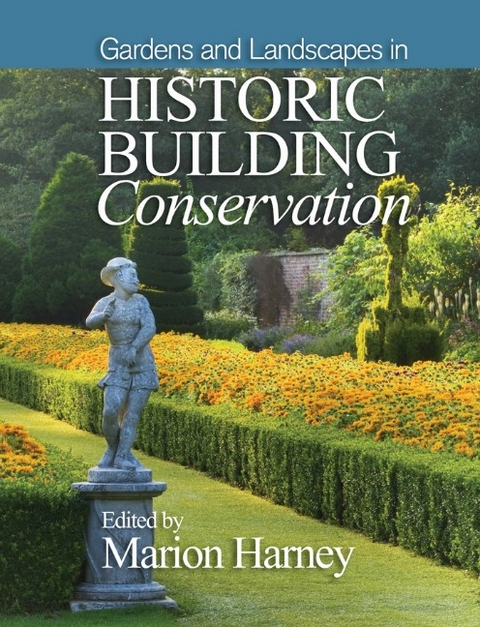
This comprehensive guide on historic garden and landscape conservation will help landscape professionals familiarise themselves with what the conservation of historic gardens, garden structures and designed landscapes encompasses.
The aim of the series is to introduce each aspect of conservation and to provide concise, basic and up-to-date knowledge within five volumes, sufficient for the professional to appreciate the subject better and to know where to seek further help.
Gardens & Landscapes in Historic Building Conservation is an essential guide for everyone with an interest in the conservation of historic gardens and designed landscapes worldwide. The latest assessment of the origins, scope and impact of gardens and designed landscapes is vital reading. Covering history and theory, survey and assessment, conservation and management and the legislative framework the book considers all aspects of garden and landscape conservation and related issues. It explores the challenge of conserving these important sites and surviving physical remains and a conservation movement which must understand, protect and interpret those remains.
This book demonstrates how the discipline of the history and conservation of gardens and landscapes has matured in recent decades, recognising the increased participation of professional contract and curatorial managers in the management of these sites and in conserving and interpreting landscapes.
Drawing on a wide range of sources, combining academic and professional perspectives, the book provides information and advice relevant to all involved in trying to preserve one of England's greatest cultural contributions and legacy for future generations to enjoy. With chapters by all the leading players in the field and illustrated by copious examples this gives essential guidance to the management and conservation of historic gardens and designed landscapes.
Marion Harney
Director of Studies, MSc in the Conservation of Historic Gardens and Cultural Landscapes, University of Bath
Devised and directs this postgraduate degree programme, which is taught by leading professionals, expert practitioners and academics and is open to graduates from most disciplines and other professionals with relevant experience wishing to gain a vocational degree.
This comprehensive guide on historic garden and landscape conservation will help landscape professionals familiarise themselves with what the conservation of historic gardens, garden structures and designed landscapes encompasses. The aim of the series is to introduce each aspect of conservation and to provide concise, basic and up-to-date knowledge within five volumes, sufficient for the professional to appreciate the subject better and to know where to seek further help. Gardens & Landscapes in Historic Building Conservation is an essential guide for everyone with an interest in the conservation of historic gardens and designed landscapes worldwide. The latest assessment of the origins, scope and impact of gardens and designed landscapes is vital reading. Covering history and theory, survey and assessment, conservation and management and the legislative framework the book considers all aspects of garden and landscape conservation and related issues. It explores the challenge of conserving these important sites and surviving physical remains and a conservation movement which must understand, protect and interpret those remains. This book demonstrates how the discipline of the history and conservation of gardens and landscapes has matured in recent decades, recognising the increased participation of professional contract and curatorial managers in the management of these sites and in conserving and interpreting landscapes. Drawing on a wide range of sources, combining academic and professional perspectives, the book provides information and advice relevant to all involved in trying to preserve one of England s greatest cultural contributions and legacy for future generations to enjoy. With chapters by all the leading players in the field and illustrated by copious examples this gives essential guidance to the management and conservation of historic gardens and designed landscapes.
Marion Harney Director of Studies, MSc in the Conservation of Historic Gardens and Cultural Landscapes, University of Bath Devised and directs this postgraduate degree programme, which is taught by leading professionals, expert practitioners and academics and is open to graduates from most disciplines and other professionals with relevant experience wishing to gain a vocational degree.
Cover 1
Title page 5
Copyright page 6
Contents 7
Contributors 9
Introduction 17
Part I: History and Theory 27
1: What is it about gardens that you want to conserve?1 27
2: The National Trust approach to garden conservation 35
Why conserve gardens? 35
The National Trust and gardens 35
Historically significant gardens 36
A roll call of artistic genius 36
National Trust Acquisition criteria 37
Plants and their significance 38
Conservation approaches 39
Development of National Trust conservation policy and practice 39
Conservation – management influences 40
Evidence 40
Restoration 41
Re-creation 42
Flower garden conservation 43
Access and conservation 44
Financial implications 45
Staffing levels 46
Continual development/Innovation 46
Conclusion 47
3: The nature of gardens and their significance 49
Introduction 49
Defining gardens 49
Approach to conservation 51
4: Some Olla Podrida from the diary of a garden historian1 57
Diary entry March 2011 – Crom Castle 57
The house and immediate gardens 57
The site of the old house 58
The water and the eye-catchers 58
The walled garden 59
Diary entry September 2011 – A visit to Castle Drogo on the edge of Dartmoor 59
Diary entry: February 2012 Stourhead – a classical Elysium set in a picturesque landscape 61
Diary entry from March 2012 – Sissinghurst 64
Diary entry November 2012, Nostell Priory, Yorkshire 66
Thoughts on the design and its possible intent 67
Diary entry March 2013 – Attingham Park, Shropshire 69
Addendum – The Walled Gardens and their surrounds 71
5: On design and process 73
6: Evolution of principles for the conservation of gardens and designed landscapes 81
Older approaches to conservation 81
Historicist 81
Modernist 81
Restoration by charter – The desire for accuracy 82
The public purse 82
Restoration principles in the 1980s 83
Aids to accuracy: garden archaeology and conjectural detailing 84
Conservation thinking today 84
Philosophical background 84
The benefit of experience 86
Acceptance of change 87
New work and adaptation 88
Restoration in the 2010s 88
Summary 91
7: Conservation of garden buildings 93
Introduction 93
The desktop study 94
Stowe, Buckinghamshire 94
Temple of Concord and Victory 96
Temple of Friendship 97
The Chinese House 97
The New Inn 98
Croome Park 99
Ecological investigation 100
Dunstall Castle 100
Pirton Castle 101
Panorama 102
8: ‘Perished Perches’: historic garden furniture 105
9: The history and the future of public parks 117
10: The history and aesthetic development of the cemetery and related conservation issues 127
Cemetery, burial ground, graveyard or churchyard? 127
The social and aesthetic context for the earliest English cemeteries 128
The sublime and commercial cemetery in early nineteenth-century England 128
The early commercial cemeteries of the Metropolis 130
The transition from private to public burial provision 131
Municipal or ‘Burial Board’ cemeteries 133
Twentieth-century changes in cemetery aesthetics 136
Conservation issues affecting cemeteries 137
Part II: Survey and Assessment 143
11: Researching historic parks and gardens 143
Storage and reference system 143
First steps 144
Repositories 146
Maps and plans 146
Private estate papers 149
Other material 151
Local authority records 151
Library 152
Copyright libraries and publications available online 153
12: Defining significance and developing a conservation philosophy 155
Significance 156
Examples of significance and conservation philosophy 158
Pitzhanger Manor and Walpole Park in Ealing 158
Wicksteed Park, Kettering, Northamptonshire 161
Alexandra Road, Camden, London 163
Significance 164
13: Science and craft in understanding historic gardens and their management 167
Introduction 167
Recognising a garden’s objectives and the changing role from private to public 167
Dangers in intellectualising the process of gardening 168
The literature as a source of information on past practices of gardening 168
The place of science in managing historic gardens 169
Craft skills 171
Period correctness 172
14: Garden archaeology 175
15: Conservation arboriculture: the natural art of tree management in historic landscapes 179
Introduction 179
Tree time and human time 179
Necessity – mother of arboricultural invention 184
Dead wood – hidden life 185
Integrating vernacular, modern and conservation arboriculture 186
Acknowledgements 187
16: The use of aerial photographs for conservation and research 189
Ways of seeing the evidence 189
Sources 192
Historic aerial photographs and landscape change 193
Newer technology 193
Archaeological mapping and landscape analysis 194
Conservation and heritage management 195
Acknowledgements 196
Part III: Conservation and Management 199
17: Values in heritage management: conservation plans and beyond 199
Introduction 199
Valuable and significant . . . to whom? 200
Values as defined in English Heritage’s Conservation Principles 201
Guidance on the subject 201
The process in a little more detail 202
The scope of CMPs and the principle of proportionality 202
Conservation plans in practice 203
Some conclusions 205
18: Developing a conservation management plan 207
Gaining understanding through research 209
Research: written material 210
Research: map material 210
Research: images 212
Gaining understanding through a site survey 212
Gaining understanding through analysis 214
‘Significance’ 214
Defining issues 215
Policies 215
Management action plan 216
Gazetteer 216
Appendices 216
19: Public parks and their conservation 219
Park movement – first phase 219
Influences on Public Park design 221
Turn of the century and inter-war period 222
Recreation and public health 223
Park systems, chain parks and parkways 223
Post World War II 224
Parks in the 1970s and 80s 224
Buildings 225
New buildings 226
Bandstands 226
Palm houses and winter gardens 227
Statues and monuments 227
Planting: trees and shrubs 228
Flowers 229
Conclusion 230
20: Conserving historic parks and gardens in a changing climate 233
The climate is changing 233
Learning from past extreme weather events and other threats 234
Floods, droughts and temperature extremes 234
Storms 235
Pests and diseases 235
Planning adaptation in the historic park and garden 236
Conservation management plans 238
Trees in a changing climate 238
Managing water features in a changing climate, and sea-level rise issues 240
The climate change management experts 241
Beyond the historic park and garden 241
Conclusions 242
21: Conserving the grey? Management of vegetation without an end-point in culturally important landscapes 245
22: ‘Plants are fashioned by cultivation, man by education’ 253
Introduction 253
The Craftsman – ‘Learning How’ as well as ‘Learning That’5 254
The rise of the Victorian head gardener 256
Learning the skills of cultivation 256
Is there a solution? 258
Conclusion 260
23: Costing and contracts for historic gardens and landscapes 265
Introduction 265
Costing the project 265
Contractual obligations 268
24: Constraints and working on site: some practical and contractual problems 273
Topographic survey 273
Visual survey and assessment of the site 274
Covered and hidden items 274
Drawings 275
Health and safety considerations 275
Programme and sequencing works 275
Choosing materials 277
Choosing contractors 277
Protection 278
Temporary access routes and hard-standing areas 278
Disposal of surplus subsoil 279
Services, utilities and drainage 279
Repair 279
Part IV: The Legislative Framework 281
25: Designed landscapes and national designation 281
Introduction 281
The first edition of the Register of Parks and Gardens 281
Improving the Register 1993–2000 282
Heritage Protection Reform and Unified Designation 283
Revised Criteria and publication of Selection Guides 284
Designed landscapes and the National Heritage Protection Plan 285
Conclusion 285
26: Conservation legislation in the UK 287
27: Historic parks and gardens: the planning system and other conservation tools 297
The National Planning context for the conservation of designed landscapes 297
National designation for the historic environment 299
Listed buildings 299
Scheduled Ancient Monuments 301
Registered Battlefields 302
Registered Parks and Gardens 302
Other useful national designations 303
Other useful local designations 304
Conclusion 306
28: The role of the Heritage Lottery Fund in the conservation of historic gardens and designed landscapes 309
The Urban Parks Programme/Parks for People 309
Conservation plans at the heart of HLF approach 312
Funding for training 313
Cemeteries, country parks, seaside promenades and urban squares 314
HLF’s changing role 315
29: Legal protection for structures, trees and wildlife 317
Introduction 317
Mainstream planning control 318
The need for planning permission 318
Environmental impact assessment 319
Historic structures 320
Protection for listed structures 321
Conservation areas 321
Scheduled monuments 322
Urgent repairs 322
Protected trees 322
Trees and the law generally 322
Tree preservation orders 323
Works to protected trees 323
Trees in conservation areas 324
Wildlife 324
30: Easy access to historic landscapes 327
31: The international context – the European Landscape Convention1 335
The origins of the ELC 335
What does the ELC do? 336
What progress has been made with the Florence Convention since 2000? 339
The ELC in the UK 339
Progress since 2006 in the UK 342
The ELC and the historic gardens and designed landscapes 344
32: Cultural landscapes and the World Heritage Convention 347
What are cultural landscapes? 347
The emergence of World Heritage cultural landscapes 348
Examples of World Heritage Cultural Landscapes 350
Val d’Orcia, Italy 351
West Lake Cultural Landscape of Hangzhou, China 352
Osun-Osogbo Sacred Grove, Nigeria 353
Cultural Landscape of Bali Province: the Subak system as a manifestation of the Tri Hita Karana philosophy, Indonesia 353
Impact of the World Heritage cultural landscape category 354
33: Why should there be any international law relating to monuments and cultural landscapes? 357
Part V: Conservation in Action: Case Studies 365
34: ‘. . . with great art, cost, and diligens . . .’ – the reconstruction of the Elizabethan Garden at Kenilworth Castle 365
35: Paradise restored – a case study exploring the restoration of three of Hestercombe’s period gardens 371
Introduction 371
Restoration of the Great Plat and Victorian Terrace 372
Restoration of the Victorian shrubbery 372
The lost eighteenth-century garden 373
Archaeology and archives 375
The buildings 376
Funding and future security 379
Constraints 379
The future 380
What experience has taught me 380
Conclusion 381
36: Strawberry Hill, Twickenham 383
The restoration 391
37: Stourhead – the conservation and management of a ‘Living work of art’ 397
38: Hackfall, Yorkshire 403
Building restoration 405
Water features 406
Car parking 408
Paths and materials 408
39: Yorkshire Sculpture Park, Wakefield 411
40: The Roof Gardens, Kensington, London 419
Kensington: a rich history 419
Hancock and the Garden of the Nations 421
Building the gardens 421
1973: Biba and subsequent vacancy 425
1978 adaptations 426
1987 restoration 426
2008 restoration 426
Acknowledgements 429
41: Lowther Castle & Gardens
Planning the restoration 434
Description of the gardens 434
Lowther Gardens’ significance and their re-presentation 436
Presentation of the garden 437
The management strategy 438
42: Monticello 439
The development of the garden 442
The restoration project 444
43: The Gardens of the Alhambra 447
44: Central Park, New York City 457
Index 461
"With an august roll call of contributors, Gardens and Landscapes in Historic Building Conservation fills a useful niche . . . Theory and practice are here combined in a rich mix." (Journal of Australian Garden, 1 April 2015)
| Erscheint lt. Verlag | 20.3.2014 |
|---|---|
| Reihe/Serie | Historic Building Conservation | Historic Building Conservation |
| Sprache | englisch |
| Themenwelt | Technik ► Architektur |
| Schlagworte | application • Architecture • Architektur • Book • Chapters • conservation • Cultural • Denkmalpflege • encompasses • enjoy • familiarise • Field • Future • Garden • Gardening / Landscape & Lawns • Garden structures • Generations • Guide • Historic • historic preservation • Interdisciplinary • Landscape Design • Landschaftsarchitektur • Landschaftsgärten u. Grünflächen • Landschaftsgärten u. Grünflächen • leading players • lifestyle • lifestyles • Managers • Nature • Professionals • Themselves • Work |
| ISBN-13 | 9781118508121 / 9781118508121 |
| Informationen gemäß Produktsicherheitsverordnung (GPSR) | |
| Haben Sie eine Frage zum Produkt? |
 PDF (Adobe DRM)
Kopierschutz: Adobe-DRM
Adobe-DRM ist ein Kopierschutz, der das eBook vor Mißbrauch schützen soll. Dabei wird das eBook bereits beim Download auf Ihre persönliche Adobe-ID autorisiert. Lesen können Sie das eBook dann nur auf den Geräten, welche ebenfalls auf Ihre Adobe-ID registriert sind.
Details zum Adobe-DRM
Dateiformat: PDF (Portable Document Format)
Mit einem festen Seitenlayout eignet sich die PDF besonders für Fachbücher mit Spalten, Tabellen und Abbildungen. Eine PDF kann auf fast allen Geräten angezeigt werden, ist aber für kleine Displays (Smartphone, eReader) nur eingeschränkt geeignet.
Systemvoraussetzungen:
PC/Mac: Mit einem PC oder Mac können Sie dieses eBook lesen. Sie benötigen eine
eReader: Dieses eBook kann mit (fast) allen eBook-Readern gelesen werden. Mit dem amazon-Kindle ist es aber nicht kompatibel.
Smartphone/Tablet: Egal ob Apple oder Android, dieses eBook können Sie lesen. Sie benötigen eine
Geräteliste und zusätzliche Hinweise
Buying eBooks from abroad
For tax law reasons we can sell eBooks just within Germany and Switzerland. Regrettably we cannot fulfill eBook-orders from other countries.
aus dem Bereich