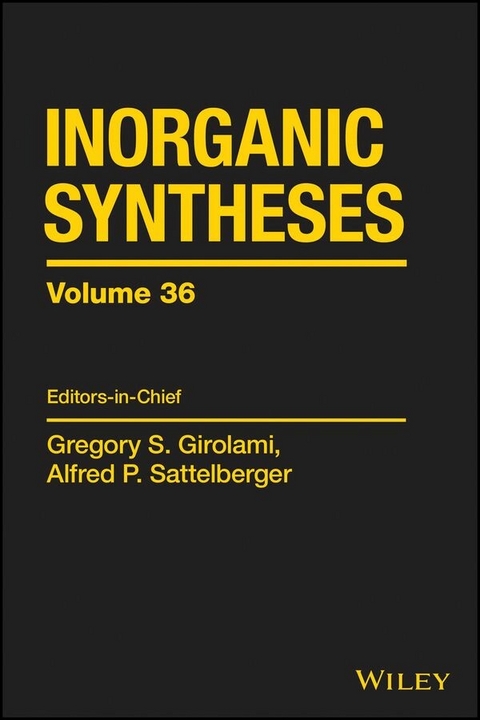
Inorganic Syntheses, Volume 36 (eBook)
John Wiley & Sons (Verlag)
978-1-118-74484-0 (ISBN)
some key early transition metal halide clusters and the very useful mononuclear molybdenum(III) synthon, MoCl3(THF)3. Chapter 2 covers the synthesis of a number of cyclopentadienyl compounds, including a novel route to sodium and potassium cyclopentadienide, MC5H5. Chapter 3 details synthetic procedures for a range of metal-metal bonded compounds, including several with metal-metal multiple bonds. Chapter 4 contains procedures for a range of
early and late transition metal compounds, each a useful synthon for further synthetic elaboration. Chapter 5 deals
with the synthesis of a number of main group compounds and ligands, while Chapter 6 covers teaching laboratory experiments.
This volume of Inorganic Syntheses spans the preparations of wide range of important inorganic, organometallic and solid-state compounds. The volume is divided into 6 chapters. The first chapter contains the syntheses of some key early transition metal halide clusters and the very useful mononuclear molybdenum(III) synthon, MoCl3(THF)3. Chapter 2 covers the synthesis of a number of cyclopentadienyl compounds, including a novel route to sodium and potassium cyclopentadienide, MC5H5. Chapter 3 details synthetic procedures for a range of metal-metal bonded compounds, including several with metal-metal multiple bonds. Chapter 4 contains procedures for a range of early and late transition metal compounds, each a useful synthon for further synthetic elaboration. Chapter 5 deals with the synthesis of a number of main group compounds and ligands, while Chapter 6 covers teaching laboratory experiments.
Professor Gregory S. Girolami received his B.S. degrees in chemistry and physics from the University of Texas at Austin and his Ph.D. degree from the University of California at Berkeley. Thereafter, he was a NATO postdoctoral fellow with Sir Geoffrey Wilkinson at Imperial College of Science and Technology, and joined the Illinois faculty in 1983. Alfred P. Sattelberger is Argonne's Associate?Laboratory Director for Energy Engineering and Systems Analysis. He oversees the Energy Engineering and Systems Analysis?Directorate (EESA), which is responsible for Argonne's programs in energy?research--including energy storage, renewable energy, energy efficiency and nuclear energy--and national security. Sattelberger obtained a Ph.D. in inorganic chemistry from Indiana University and was a National Science Foundation Postdoctoral Fellow at Case Western Reserve University.
Inorganic Syntheses 1
Preface 7
Dedication 9
Notice to Contributors and Checkers 17
Toxic Substances and Laboratory Hazards 19
Contents 21
Chapter One: Transition Metal Halide Compounds 29
1. Octahedral Hexatantalum Halide Clusters 29
A. Tetradecachlorohexatantalum Octahydrate 31
B. Tetradecabromohexatantalum Octahydrate 32
C. Tetrakis(benzyltributylammonium) Octadecachlorohexatantalate 33
2. Octahedral Hexamolybdenum Halide Clusters 36
A. Tetradecachlorohexamolybdate Hexahydrate (Chloromolybdic Acid) 38
B. Hexamolybdenum Dodecachloride 40
3. Ether Complexes of Molybdenum(III) and Molybdenum(IV) Chlorides 43
A. Tetrachlorobis(diethyl ether)molybdenum(IV) 44
B. Trichlorotris(tetrahydrofuran)molybdenum(III) 45
4. Octahedral Hexatungsten Halide Clusters 47
A. Bis(hydroxonium) Tetradecachlorohexatungstate Heptahydrate (Chlorotungstic Acid) 49
B. Hexatungsten Dodecachloride 50
5. Trinuclear Tungsten Halide Clusters 52
A. Tritungsten Decachloride 54
B. Trisodium Tridecachlorotritungstate 55
C. Tris(benzyltributylammonium) Tridecachlorotritungstate 56
6. Crystalline and Amorphous Forms of Tungsten Tetrachloride 58
A. Crystalline Tungsten Tetrachloride by Solid-State Reduction 60
B. Amorphous Tungsten Tetrachloride by Solution-Phase Reduction 61
Chapter Two: Cyclopentadienyl Compounds 63
7. Sodium and Potassium Cyclopentadienide 63
A. Sodium Cyclopentadienide 64
B. Potassium Cyclopentadienide 65
8. (Pentafluorophenyl)cyclopentadiene and its Sodium Salt 66
A. (Pentafluorophenyl)cyclopentadiene 67
B. Sodium (Pentafluorophenyl)cyclopentadienide 69
9. Bis(?5-pentamethylcyclopentadienyl) Complexes of Scandium 70
A. Bis(?5-pentamethylcyclopentadienyl)chloroscandium 71
B. Bis(?5-pentamethylcyclopentadienyl)methylscandium 72
C. Bis(?5-pentamethylcyclopentadienyl)phenylscandium 73
D. Bis(?5-pentamethylcyclopentadienyl)(o-tolyl)scandium 74
10. Bis(?5-pentamethylcyclopentadienyl) Complexes of Titanium,Zirconium, and Hafnium 75
A. Bis(?5-pentamethylcyclopentadienyl)dichlorotitanium(IV) 75
B. Bis(?5-pentamethylcyclopentadienyl)dichlorozirconium(IV) 77
C. Bis(?5-pentamethylcyclopentadienyl)dichlorohafnium(IV) 78
11. Bis(?5-pentamethylcyclopentadienyl) Complexes of Niobiumand Tantalum 80
A. Bis(?5-pentamethylcyclopentadienyl)dichlorotantalum(IV) 81
B. Bis(?5-pentamethylcyclopentadienyl)dichloroniobium(IV) 83
12. Bis(?5-pentamethylcyclopentadienyl) Complexes of Molybdenum 86
A. Bis(pentamethylcyclopentadienyl)dichloromolybdenum(IV) 87
B. Bis(pentamethylcyclopentadienyl)dihydridomolybdenum(IV) 89
13. (?5-Cyclopentadienyl)tricarbonylmanganese(I) Complexes 90
A. (?5-Cyclopentadienyl)tricarbonylmanganese(I) 91
B. (?5-Pentamethylcyclopentadienyl)tricarbonylmanganese(I) 91
14. 1,1'-Diaminoferrocene 93
A. 1,1'-Dilithioferrocene N,N,N',N'-Tetramethylethylenediamine 94
B. 1,1'-Dibromoferrocene 95
C. One-Pot Preparation of 1,1'-Dibromoferrocene from Ferrocene 96
D. 1,1'-Diaminoferrocene 97
E. 1,1'-Diaminoferrocenium Hexafluorophosphate 98
F. 1,1'-Diaminoferrocenium Triflate 99
15. Mono(?5-pentamethylcyclopentadienyl) Complexes of Osmium 100
A. Bromoosmic Acid 102
B. Bis(?5-pentamethylcyclopentadienyl)tetrabromodiosmium(III) 103
C. (?5-Pentamethylcyclopentadienyl)(1,5-cyclooctadiene)-bromoosmium(II) 104
Chapter Three: Compounds with Metal–Metal Bonds 106
16. Tetra(acetato)dimolybdenum(II) 106
17. Supramolecular Arrays Based on Dimolybdenum Building Blocks 109
A. Tetrakis(N,N'-di-p-anisylformamidinato)dimolybdenum(II) 112
B. Tris(N,N'-di-p-anisylformamidinato)di(chloro)- dimolybdenum(II,III) 114
C. cis-Bis(N,N'-di-p-anisylformamidinato)tetrakis(acetonitrile)- dimolybdenum(II) Bis(tetrafluoroborate) 115
D. (?2-Succinato)bis[tris(N,N"-di-p-anisylformamidinato)-dimolybdenum(II)] 116
E. (?2-?2,?2-Molybdato)bis[tris(N,N'-di-p-anisylformamidinato)-dimolybdenum(II)] 117
F. (?2-N,N'-Diphenylterephthaloyldiamidato)bis[tris(N,N'-di-panisylformamidinato)dimolybdenum(II)] 118
G. Molecular Propeller: (?3-Trimesate)tris[tris(N,N0-di-panisylformamidinato)dimolybdenum(II)] 119
H. Molecular Loop: closo-Bis(?2-malonato)bis[bis(N,N'-di-panisylformamidinato)dimolybdenum(II)] 120
I. Molecular Triangle: closo-Tris(?2-eq,eq-1,4-cyclohexanedicarboxylato)tris[bis(N,N'-di-p-anisylformamidinato)-dimolybdenum(II)] 120
J. Molecular Square: closo-Tetrakis(?2-oxalato)tetrakis[bis(N,N'-di-p-anisylformamidinato)dimolybdenum(II)] 121
K. Molecular Cage: closo-Tetrakis(?3-trimesate)hexakis[bis(N,N'-di-p-anisylformamidinato)dimolybdenum(II)] 122
18. Dimolybdenum and Ditungsten Hexa(alkoxides) 123
A. Hexa(tert-butoxy)dimolybdenum(III) 124
B. Hexakis(2-trifluoromethyl-2-propoxy)dimolybdenum(III) 125
C. Sodium Heptachloropentakis(tetrahydrofuran)ditungstate(III) 126
D. Hexa(tert-butoxy)ditungsten(III) 127
E. Hexakis(2-trifluoromethyl-2-propoxy)ditungsten(III) 128
19. Linear Trichromium, Tricobalt, Trinickel, and Tricopper Complexes of 2,2'-Dipyridylamide 130
A. Dichlorotetrakis(2,2'-dipyridylamido)trichromium(II) 131
B. Dichlorotetrakis(2,2'-dipyridylamido)tricobalt(II) 132
C. Dichlorotetrakis(2,2'-dipyridylamido)trinickel(II) 133
D. Dichlorotetrakis(2,2'-dipyridylamido)tricopper(II) 134
E. Bis(acetonitrile)tetrakis(2,2'-dipyridylamido)trichromium(II) Bis(hexafluorophosphate) 135
F. Bis(acetonitrile)tetrakis(2,2'-dipyridylamido)tricobalt(II) Bis(hexafluorophosphate) 136
G. Bis(acetonitrile)tetrakis(2,2'-dipyridylamido)trinickel(II) Bis(hexafluorophosphate) 136
20. Bis(tetrabutylammonium) Octachloroditechnetate(III) 138
A. Tetrabutylammonium Pertechnetate(VII) 139
B. Tetrabutylammonium Oxotetrachlorotechnetate(V) 140
C. Bis(tetrabutylammonium) Octachloroditechnetate(III) 140
21. Diruthenium Formamidinato Complexes 142
A. Chlorotris(acetato)(N,N'-di-2,6-xylylformamidinato)- diruthenium(II,III) 143
B. trans-Chlorobis(acetato)bis(N,N'-di-2,6-xylylformamidinato)- diruthenium(II,III) 145
C. cis-Chlorobis(acetato)bis(N,N'-di-p-anisylformamidinato)- diruthenium(II,III) 146
D. Chloro(acetato)tris(N,N'-di-p-anisylformamidinato)- diruthenium(II,III) 147
E. Chlorotetrakis(N,N'-di-p-anisylformamidinato)- diruthenium(II,III) 148
22. Heptacarbonyl(disulfido)dimanganese(I). 150
23. Di(carbido)tetracosa(carbonyl)decaruthenate(2–) Salts 152
A. Calcium Di(carbido)tetracosa(carbonyl)decaruthenate(2–) 152
B. Bis[bis(triphenylphosphoranylidene)ammonium] Di(carbido)tetracosa(carbonyl)decaruthenate(2–) 153
Chapter Four: General Transition Metal Compounds 155
24. Bis(1,2-bis(dimethylphosphano)ethane)tricarbonyltitanium(0) and Hexacarbonyltitanate(2–) 155
A. Bis(1,2-bis(dimethylphosphano)ethane)- tricarbonyltitanium(0) 157
B. Bis[18-crown-6)(acetonitrile)potassium] Hexacarbonyltitanate(2–) 159
25. Tungsten Benzylidyne Complexes 162
A. Trichloro(1,2-dimethoxyethane)benzylidynetungsten(VI) 163
B. Chloro Bis[1,2-bis(diphenylphosphino)ethane]- benzylidynetungsten(IV) 164
26. Tungsten Oxytetrachloride and (Acetonitrile)tetrachlorotungsten Imido Complexes 166
A. Tungsten Oxytetrachloride 167
B. (Acetonitrile)tetrachloro(phenylimido)tungsten(VI) 168
C. (Acetonitrile)tetrachloro(2-propylimido)tungsten(VI) 169
D. (Acetonitrile)tetrachloro(2-propenylimido)tungsten(VI) 170
27. Tungsten Oxytetrachloride and Several Tungstate Salts 171
A. Tungsten Oxytetrachloride 172
B. Bis(tetrabutylammonium) Hexapolytungstate 173
C. Di(cetylpyridinium) Peroxoditungstate 174
D. Bis(tetrabutylammonium) Phenylphosphonatodiperoxotungstate 175
28. Bromotricarbonyldi(pyridine)manganese(I) 176
29. Bis(tetraethylammonium) fac-Tribromotricarbonylrhenate(I) and -Technetate(I) 177
A. Bis(tetraethylammonium) fac-Tribromotricarbonylrhenate(I) 179
B. Bis(tetraethylammonium) fac-Trichlorotricarbonyltechnetate( I) 180
30. Methyl(oxo)rhenium(V) Complexes with Chelating Ligands 183
A. Methyl(oxo)(1,2-ethanedithiolato)rhenium(V) Dimer 184
B. Methyl(oxo)bis(2-oxyquinoline)rhenium(V) 185
C. Methyl(oxo)(2,2'-thiodiacetato)(triphenylphosphine)- rhenium(V) 186
31. Hexahydridoferrate(II) Salts 188
A. Tetrakis[bromobis(tetrahydrofuran)magnesium] Hexahydridoferrate( II) 189
B. Tetrakis[2-methyl-2-propoxomagnesium] Hexahydridoferrate(II) 191
32. Tris(allyl)iridium and -Rhodium 193
A. Allyllithium 194
B. mer-Trichlorotris(tetrahydrothiophene)iridium(III) 194
C. mer-Trichlorotris(tetrahydrothiophene)rhodium(III) 195
D. Tris(allyl)iridium(III) 196
E. Tris(allyl)rhodium(III) 198
33. Trinuclear Palladium(II) Acetate 199
Chapter Five: Main Group Compounds and Ligands 202
34. Monocarbaborane Anions with 10 or 12 Vertices 202
A. Tetraethylammonium arachno-6-Carba-decaboranate(14) 204
B. Tetraethylammonium closo-2-Carba-decaboranate(10) 205
C. Tetraethylammonium closo-1-Carba-decaboranate(10) 206
D. Tetraethylammonium closo-1-Carba-dodecaboranate(12) 207
E. Tetraethylammonium nido-6-Phenyl-6-carbadecaboranate( 12) 208
F. Tetraethylammonium closo-2-Phenyl-2-carbadecaboranate( 10) 209
G. Tetraethylammonium closo-1-Phenyl-1-carbadecaboranate( 10) 210
H. Tetraethylammonium closo-1-Phenyl-1-carbadodecaboranate( 12) 211
35. Tetrakis(5-tert-butyl-2-hydroxyphenyl)ethene 214
A. 5,5'-Di-tert-butyl-2,2'-dimethoxybenzophenone 215
B. Titanium Trichloride 1,2-Dimethoxyethane (1:1.5) 217
C. Tetrakis(5-tert-butyl-2-methoxyphenyl)ethene 217
D. Tetrakis(5-tert-butyl-2-hydroxyphenyl)ethene 220
36. Electrochemical Synthesis of Tetraethylammonium Tetrathiooxalate 223
37. Mid-Infrared Emitting Lead Selenide Nanocrystal Quantum Dots 226
A. Lead Selenide NQDs Emitting at 2.5 ?m (0.50 eV) 227
B. Lead Selenide NQDs Emitting at 2.8 ?m (0.44 eV) 228
C. Lead Selenide NQDs Emitting at 3.3 ?m (0.38 eV) 229
D. Lead Selenide NQDs Emitting at 3.5 ?m (0.35 eV) 229
Chapter Six: Teaching Laboratory Experiments 231
38. Tetra(acetato)dichromium(II) Dihydrate 231
39. Keggin Structure Polyoxometalates 238
A. Tri(ammonium) 12-Molybdophosphate 239
B. 12-Tungstosilicic Acid 240
C. 12-Tungstophosphoric Acid 242
D. 12-Molybdophosphoric Acid 243
40. Quadruply Metal–Metal Bonded Complexes of Rhenium(III) 245
A. Tetrabutylammonium Perrhenate(VII) 246
B. Bis(tetrabutylammonium) Octachlorodirhenate(III) 247
C. Tetra(acetato)dichlorodirhenium(III) 249
41. Bis[bis(triphenylphosphoranylidene)ammonium] Undecacarbonyltriferrate( 2 251
42. Acetylide Complexes of Ruthenium 254
A. (Cyclopentadienyl)bis(triphenylphosphine)- chlororuthenium(II) 255
B. (Cyclopentadienyl)bis(triphenylphosphine)(phenylacetylido)- ruthenium(II) 256
43. N,N'-Bis(mercaptoethyl)-1,4-diazacycloheptane (H2BME-DACH) and its Nickel Complex: A Model for Bioinorganic Chemistry 259
A. [N,N'-Bis(2-mercaptidoethyl)-1,4-diazacycloheptane]- nickel(II) 262
B. Sulfur Dioxide Adduct of NiII(BME-DACH) 264
C. Acetylation of NiII(BME-DACH) 265
44. Tin(II) Iodide 268
45. N-tert-Butyl-3,5-dimethylaniline 272
A. 2,4,6-Trimethylpyrylium Tetrafluoroborate 273
B. N-tert-Butyl-3,5-dimethylaniline 274
Cumulative Contributor Index 279
Cumulative Subject Index 288
Cumulative Formula Index 315
| Erscheint lt. Verlag | 18.3.2014 |
|---|---|
| Reihe/Serie | Inorganic Syntheses |
| Inorganic Syntheses | Inorganic Syntheses |
| Mitarbeit |
Chef-Herausgeber: Gregory S. Girolami, Alfred P. Sattelberger |
| Sprache | englisch |
| Themenwelt | Naturwissenschaften ► Chemie ► Anorganische Chemie |
| Naturwissenschaften ► Chemie ► Organische Chemie | |
| Naturwissenschaften ► Chemie ► Physikalische Chemie | |
| Technik ► Maschinenbau | |
| Schlagworte | Anorganische Chemie • Checkers • Chemie • Chemistry • chloromolybdic • contributors • Coordination Chemistry • Dedication • halide • hexahydrate • hexamolybdenum • hexatantalum • Inorganic Chemistry • Koordinationschemie • Materialeigenschaften • Materials Science • Materialwissenschaften • Metal • Notice • octahedral • octahydrate • One • properties of materials • tetradecachlorohexamolybdate • tetradecachlorohexatantalum • Transition • V • VII |
| ISBN-10 | 1-118-74484-5 / 1118744845 |
| ISBN-13 | 978-1-118-74484-0 / 9781118744840 |
| Informationen gemäß Produktsicherheitsverordnung (GPSR) | |
| Haben Sie eine Frage zum Produkt? |
 PDF (Adobe DRM)
Größe: 2,5 MB
Kopierschutz: Adobe-DRM
Adobe-DRM ist ein Kopierschutz, der das eBook vor Mißbrauch schützen soll. Dabei wird das eBook bereits beim Download auf Ihre persönliche Adobe-ID autorisiert. Lesen können Sie das eBook dann nur auf den Geräten, welche ebenfalls auf Ihre Adobe-ID registriert sind.
Details zum Adobe-DRM
Dateiformat: PDF (Portable Document Format)
Mit einem festen Seitenlayout eignet sich die PDF besonders für Fachbücher mit Spalten, Tabellen und Abbildungen. Eine PDF kann auf fast allen Geräten angezeigt werden, ist aber für kleine Displays (Smartphone, eReader) nur eingeschränkt geeignet.
Systemvoraussetzungen:
PC/Mac: Mit einem PC oder Mac können Sie dieses eBook lesen. Sie benötigen eine
eReader: Dieses eBook kann mit (fast) allen eBook-Readern gelesen werden. Mit dem amazon-Kindle ist es aber nicht kompatibel.
Smartphone/Tablet: Egal ob Apple oder Android, dieses eBook können Sie lesen. Sie benötigen eine
Geräteliste und zusätzliche Hinweise
Zusätzliches Feature: Online Lesen
Dieses eBook können Sie zusätzlich zum Download auch online im Webbrowser lesen.
Buying eBooks from abroad
For tax law reasons we can sell eBooks just within Germany and Switzerland. Regrettably we cannot fulfill eBook-orders from other countries.
 EPUB (Adobe DRM)
Kopierschutz: Adobe-DRM
Adobe-DRM ist ein Kopierschutz, der das eBook vor Mißbrauch schützen soll. Dabei wird das eBook bereits beim Download auf Ihre persönliche Adobe-ID autorisiert. Lesen können Sie das eBook dann nur auf den Geräten, welche ebenfalls auf Ihre Adobe-ID registriert sind.
Details zum Adobe-DRM
Dateiformat: EPUB (Electronic Publication)
EPUB ist ein offener Standard für eBooks und eignet sich besonders zur Darstellung von Belletristik und Sachbüchern. Der Fließtext wird dynamisch an die Display- und Schriftgröße angepasst. Auch für mobile Lesegeräte ist EPUB daher gut geeignet.
Systemvoraussetzungen:
PC/Mac: Mit einem PC oder Mac können Sie dieses eBook lesen. Sie benötigen eine
eReader: Dieses eBook kann mit (fast) allen eBook-Readern gelesen werden. Mit dem amazon-Kindle ist es aber nicht kompatibel.
Smartphone/Tablet: Egal ob Apple oder Android, dieses eBook können Sie lesen. Sie benötigen eine
Geräteliste und zusätzliche Hinweise
Buying eBooks from abroad
For tax law reasons we can sell eBooks just within Germany and Switzerland. Regrettably we cannot fulfill eBook-orders from other countries.
aus dem Bereich