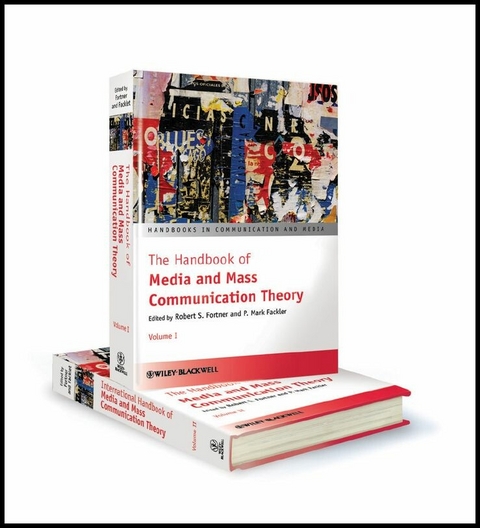
The Handbook of Media and Mass Communication Theory (eBook)
John Wiley & Sons (Verlag)
978-1-118-76997-3 (ISBN)
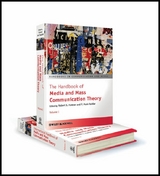
The Handbook of Media and Mass Communication Theory presents a comprehensive collection of original essays that focus on all aspects of current and classic theories and practices relating to media and mass communication.
- Focuses on all aspects of current and classic theories and practices relating to media and mass communication
- Includes essays from a variety of global contexts, from Asia and the Middle East to the Americas
- Gives niche theories new life in several essays that use them to illuminate their application in specific contexts
- Features coverage of a wide variety of theoretical perspectives
- Pays close attention to the use of theory in understanding new communication contexts, such as social media
2 Volumes
About the Editors
Robert S. Fortner is Professor of Journalism and Mass Communication at the American University in Bulgaria. He is the author or editor of seven books and almost 100 essays.
P. Mark Fackler is Professor of Communication at Calvin College, USA. He has written extensively on topics relating to communication and journalism ethics.
Robert S. Fortner is Professor of Journalism and Mass Communication at the American University in Bulgaria. He is the author or editor of seven books and almost 100 essays. P. Mark Fackler is Professor of Communication at Calvin College. He has written extensively on topics relating to communication and journalism ethics.
"This two-volume collection is a rich, comprehensive source of developing media theory. Original foundational essays focus on theory, and empirical analyses explore a wide range of case studies and their applications ... Unique for the current and comprehensive range of perspectives it offers, this set is a must read for those interested in having a broad understanding of the evolution and current state of theories in mass communication. Highly recommended. Upper-division undergraduates through faculty." (Choice, 1 April 2015)
"This is a richly detailed set on media theory and its application in communication studies. While the focus is very much on its application in the media sphere, scholars in allied cultural and sociological disciplines will also find much they can adopt and adapt within their own work as well; broadening the appeal and readership likewise ... Given that there is much within this work that will be of repeated use to students and faculty, purchase of this work by any academic library supporting these disciplines is one that should be strongly considered." (Reference Reviews, 1 April 2015)
"That this Handbook calls for two large volumes and
more than four dozen essays illustrates the dramatic pace of
developing media theory in recent years. Such a reference work
would have been impossible a decade or two ago when serious media
theoretical research was just getting off the ground and we had far
more questions than potential answers. Fortner and Fackler and
their impressive array of contributors provide an invaluable
intellectual anthology of what we now know, topics which are still
only partially understood, and aspects where much remains to be
done."
Chris Sterling, George Washington University
"Like Rodgers and Hammerstein or Lerner and Lowe, Robert
Fortner and Mark Fackler are becoming the gourmet indispensable
team who provide excellent inspiration for our field. Like
Christians and Wilkins, they have set the bar with a handbook on
international media ethics. Now they are raising that bar with
The Handbook of Media and Mass Communication Theory, which
assembles a who's who of leading theorists and media studies
thinkers worldwide. Far more than an introduction to media theory,
this double volume is the most current and comprehensive overview
and analysis of the field. ... MUST reading."
Dr. Tom Cooper, Emerson College
"A rich resource for all media-related disciplines.
Impressive for its vision, both retrospective and future-oriented;
and comprehensive in its range of perspectives, from the
established to the innovatory."
Denis McQuail, University of Amsterdam
Notes on Contributors
Daniel A. Berkowitz is Professor of Journalism and Mass Communication and associate dean in the Graduate College at the University of Iowa. His research includes social and cultural approaches to the study of news and news production, with an emphasis on mythical narrative and collective memory. He has published in journals such as Journalism: Theory, Practice & Criticism, Journalism & Mass Communication Quarterly, Journalism Studies, Memory Studies, and the International Communication Gazette. He has also published two edited volumes, Social Meanings of News and Cultural Meanings of News.
Amy Bleakley is a senior research scientist in the Health Communication Group at the Annenberg Public Policy Center at the University of Pennsylvania. Her research focuses on investigating media effects on health risk behaviors and on using theory to create evidence-based health interventions.
Brett A. Borton is an Assistant Professor of Communication Studies at the University of South Carolina, Beaufort. A former print journalist and integrated communications specialist, his research interests are in sustainability of journalism, communication and culture, and media law.
Catherine Cassara is Associate Professor of Journalism, Bowling Green State University, and the author of articles and book chapters on international news coverage and human rights in American newspapers, media use, protest, and the impact of Al Jazeera in Tunisia. She worked for six years with colleagues at universities in Tunisia and Algeria.
Guo-Ming Chen is Professor of Communication Studies at the University of Rhode Island. His research interests are in intercultural/organizational/global communication. Chen has published numerous articles and books. Those books include Foundations of Intercultural Communication; Communication and Global Society; Chinese Conflict Management and Resolution; and Theories and Principles of Chinese Communication.
Clifford G. Christians is Research Professor of Communications, Professor of Journalism, and Professor of Media Studies Emeritus, University of Illinois-Urbana. He co-auhored Normative Theories of the Media (2009), and is editor (with Kaarle Nordenstreng) of Communication Theories in a Multicultural World (forthcoming).
Yoel Cohen is Associate Professor, School of Communication, Ariel University, Israel. His research interests include media and religion in Israel and in Judaism; religion and news; foreign news reporting; defence and the media. His book publications include God, Jews & the Media: Religion & Israel’s Media (2012); Whistleblowers and the Bomb: Vanunu, Israel and Nuclear Secrecy (2005); The Whistleblower of Dimona: Vanunu, Israel & the Bomb (2003); Media Diplomacy: The Foreign Office in the Mass Communications Age (1986). His research has appeared in the Harvard International Journal of Press/Politics, Gazette, the Journal of Media & Religion, Israel Affairs, the Review of International Affairs, and the Encyclopaedia of Religion, Communication & Media. He was Israel Media editor of Encyclopaedia Judaica.
Jeffrey Crouch is Assistant Professor of Political Science at the American University in Washington, DC. He is the author of The Presidential Pardon Power (2009).
Kevin Cummings is Associate Professor of Communication Studies at Mercer University and is an affiliated faculty member in the Department of Women and Gender Studies. His research examines the rhetoric surrounding domestic terrorism. More recently, his work has explored the figure of the terrorist and the figure of the citizen.
Xiaodong Dai is Associate Professor of Foreign Languages at Shanghai Normal University, China. His major research interests are cultural identity, identity negotiation, and intercultural communication theory. Dai has published numerous articles. His most recent books are Identity and Intercultural Communication: Theoretical and Contextual Construction and Intercultural Communication Theories.
Norman K. Denzin is Distinguished Professor of Communications, College of Communications Scholar, and Research Professor of Communications, Sociology, and Humanities at the University of Illinois, Urbana-Champaign. One of the world’s foremost authorities on qualitative research and cultural criticism, Denzin is the author or editor of more than two dozen books, including The Qualitative Manifesto; Qualitative Inquiry Under Fire; Searching for Yellowstone; Reading Race; Interpretive Ethnography; The Cinematic Society; The Voyeur’s Gaze; and The Alcoholic Self. He is former editor of The Sociological Quarterly, co-editor (with Yvonna S. Lincoln) of four editions of the landmark Handbook of Qualitative Research, co-editor (with Michael D. Giardina) of five plenary volumes from the annual Congress of Qualitative Inquiry, co-editor (with Lincoln) of the methods journal Qualitative Inquiry, founding editor of Cultural Studies/Critical Methodologies and International Review of Qualitative Research, and editor of three book series.
Wimal Dissanayake teaches at the Academy for Creative Media, University of Hawai’i and is a Senior Fellow at the East–West Center Hawai’i. He was formerly director of international cultural studies at the East West Center. Dissanayake is the author and editor of a large number of books on cinema and culture published by prestigious presses. He is the founding editor of the East–West Film Journal.
P. Mark Fackler is Professor of Communication Arts and Sciences at Calvin College, Grand Rapids, Michigan. He holds a PhD from the University of Illinois. His recent books include Ethics and Evil in the Public Sphere (edited with his present co-editor, Robert Fortner) and Ethics for Public Communication (co-edited with Clifford Christians and John Ferre). He teaches and does media research in East Africa.
Robert S. Fortner is Professor of Journalism and Mass Communication at the American University in Bulgaria. His research interests include media theory, international communication, media ethics, philosophy of technology, media cultural history, and political economy of the media. He has written and edited nine books and published essays in several others, along with publications in communication and media journals. He has conducted field research in twenty-two countries examining the application of new technologies and the credibility of the media, mostly in the developing world. His last work was a co-edited (with P. Mark Fackler) Blackwell International Handbook of Journalism and Mass Communication Ethics.
Ana Cristina Correia Gil teaches Portuguese culture, culture and identity, journalism, and media and mass culture at the University of the Azores. She is currently the director of the mass media communication and culture degree. Her research interests are identity issues and their relation to theory of culture, national culture and mass culture. She frequently participates in conferences and she is the coordinator of the newspaper (S)Em Rede, produced by students and teachers of the mass media and culture degree and published in Açoriano Oriental, Portugal’s most ancient newspaper. In Açoriano Oriental she publishes a weekly opinion column.
Ellen W. Gorsevski researches contemporary peacebuilding rhetoric (persuasive advocacy) in social and environmental justice movements. Her recent articles appeared in the Quarterly Journal of Speech, the Western Journal of Communication, and Environmental Communication. Her books are Peaceful Persuasion: The Geopolitics of Nonviolent Rhetoric (2004) and Dangerous Women: The Rhetoric of the Women Nobel Peace Laureates (2013).
Cynthia Gottshall is the Davenport Professor of Journalism and Media Studies at Mercer University and is an affiliated faculty member in the Department of Women and Gender Studies. Her teaching and research interests are in representations of sex, gender, and sexuality in the American media.
Shelton A. Gunaratne is Professor of Mass Communications Emeritus at Minnesota State University Moorhead. He earned a doctorate from the University of Minnesota in 1972. Thereafter he taught journalism for 35 years in Malaysia, Australia, and the United States. He started his career as a journalist in Sri Lanka (1962–1967). After retirement he published an autobiographic trilogy in 2012, one titled Village Life in the Forties: Memories of a Lankan Expatriate, the other two titled From Village Boy to Global Citizen. The first bears the subtitle The Life Journey of a Journalist; the second and third, The Travels of a Journalist.
Lei Guo, a doctoral student at the University of Texas at Austin, has, together with Maxwell McCombs, initiated a new line of research, explicating the third level of agenda setting.
Kai Hafez is Professor of International and Comparative Media and Communication Studies at the University of Erfurt, Germany. He was a senior associate fellow at the University of Oxford and a visiting scholar at the American University in Cairo. Hafez is on the...
| Erscheint lt. Verlag | 10.3.2014 |
|---|---|
| Reihe/Serie | Handbooks in Communication and Media |
| Handbooks in Communication and Media | Handbooks in Communication and Media |
| Sprache | englisch |
| Themenwelt | Sozialwissenschaften ► Kommunikation / Medien ► Allgemeines / Lexika |
| Sozialwissenschaften ► Kommunikation / Medien ► Medienwissenschaft | |
| Sozialwissenschaften ► Politik / Verwaltung | |
| Technik ► Elektrotechnik / Energietechnik | |
| Schlagworte | Communication & Media Studies • global media, global communication, international media, media in Asia, , reference, research, scholarship, communication and society, communication studies, feminist media, globalization, social media, technology, journalism, global journalism, social control, cultural studies, media theory, classical theory, contemporary theory, case studies • Kommunikation u. Medienforschung • Medienforschung |
| ISBN-10 | 1-118-76997-X / 111876997X |
| ISBN-13 | 978-1-118-76997-3 / 9781118769973 |
| Informationen gemäß Produktsicherheitsverordnung (GPSR) | |
| Haben Sie eine Frage zum Produkt? |
 PDF (Adobe DRM)
Kopierschutz: Adobe-DRM
Adobe-DRM ist ein Kopierschutz, der das eBook vor Mißbrauch schützen soll. Dabei wird das eBook bereits beim Download auf Ihre persönliche Adobe-ID autorisiert. Lesen können Sie das eBook dann nur auf den Geräten, welche ebenfalls auf Ihre Adobe-ID registriert sind.
Details zum Adobe-DRM
Dateiformat: PDF (Portable Document Format)
Mit einem festen Seitenlayout eignet sich die PDF besonders für Fachbücher mit Spalten, Tabellen und Abbildungen. Eine PDF kann auf fast allen Geräten angezeigt werden, ist aber für kleine Displays (Smartphone, eReader) nur eingeschränkt geeignet.
Systemvoraussetzungen:
PC/Mac: Mit einem PC oder Mac können Sie dieses eBook lesen. Sie benötigen eine
eReader: Dieses eBook kann mit (fast) allen eBook-Readern gelesen werden. Mit dem amazon-Kindle ist es aber nicht kompatibel.
Smartphone/Tablet: Egal ob Apple oder Android, dieses eBook können Sie lesen. Sie benötigen eine
Geräteliste und zusätzliche Hinweise
Buying eBooks from abroad
For tax law reasons we can sell eBooks just within Germany and Switzerland. Regrettably we cannot fulfill eBook-orders from other countries.
aus dem Bereich