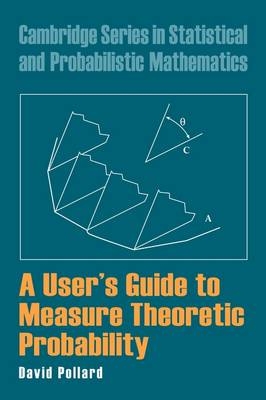
User's Guide to Measure Theoretic Probability (eBook)
Cambridge University Press (Verlag)
978-1-139-23906-6 (ISBN)
Rigorous probabilistic arguments, built on the foundation of measure theory introduced eighty years ago by Kolmogorov, have invaded many fields. Students of statistics, biostatistics, econometrics, finance, and other changing disciplines now find themselves needing to absorb theory beyond what they might have learned in the typical undergraduate, calculus-based probability course. This 2002 book grew from a one-semester course offered for many years to a mixed audience of graduate and undergraduate students who have not had the luxury of taking a course in measure theory. The core of the book covers the basic topics of independence, conditioning, martingales, convergence in distribution, and Fourier transforms. In addition there are numerous sections treating topics traditionally thought of as more advanced, such as coupling and the KMT strong approximation, option pricing via the equivalent martingale measure, and the isoperimetric inequality for Gaussian processes. The book is not just a presentation of mathematical theory, but is also a discussion of why that theory takes its current form. It will be a secure starting point for anyone who needs to invoke rigorous probabilistic arguments and understand what they mean.
Rigorous probabilistic arguments, built on the foundation of measure theory introduced eighty years ago by Kolmogorov, have invaded many fields. Students of statistics, biostatistics, econometrics, finance, and other changing disciplines now find themselves needing to absorb theory beyond what they might have learned in the typical undergraduate, calculus-based probability course. This 2002 book grew from a one-semester course offered for many years to a mixed audience of graduate and undergraduate students who have not had the luxury of taking a course in measure theory. The core of the book covers the basic topics of independence, conditioning, martingales, convergence in distribution, and Fourier transforms. In addition there are numerous sections treating topics traditionally thought of as more advanced, such as coupling and the KMT strong approximation, option pricing via the equivalent martingale measure, and the isoperimetric inequality for Gaussian processes. The book is not just a presentation of mathematical theory, but is also a discussion of why that theory takes its current form. It will be a secure starting point for anyone who needs to invoke rigorous probabilistic arguments and understand what they mean.
| Erscheint lt. Verlag | 11.5.2012 |
|---|---|
| Sprache | englisch |
| Themenwelt | Mathematik / Informatik ► Mathematik ► Wahrscheinlichkeit / Kombinatorik |
| Technik | |
| ISBN-10 | 1-139-23906-6 / 1139239066 |
| ISBN-13 | 978-1-139-23906-6 / 9781139239066 |
| Informationen gemäß Produktsicherheitsverordnung (GPSR) | |
| Haben Sie eine Frage zum Produkt? |
 PDF (Adobe DRM)
Kopierschutz: Adobe-DRM
Adobe-DRM ist ein Kopierschutz, der das eBook vor Mißbrauch schützen soll. Dabei wird das eBook bereits beim Download auf Ihre persönliche Adobe-ID autorisiert. Lesen können Sie das eBook dann nur auf den Geräten, welche ebenfalls auf Ihre Adobe-ID registriert sind.
Details zum Adobe-DRM
Dateiformat: PDF (Portable Document Format)
Mit einem festen Seitenlayout eignet sich die PDF besonders für Fachbücher mit Spalten, Tabellen und Abbildungen. Eine PDF kann auf fast allen Geräten angezeigt werden, ist aber für kleine Displays (Smartphone, eReader) nur eingeschränkt geeignet.
Systemvoraussetzungen:
PC/Mac: Mit einem PC oder Mac können Sie dieses eBook lesen. Sie benötigen eine
eReader: Dieses eBook kann mit (fast) allen eBook-Readern gelesen werden. Mit dem amazon-Kindle ist es aber nicht kompatibel.
Smartphone/Tablet: Egal ob Apple oder Android, dieses eBook können Sie lesen. Sie benötigen eine
Geräteliste und zusätzliche Hinweise
Buying eBooks from abroad
For tax law reasons we can sell eBooks just within Germany and Switzerland. Regrettably we cannot fulfill eBook-orders from other countries.
aus dem Bereich