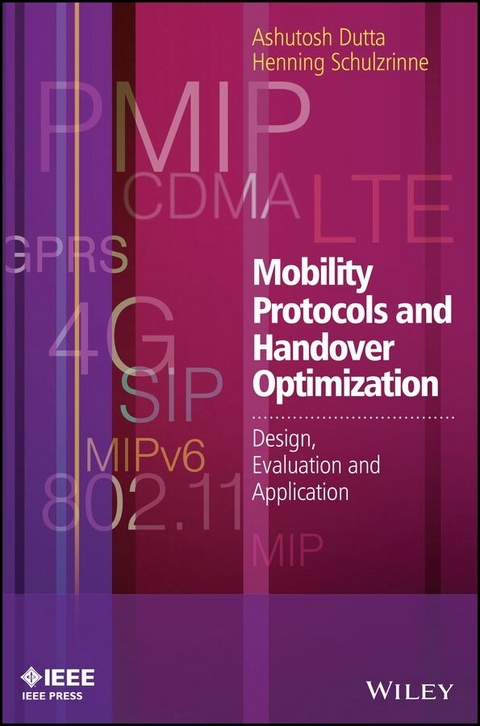
Mobility Protocols and Handover Optimization (eBook)
John Wiley & Sons (Verlag)
978-1-118-82537-2 (ISBN)
This book provides a common framework for mobility management that considers the theoretical and practical aspects of systems optimization for mobile networks.
In this book, the authors show how an optimized system of mobility management can improve the quality of service in existing forms of mobile communication. Furthermore, they provide a theoretical approach to mobility management, as well as developing the model for systems optimization, including practical case studies using network layer and mobility layer protocols in different deployment scenarios. The authors also address the different ways in which the specific mobility protocol can be developed, taking into account numerous factors including security, configuration, authentication, quality of service, and movement patterns of the mobiles.
Key Features:
- Defines and discusses a common set of optimization methodologies and their application to all mobility protocols for both IPv4 and IPv6 networks
- Applies these technologies in the context of various layers: MAC layer, network layer, transport layer and application layer covering 802.11, LTE, WiMax, CDMA networks and protocols such as SIP, MIP, HIP, VoIP, and many more
- Provides a thorough analysis of the required steps during a mobility event such as discovery, network selection, configuration, authentication, security association, encryption, binding update, and media direction
- Includes models and tables illustrating the analysis of mobility management as well as architecture of sample wireless and mobility test beds built by the authors, involving inter-domain and intra-domain mobility scenarios
This book is an excellent resource forprofessionals and systems architects in charge of designing wireless networks for commercial (3G/4G), LTE, IMS, military and Ad Hoc environment. It will be useful deployment guide for the architects wireless service providers. Graduate students, researchers in industry and academia, and systems engineers will also find this book of interest.
Dr. Ashutosh Dutta
Dr. Ashutosh Dutta obtained his Ph.D. in EE from Columbia University, M.S. in Computer Science from NJIT, USA and BSEE from NIT, Rourkela, India. As a seasoned mobility and security architect and an accomplished networking and computer science expert with 20-plus years experience, Ashutosh directed multiple IT operations, led the research and development for leading global technology corporations and top university and has in-depth expertise in developing and implementing research, analysis and design initiatives.
His career spanning 25 years includes LMTS (Lead Member of Technical Staff) at AT&T, NJ; CTO Wireless at NIKSUN, NJ; Senior Scientist in Telcordia Technologies, NJ; CRF Director at Columbia University, NY and Computer Engineer with TATA Motors, India. Ashutosh’s research interests include wireless Internet, multimedia signaling, mobility management, 4G networks, IMS (IP Multimedia Subsystems), VoIP and session control protocols. He has published more than 80 conference, journal papers and Internet drafts, three book chapters, and has given tutorials in mobility management at various conferences. Ashutosh has 19 issued security and mobility related US patents.
Ashutosh is a senior member of IEEE and ACM. He has served as an IEEE volunteer and leader at the section, region, chapter, society, MGA, and EAB level. Ashutosh is recipient of the 2009 IEEE Region 1, IEEE MGA and 2010 IEEE-USA Leadership Awards.
Prof. Henning Schulzrinne
Prof. Henning Schulzrinne, Levi Professor of Computer Science at Columbia University, received his Ph.D. from the University of Massachusetts in Amherst, Massachusetts. He was an MTS at AT&T Bell Laboratories and an associate department head at GMD-Fokus (Berlin), before joining the Computer Science and Electrical Engineering departments at Columbia University. He served as chair of the Department of Computer Science from 2004 to 2009, as Engineering Fellow at the US Federal Communications Commission (FCC) in 2010 and 2011, and as Chief Technology Officer at the FCC since 2012.
He has published more than 250 journal and conference papers, and more than 70 Internet RFCs. Protocols co-developed by him, such as RTP, RTSP and SIP, are now Internet standards, used by almost all Internet telephony and multimedia applications. His research interests include Internet multimedia systems, ubiquitous computing, and mobile systems.
He is a Fellow of the IEEE, has received the New York City Mayor's Award for Excellence in Science and Technology, the VON Pioneer Award, TCCC service award, the IEEE Region 1 William Terry Award for Lifetime Distinguished Service to IEEE and the UMass Computer Science Outstanding Alumni recognition.
This book provides a common framework for mobility management that considers the theoretical and practical aspects of systems optimization for mobile networks. In this book, the authors show how an optimized system of mobility management can improve the quality of service in existing forms of mobile communication. Furthermore, they provide a theoretical approach to mobility management, as well as developing the model for systems optimization, including practical case studies using network layer and mobility layer protocols in different deployment scenarios. The authors also address the different ways in which the specific mobility protocol can be developed, taking into account numerous factors including security, configuration, authentication, quality of service, and movement patterns of the mobiles. Key Features: Defines and discusses a common set of optimization methodologies and their application to all mobility protocols for both IPv4 and IPv6 networks Applies these technologies in the context of various layers: MAC layer, network layer, transport layer and application layer covering 802.11, LTE, WiMax, CDMA networks and protocols such as SIP, MIP, HIP, VoIP, and many more Provides a thorough analysis of the required steps during a mobility event such as discovery, network selection, configuration, authentication, security association, encryption, binding update, and media direction Includes models and tables illustrating the analysis of mobility management as well as architecture of sample wireless and mobility test beds built by the authors, involving inter-domain and intra-domain mobility scenarios This book is an excellent resource forprofessionals and systems architects in charge of designing wireless networks for commercial (3G/4G), LTE, IMS, military and Ad Hoc environment. It will be useful deployment guide for the architects wireless service providers. Graduate students, researchers in industry and academia, and systems engineers will also find this book of interest.
Dr. Ashutosh Dutta Dr. Ashutosh Dutta obtained his Ph.D. in EE from Columbia University, M.S. in Computer Science from NJIT, USA and BSEE from NIT, Rourkela, India. As a seasoned mobility and security architect and an accomplished networking and computer science expert with 20-plus years experience, Ashutosh directed multiple IT operations, led the research and development for leading global technology corporations and top university and has in-depth expertise in developing and implementing research, analysis and design initiatives. His career spanning 25 years includes LMTS (Lead Member of Technical Staff) at AT&T, NJ; CTO Wireless at NIKSUN, NJ; Senior Scientist in Telcordia Technologies, NJ; CRF Director at Columbia University, NY and Computer Engineer with TATA Motors, India. Ashutosh's research interests include wireless Internet, multimedia signaling, mobility management, 4G networks, IMS (IP Multimedia Subsystems), VoIP and session control protocols. He has published more than 80 conference, journal papers and Internet drafts, three book chapters, and has given tutorials in mobility management at various conferences. Ashutosh has 19 issued security and mobility related US patents. Ashutosh is a senior member of IEEE and ACM. He has served as an IEEE volunteer and leader at the section, region, chapter, society, MGA, and EAB level. Ashutosh is recipient of the 2009 IEEE Region 1, IEEE MGA and 2010 IEEE-USA Leadership Awards. Prof. Henning Schulzrinne Prof. Henning Schulzrinne, Levi Professor of Computer Science at Columbia University, received his Ph.D. from the University of Massachusetts in Amherst, Massachusetts. He was an MTS at AT&T Bell Laboratories and an associate department head at GMD-Fokus (Berlin), before joining the Computer Science and Electrical Engineering departments at Columbia University. He served as chair of the Department of Computer Science from 2004 to 2009, as Engineering Fellow at the US Federal Communications Commission (FCC) in 2010 and 2011, and as Chief Technology Officer at the FCC since 2012. He has published more than 250 journal and conference papers, and more than 70 Internet RFCs. Protocols co-developed by him, such as RTP, RTSP and SIP, are now Internet standards, used by almost all Internet telephony and multimedia applications. His research interests include Internet multimedia systems, ubiquitous computing, and mobile systems. He is a Fellow of the IEEE, has received the New York City Mayor's Award for Excellence in Science and Technology, the VON Pioneer Award, TCCC service award, the IEEE Region 1 William Terry Award for Lifetime Distinguished Service to IEEE and the UMass Computer Science Outstanding Alumni recognition.
"It is a recommended resource for graduate students, researchers, and IT professionals interested in the study of handoff management." (IEEE Communications Magazine, 1 April 2015)
List of Abbreviations
| 1G | First-generation cellular network. 1G networks are based on analog systems meant to carry voice only. These were developed around 1980. NMT, AMPS, and TACS are examples of 1G systems. |
| 2G | Second-generation cellular network. 2G networks are an evolution of 1G networks that was introduced during the 1990s. 2G networks are digital in nature and provide a per-user bandwidth of up to 144 kb/s. GSM, IS-54/136, and IS-95 are examples of 2G systems. |
| 3G | Third-generation cellular network. 3G networks can provide a per-user bandwidth of up to 2 Mb/s and can carry multimedia traffic. WCDMA and CDMA2000 are examples of 3G systems. |
| 3GPP | Third Generation Partnership Project. A collaborative effort by a group of telecommunications associations to define the standards for 3G networks and for the development of WCDMA/UMTS. |
| 3GPP2 | Third Generation Partnership Project 2. The standards body and organization that coordinates the development of 3G networks based on CDMA2000. |
| 4G | Fourth-generation cellular network. 4G networks are an evolution of 2G and 3G cellular networks; they are being defined as part of IMT-2000 and can provide a per-user bandwidth of up to 100 Mb/s. |
| AAA | Authentication, Authorization, and Accounting. AAA is a generic model for IP network access control, initiated and developed by the IETF (de Laat et al., 2000). |
| AH | Authentication Header. The AH is a component of the IPSec protocol suite (Kent and Seo, 2005) that guarantees connectionless integrity and data origin authentication of IP datagrams. |
| AKA | Authentication and Key Agreement. The AKA process is a challenge—response-based mechanism aimed at mutual network/terminal authentication and security key distribution (Niemi et al., 2002). |
| AMT | Automatic Multicast Tunneling. AMT allows multicast communication amongst isolated multicast-enabled sites or hosts, attached to a network which has no native multicast support (Thaler et al., 2007). |
| ANSI | American National Standards Institute. ANSI is responsible for overseeing the development of voluntary consensus standards for products and services in the United States. |
| ARP | Address Resolution Protocol. This is the process of finding out a host's link layer address when only a network layer address is given (Plummer, 1982). |
| AuC | Authentication Center. An AuC is a database used to control the authentication process and compare users' identifications with those recognized as valid by the network in a GSM or UMTS network. |
| AVP | Attribute—Value Pair. The AVP is a fundamental data representation in computing systems and applications. It is a data structure that allows future extension without modifying existing code or data. |
| B2BUA | Back-to-Back User Agent. A B2BUA consists of two SIP user agents, where one can initiate a call and the other modifies and terminates the call. A B2BUA can act as a third party call controller and can establish a call between two user agents. |
| BCCH | Broadcast Control CHannel. A BCCH is a point-to-multipoint, unidirectional downlink channel used in the GSM cellular standard. |
| BCP | Buffer Control Protocol. Using a buffer control protocol (Dutta et al., 2006e), a mobile node communicates with buffering nodes in a network to reduce packet loss during handoff by adjusting the buffer value dynamically. |
| BN | Buffering Node. A buffering node is a logical entity in a network that allows the buffering of packets during a handoff. |
| BSC | Base Station Controller. Part of a network that controls one or more base stations, and interfaces with the switching center (e.g., the MSC in a GSM network). |
| BSS | Base Station Subsystem. The overall system that encompasses the BTS and BSC and takes care of handling traffic and signaling between a mobile phone and the network switching subsystem. A BSS is typically used in 2G and 3G networks. |
| BSSID | Basic Service Set IDentifier. This uniquely identifies each basic service set. The BSSID is the MAC address of an 802.11 wireless access point. |
| BTS | Base Transceiver Station. The base station equipment used to transmit and receive signals to and from mobile handsets. |
| CARD | Candidate Access Router Discovery. A protocol (Liebsch et al., 2005) that provides a network discovery mechanism in layer 3 by way of signaling exchanges between the routers in the previous and target networks. |
| CDMA | Code Division Multiple Access. A wireless access mechanism defined for 2G and 3G networks. |
| CDN | Content Distribution Network. A CDN is a system of computers containing copies of data, placed at various points in a network so as to maximize the bandwidth for access to the data from clients throughout the network. |
| CGMP | Cisco Group Management Protocol. CGMP (Farinacci et al., 1996) is a Cisco proprietary group management protocol that manages the multicast groups in layer 2. |
| CoTI | Care-of Test Init. In MIPv6, a mobile node uses a CoTI message to initiate the return routability procedure and request a care-of keygen token from a correspondent node. |
| CS | Circuit Switch. The CS domain is a subset of a 2G/GSM or 3G/UMTS core network domain dedicated to the support of circuit-based services such as voice calls. |
| CSMA/CA | Carrier Sense Multiple Access/Collision Avoidance. A mobile uses this mechanism to get access to IEEE 802.11-type networks. |
| CTN | Candidate Target Network. A CTN is one of the possible network attachment points where a mobile might move to. |
| DAD | Duplicate Address Detection. A process of verifying the uniqueness of a layer 3 identifier, which is an IP address in a subnet. This is often carried out during the layer 3 configuration process (Narten et al., 1998). |
| DCDP | Dynamic Configuration Distribution Protocol. DCDP is a protocol that works in conjunction with DRCP to configure servers with a block of addresses that can be distributed to the end clients (McAuley et al., 2001). |
| DEDS | Discrete-Event Dynamic System. A DEDS (Cao and Ho, 1990) may be viewed as a sequence of events. The completion of an activity may initiate one or more new activities. The order of the sequence of events is not necessarily unique. |
| DMZ | DeMilitarized Zone. In computer security, a DMZ is a physical or logical subnetwork that contains an organization's external services and exposes them to a larger, untrusted network, usually the Internet. |
| DRCP | Dynamic Rapid Configuration Protocol. A lightweight version of DHCP that reduces the number of messages over the air and the message size, thereby reducing the configuration time (McAuley et al., 2001). |
| DTTPN | Deterministic Timed-Transition Petri Net. A type of timed-transition Petri net where each of the transitions is associated with a deterministic firing time (Ramamoorthy and Ho, 1980). |
| EAP | Extensible Authentication Protocol. An authentication framework (Aboba et al., 2004) that supports multiple authentication methods and can run directly over data link layers such as PPP (Point-to-Point Protocol) or IEEE 802 without requiring IP. |
| EPC | Evolved Packet Core. See the definition of SAE. |
| EPS | Evolved Packet System. |
| ESN | Electronic Serial Number. A 32-bit identifier used mainly with AMPS, TDMA, and CDMA phones in the United States; compare with the IMEI numbers used by all GSM phones. |
| ESP | Encapsulating Security Payload. ESP (Kent and Atkinson, 1998a) is a member of the IPSec protocol suite that provides origin authenticity, integrity, and confidentiality protection of packets. |
| FA | Foreign Agent. This acts as a decapsulation agent in a Mobile IPv4 network. |
| FACH | Forward Access CHannel. A downlink access channel that carries control information to terminals known to be located in a given cell in a GSM network. |
| FEC | Forward Error Correction. A system of error control for data transmission, whereby... |
| Erscheint lt. Verlag | 7.3.2014 |
|---|---|
| Reihe/Serie | IEEE Press |
| Wiley - IEEE | Wiley - IEEE |
| Sprache | englisch |
| Themenwelt | Technik ► Elektrotechnik / Energietechnik |
| Technik ► Nachrichtentechnik | |
| Schlagworte | Approach • Book • CASE • Common • Communication Technology - Networks • Computer Science • Different • Drahtlose Kommunikation • Electrical & Electronics Engineering • Elektrotechnik u. Elektronik • forms • Framework • Informatik • Kommunikationsnetz • Kommunikationsnetze • Management • Mobile & Wireless Communications • Mobility • Model • Networking • Netzwerke • Optimization • optimized • Practical • practical aspects • protocols • quality • System • Systems • Theoretical |
| ISBN-10 | 1-118-82537-3 / 1118825373 |
| ISBN-13 | 978-1-118-82537-2 / 9781118825372 |
| Informationen gemäß Produktsicherheitsverordnung (GPSR) | |
| Haben Sie eine Frage zum Produkt? |
 EPUB (Adobe DRM)
Kopierschutz: Adobe-DRM
Adobe-DRM ist ein Kopierschutz, der das eBook vor Mißbrauch schützen soll. Dabei wird das eBook bereits beim Download auf Ihre persönliche Adobe-ID autorisiert. Lesen können Sie das eBook dann nur auf den Geräten, welche ebenfalls auf Ihre Adobe-ID registriert sind.
Details zum Adobe-DRM
Dateiformat: EPUB (Electronic Publication)
EPUB ist ein offener Standard für eBooks und eignet sich besonders zur Darstellung von Belletristik und Sachbüchern. Der Fließtext wird dynamisch an die Display- und Schriftgröße angepasst. Auch für mobile Lesegeräte ist EPUB daher gut geeignet.
Systemvoraussetzungen:
PC/Mac: Mit einem PC oder Mac können Sie dieses eBook lesen. Sie benötigen eine
eReader: Dieses eBook kann mit (fast) allen eBook-Readern gelesen werden. Mit dem amazon-Kindle ist es aber nicht kompatibel.
Smartphone/Tablet: Egal ob Apple oder Android, dieses eBook können Sie lesen. Sie benötigen eine
Geräteliste und zusätzliche Hinweise
Buying eBooks from abroad
For tax law reasons we can sell eBooks just within Germany and Switzerland. Regrettably we cannot fulfill eBook-orders from other countries.
aus dem Bereich