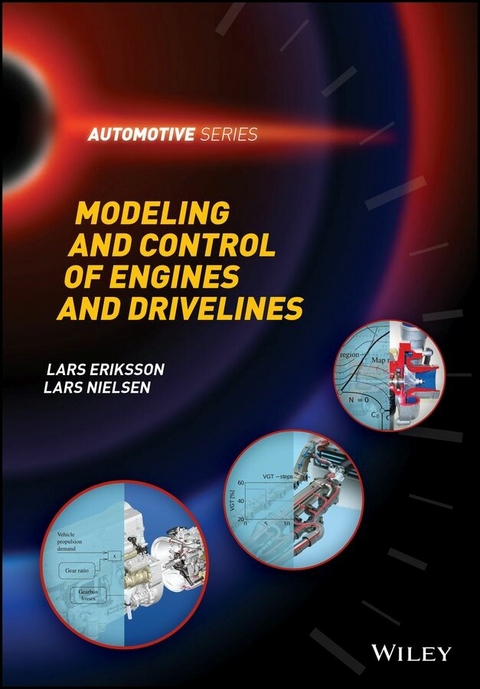
Modeling and Control of Engines and Drivelines (eBook)
John Wiley & Sons (Verlag)
978-1-118-53620-9 (ISBN)
A reference guide to modeling, analysis, and control of engines and drivelines
- A reference manual for engineers and an introduction for students in the areas of modeling, analysis, and control of engines and drivelines
- Covers the basic dynamics of internal combustion engines and drivelines
- Discusses the goals that engine control design system aims for, and how these targets can be achieved
- Provides a set of standard models and includes examples and case studies
- Includes an overview of hybrid vehicles and powertrains
- Accompanied by a website hosting example models
Modeling and Control of Engines and Drivelines provides an introduction to the subject of modeling, analysis, and control of engines and drivelines. The aim of the book is to provide a set of standard models and serve as a reference material for engineers in the field.
Modeling and Control of Engines and Drivelines highlights the interplay between the engine and driveline systems, and the integration between systems that is needed for successfully engineering a complete vehicle powertrain. In addition it also emphasises that systems should be designed such that they can be maintained and diagnosed over the vehicle life time, which is also an important engineering task in the development of control systems.
Lars Eriksson is an Associate Professor of Vehicular Systems at Linköping University with main responsibility for the engine control laboratory. Since 1994, he has been working as a researcher in the field of modeling and control of engines and drivelines with research that is performed in close collaboration with industry. This provides good contact with practicing engineers and who are then able to offer their input when new research results are integrated into course curriculums. As a teacher he has developed and taught several courses on this subject, both at the university and for industry. At Linköping University he is responsible for the course “Modeling and Control of Engines and Drivelines” which has been given on the subject since 1998 and he is also a regular lecturer for the module “Basics of SI engine control” on the Powertrain Engineering Programme at IFP School in Paris.
Since 1992, Lars Nielsen has been a Professor of Vehicular Systems holding the Sten Gustafsson chair at Linköping University. His main research interests are in automotive modeling, control, and diagnosis, and he has been active in all aspects of this field during its expansion and growth since the nineties. His supervision has led to thirty graduate exams, in many cases with significant industrial participation. The collaboration aspect has also been strong in his role as center director for two large centers of excellence (ECSEL 1996-2002, LINK-SIC 2010- ). In the international research community, he was the Chairman of Automotive Control within the International Federation of Automatic Control (2002-2005), and then the Chairman of all Transportation and Vehicle Systems (2005-2011). Selected national commissions of trust are Board Member of the Swedish Research Council-NT (2001-2006), and vice chair in IVA II - the electrical engineering division of the Royal Swedish Academy of Engineering (2010-).
Modeling and Control of Engines and Drivelines Control systems have come to play an important role in the performance of modern vehicles with regards to meeting goals on low emissions and low fuel consumption. To achieve these goals, modeling, simulation, and analysis have become standard tools for the development of control systems in the automotive industry. Modeling and Control of Engines and Drivelines provides an up-to-date treatment of the topic from a clear perspective of systems engineering and control systems, which are at the core of vehicle design. This book has three main goals. The first is to provide a thorough understanding of component models as building blocks. It has therefore been important to provide measurements from real processes, to explain the underlying physics, to describe the modeling considerations, and to validate the resulting models experimentally. Second, the authors show how the models are used in the current design of control and diagnosis systems. These system designs are never used in isolation, so the third goal is to provide a complete setting for system integration and evaluation, including complete vehicle models together with actual requirements and driving cycle analysis. Key features: Covers signals, systems, and control in modern vehicles Covers the basic dynamics of internal combustion engines and drivelines Provides a set of standard models and includes examples and case studies Covers turbo- and super-charging, and automotive dependability and diagnosis Accompanied by a web site hosting example models and problems and solutions Modeling and Control of Engines and Drivelines is a comprehensive reference for graduate students and the authors' close collaboration with the automotive industry ensures that the knowledge and skills that practicing engineers need when analysing and developing new powertrain systems are also covered.
Lars Eriksson is an Associate Professor of Vehicular Systems at Linköping University with main responsibility for the engine control laboratory. Since 1994, he has been working as a researcher in the field of modeling and control of engines and drivelines with research that is performed in close collaboration with industry. This provides good contact with practicing engineers and who are then able to offer their input when new research results are integrated into course curriculums. As a teacher he has developed and taught several courses on this subject, both at the university and for industry. At Linköping University he is responsible for the course "Modeling and Control of Engines and Drivelines" which has been given on the subject since 1998 and he is also a regular lecturer for the module "Basics of SI engine control" on the Powertrain Engineering Programme at IFP School in Paris. Since 1992, Lars Nielsen has been a Professor of Vehicular Systems holding the Sten Gustafsson chair at Linköping University. His main research interests are in automotive modeling, control, and diagnosis, and he has been active in all aspects of this field during its expansion and growth since the nineties. His supervision has led to thirty graduate exams, in many cases with significant industrial participation. The collaboration aspect has also been strong in his role as center director for two large centers of excellence (ECSEL 1996-2002, LINK-SIC 2010- ). In the international research community, he was the Chairman of Automotive Control within the International Federation of Automatic Control (2002-2005), and then the Chairman of all Transportation and Vehicle Systems (2005-2011). Selected national commissions of trust are Board Member of the Swedish Research Council-NT (2001-2006), and vice chair in IVA II - the electrical engineering division of the Royal Swedish Academy of Engineering (2010-).
Chapter 1
Introduction
Customer needs and requirements from society have, together with a fierce competition among automotive manufacturers, had a tremendous effect on the development of our vehicles. They have evolved from being essentially mechanical systems in the early 1900s to the highly engineered and computerized machines that they are today. An important step has been the introduction of computer controlled systems that accelerate the development of clean, efficient, and reliable vehicles. Two trends are especially interesting for the scope of this book:
- Increased computational capabilities in vehicle control systems.
- New mechanical designs giving more flexible and controllable vehicle components.
These development trends are intertwined, as the development of new mechanical systems relies on the availability of more advanced controllers that can handle and optimally use these new systems. As a consequence, the design of vehicles is really evolving into co-design of mechanics and control. The tasks for such improved designs are numerous, but the main goals to strive for are:
- High efficiency, leading to lower fuel consumption.
- Low emissions, giving reduced environmental impact.
- Good driveability, providing predictable response to driver commands.
- Optimal dependability, giving predictability, reliability, and availability.
The goal of this book is to give insight into such new developments, and to do it in enough depth to show the interplay between the basic physics of the powertrain systems and the possibilities for control design. Having set the goals above, it is impossible to cover the field in breadth too. The text has to be a selection of important representatives. For example, two-stroke engines are not covered, since the usual four-stroke engine illustrates the general principles and by itself requires quite some pages to be described sufficiently.
Control systems have come to play an important role in the performance of modern vehicles in meeting goals on low emissions and low fuel consumption. To achieve these goals, modeling, simulation, and analysis have become standard tools for the development of control systems in the automotive industry. The aim is therefore to introduce engineers to the basics of internal combustion engines and drivelines in such a way that they will be able to understand today's control systems, and with the models and tools provided be able to contribute to the development of future powertrain control systems. This book provides an introduction to the subject of modeling, analysis, and control of engines and drivelines. Another goal is to provide a set of standard models and thereby serve as a reference material for engineers in the field.
1.1 Trends
Modern society is to a large extent built on transportation of both people and goods and it is amazing how well the infrastructure functions. Large amounts of food and other goods are made available, waste is transported away, and masses of people commute to and from work both by private and public transportation. Transportation is thus fundamental to society as we know it, but there is increasing concern about its effects on resources and the environment. This is also stressed when considering the increasing demands in developing countries. To meet these demands there are many efforts toward making vehicles function as efficiently and cleanly as possible, and some of the major trends are
- downsizing
- hybridization
- driver support systems
- new infrastructure.
These will be briefly introduced below, after a section on the societal drive for care of our resources and environment.
1.1.1 Energy and Environment
Different standards and regulations have been the most concrete results that have come from concern for the environment. A perfect combustion of hydrocarbon fuels will result in CO and water, whereas a non-perfect combustion results in additional unwanted pollutants. This means that the amount of CO is a direct measure of the amount of fuel consumed, and a standard formulated in terms of CO thus aims at restricting the use of fossil fuels. Worldwide standards are illustrated in Figure 1.1, illustrating that society is pushing the development of more fuel efficient vehicles. Standards and measures of control differ between regions, the USA, for example, uses a Corporate Average Fuel Consumption (CAFE) for manufacturers, while cars in Europe have a CO declaration that is used for taxation of vehicles.
Figure 1.1 Global CO emissions, historical data, and future standards. Reproduced with permission from The International Council On Clean Transportation
Another type of regulation is used to limit the emissions of important harmful pollutants. Examples are emissions of particulate matter (also called soot) and the gases carbon monoxide (CO), nitrogen oxides (NO and NO, collectively called NO), and hydrocarbons (HC). Legislators have made the levels that vehicles are allowed to emit increasingly stringent and Figure 1.2 shows the evolution for passenger cars in the USA.
Figure 1.2 The evolution of federal emission regulations for carbon monoxide (CO), nitrogen oxides (NO), and hydrocarbons (HC) of passenger cars in the USA. At model year 2004 the Tier 2 standards started, specifying 10 bins where the manufacturers can place their vehicles, provided that they fulfill fleet average regulations. No data is plotted after 2004 due to the diversity of limits in the bins
Regulations like these in Figures 1.1 and 1.2 have been, and continue to be, drivers for better vehicles and have a decisive impact on technological development within the automotive area.
1.1.2 Downsizing
There are many ongoing developments to meet legislative requirements like those above, and one major trend in the search for solutions is downsizing. Downsizing has two meanings, where one is that smaller and more lightweight cars need less fuel. The trends in this area cover new materials and new construction principles as well as customer acceptance of smaller cars. Another interpretation concerns the engine, where downsizing refers to having a smaller engine in the car that consumes less fuel. Downsizing is often used with turbocharging, where the smaller engine gets a boosted performance to come closer to that of a larger engine and improve customer acceptance. Both these ideas are depicted in Figure 1.3. The principle of downsizing engines is an important part of this book, see especially Chapter 8.
Figure 1.3 Downsizing of cars and engines to increase fuel efficiency
1.1.3 Hybridization
Downsizing is one path that leads to less fuel consumption and fewer emissions. Another path is hybridization, where there is an additional energy storage and retrieval in the car. Several ideas exist for storing and retrieving energy, and some candidates are to store energy as rotational energy in a fly-wheel, as pressure in an air tank, or as pressure in a hydraulic system. However, for now, electrification is the main line of development, where energy is stored electrically in a battery or in a super capacitor, and transformed to motion via electrical motors. Compared to traditional vehicles, hybrid vehicles are more complex since there are more components that should operate in harmony to achieve most of the promise of hybridization. This will be expanded on in Chapter 3, and a main theme is that, at the core of the solutions, the torques and velocities are the main variables to model and control; which means that the models and methodologies in this book can be directly applied to simulate and analyze hybrid systems.
1.1.4 Driver Support Systems and Optimal Driving
Fuel consumption and the amount of emissions are highly dependent on how a vehicle is driven. The fuel savings when driving optimally can be substantial compared to energy-unaware driving, so therefore there is a strong interest in systems that help the driver, or even replace the driver, when it comes to propulsion.
A driver support system proposes speed and gear selections to the driver, and can also evaluate and educate a driver. There are also systems that can plan a fuel-optimal driving based on the topography of the road, that is using knowledge of the upcoming slopes of the road, as illustrated in Figure 1.4. The basis for such a system is positioning the vehicle using GPS, a map database used to read the upcoming road slopes, and on-board optimization algorithms that take control over propulsion. A number of names are given to these systems, such as Optimal driving, Look-ahead control, and Active prediction cruise control. The latter name reflects the fact that it is a natural extension of a conventional cruise control system.
Figure 1.4 Depiction of a system for optimal driving regarding the upcoming topography of the road
New Infrastructure
Optimal driving as regards topography was made possible by the technological development of GPS and map databases. It would, of course, also be highly beneficial if driving could be optimal relative to all other circumstances like, for example, the traffic situation, other vehicles, and weather. To approach these potential benefits there is active development of vehicle-to-vehicle communication, road-side information systems, traffic systems, and on-line teleservices, such as weather and traffic reports. Such a situation is depicted in...
| Erscheint lt. Verlag | 27.2.2014 |
|---|---|
| Reihe/Serie | Automotive Series | Automotive Series |
| Sprache | englisch |
| Themenwelt | Technik ► Fahrzeugbau / Schiffbau |
| Technik ► Maschinenbau | |
| Schlagworte | Antriebstechnik • Automotive • automotive engineering • become • clear • Control • control systems • Control Systems Technology • Core • Development • Electrical & Electronics Engineering • Elektrotechnik u. Elektronik • Fahrzeugtechnik • goals • important • Industry • Maschinenbau • mechanical engineering • Modern • Performance • Perspective • regards • Regelungstechnik • Role • Standard • Systems • thermodynamics • Thermodynamik • Tools • topic • Treatment • uptodate • vehicle design • Vehicles |
| ISBN-10 | 1-118-53620-7 / 1118536207 |
| ISBN-13 | 978-1-118-53620-9 / 9781118536209 |
| Informationen gemäß Produktsicherheitsverordnung (GPSR) | |
| Haben Sie eine Frage zum Produkt? |
 EPUB (Adobe DRM)
Größe: 46,1 MB
Kopierschutz: Adobe-DRM
Adobe-DRM ist ein Kopierschutz, der das eBook vor Mißbrauch schützen soll. Dabei wird das eBook bereits beim Download auf Ihre persönliche Adobe-ID autorisiert. Lesen können Sie das eBook dann nur auf den Geräten, welche ebenfalls auf Ihre Adobe-ID registriert sind.
Details zum Adobe-DRM
Dateiformat: EPUB (Electronic Publication)
EPUB ist ein offener Standard für eBooks und eignet sich besonders zur Darstellung von Belletristik und Sachbüchern. Der Fließtext wird dynamisch an die Display- und Schriftgröße angepasst. Auch für mobile Lesegeräte ist EPUB daher gut geeignet.
Systemvoraussetzungen:
PC/Mac: Mit einem PC oder Mac können Sie dieses eBook lesen. Sie benötigen eine
eReader: Dieses eBook kann mit (fast) allen eBook-Readern gelesen werden. Mit dem amazon-Kindle ist es aber nicht kompatibel.
Smartphone/Tablet: Egal ob Apple oder Android, dieses eBook können Sie lesen. Sie benötigen eine
Geräteliste und zusätzliche Hinweise
Zusätzliches Feature: Online Lesen
Dieses eBook können Sie zusätzlich zum Download auch online im Webbrowser lesen.
Buying eBooks from abroad
For tax law reasons we can sell eBooks just within Germany and Switzerland. Regrettably we cannot fulfill eBook-orders from other countries.
 PDF (Adobe DRM)
Kopierschutz: Adobe-DRM
Adobe-DRM ist ein Kopierschutz, der das eBook vor Mißbrauch schützen soll. Dabei wird das eBook bereits beim Download auf Ihre persönliche Adobe-ID autorisiert. Lesen können Sie das eBook dann nur auf den Geräten, welche ebenfalls auf Ihre Adobe-ID registriert sind.
Details zum Adobe-DRM
Dateiformat: PDF (Portable Document Format)
Mit einem festen Seitenlayout eignet sich die PDF besonders für Fachbücher mit Spalten, Tabellen und Abbildungen. Eine PDF kann auf fast allen Geräten angezeigt werden, ist aber für kleine Displays (Smartphone, eReader) nur eingeschränkt geeignet.
Systemvoraussetzungen:
PC/Mac: Mit einem PC oder Mac können Sie dieses eBook lesen. Sie benötigen eine
eReader: Dieses eBook kann mit (fast) allen eBook-Readern gelesen werden. Mit dem amazon-Kindle ist es aber nicht kompatibel.
Smartphone/Tablet: Egal ob Apple oder Android, dieses eBook können Sie lesen. Sie benötigen eine
Geräteliste und zusätzliche Hinweise
Buying eBooks from abroad
For tax law reasons we can sell eBooks just within Germany and Switzerland. Regrettably we cannot fulfill eBook-orders from other countries.
aus dem Bereich