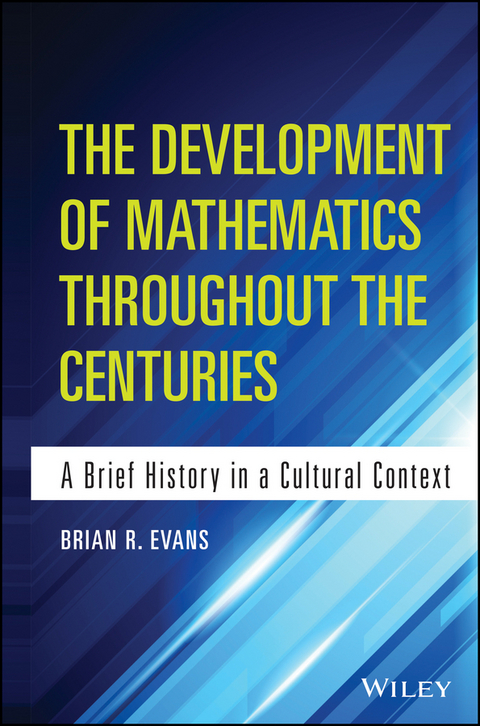
The Development of Mathematics Throughout the Centuries (eBook)
John Wiley & Sons (Verlag)
978-1-118-85397-9 (ISBN)
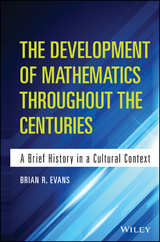
Throughout the book, readers take a journey throughout time and observe how people around the world have understood these patterns of quantity, structure, and dimension around them. The Development of Mathematics Throughout the Centuries: A Brief History in a Cultural Contex provides a brief overview of the history of mathematics in a very straightforward and understandable manner and also addresses major findings that influenced the development of mathematics as a coherent discipline. This book:
- Highlights the contributions made by various world cultures including African, Egyptian, Babylonian, Chinese, Indian, Islamic, and pre-Columbian American mathematics
- Features an approach that is not too rigorous and is ideal for a one-semester course of the history of mathematics.
- Includes a Resources and Recommended Reading section for further exploration and has been extensively classroom-tested
BRIAN R. EVANS is Department Chair and Associate Professor of Mathematics Education in the School of Education at Pace University in New York. He has authored over twenty-five publications and teaches pedagogical and content courses in mathematics including the history of mathematics. He is also managing editor for the peer reviewed Journal of the National Association for Alternative Certification.
BRIAN R. EVANS is Department Chair and Associate Professor of Mathematics Education in the School of Education at Pace University in New York. He has authored over twenty-five publications and teaches pedagogical and content courses in mathematics including the history of mathematics. He is also managing editor for the peer reviewed Journal of the National Association for Alternative Certification.
Introduction ix
PART 1 MATHEMATICS IN AFRICA AND THE MEDITERRANEAN REGION 1
1 ANCIENT CIVILIZATION MATHEMATICS: AFRICA AS OUR BIRTHPLACE 3
2 ANCIENT EGYPTIAN MATHEMATICS: THE TIME OF THE PHARAOHS 7
3 BABYLONIAN MATHEMATICS: THE MESOPOTAMIAN CRADLE OF CIVILIZATION 17
4 GREEK MATHEMATICS: THE ARCHAIC PERIOD 25
5 GREEK MATHEMATICS: THE CLASSICAL PERIOD 37
6 GREEK MATHEMATICS: THE HELLENISTIC AND ROMAN/ BYZANTINE PERIODS 45
PART 2 MATHEMATICS IN ASIA AND PRE-COLUMBIAN AMERICA 59
7 CHINESE MATHEMATICS: ANCIENT TIMES TO THE MIDDLE AGES 61
8 INDIAN MATHEMATICS: ANCIENT TIMES TO THE MIDDLE AGES 75
9 ISLAMIC MATHEMATICS: PRESERVATION,INNOVATION, AND CONNECTION BETWEEN EAST AND WEST 87
10 PRE-COLUMBIAN AMERICAN MATHEMATICS: THE OLMEC, MAYA, AND INCA CIVILIZATIONS 97
PART 3 MATHEMATICS IN EUROPE 105
11 EUROPEAN MATHEMATICS: THE MIDDLE AGES AND THE RENAISSANCE 107
12 EUROPEAN MATHEMATICS: THE 17TH CENTURY 123
13 EUROPEAN MATHEMATICS: THE 18TH CENTURY 143
14 EUROPEAN MATHEMATICS: THE 19TH CENTURY 157
PART 4 MATHEMATICS IN THE 20TH AND 21ST CENTURIES 175
15 EUROPEAN, AMERICAN, AND GLOBAL MATHEMATICS: THE 20TH AND 21ST CENTURIES 177
16 EUROPEAN, AMERICAN, AND GLOBAL MATHEMATICS: A SHIFT IN THE 20TH CENTURY 199
17 AMERICAN MATHEMATICS EDUCATION: THE 20TH AND 21ST CENTURIES 207
Resources and Recommended Readings 219
Index 221
CHAPTER 2
Ancient Egyptian Mathematics: The Time of the Pharaohs
Ancient Egyptian society was centered on the Nile River and started when the people of the region began a sedentary agricultural lifestyle using the Nile to cultivate their farmlands, which was approximately 10,000 years ago. Prior to this time, the people of the region were nomadic and lived in what is now the Sahara Desert. Desertification began around 10,000 years ago, culminating in the formation of the Sahara Desert around 4,500 years ago. Egypt became a unified state around 3150 BCE when the Upper and Lower Nile valleys joined together under the first pharaoh, Menes, which began the Early Dynastic Period. The ancient Egyptian period ends with the Roman conquest in 30 BCE, and pharaoh rule ceased with Cleopatra as the last pharaoh. The Roman Republic became the Roman Empire 3 years later when Caesar Augustus became Emperor of Rome.
The ancient Egyptians are recognized for their great accomplishments in architecture, irrigation, agriculture, art, literature, and mathematics. When considering their circumstances, it is reasonable that the Egyptians would develop their culture in the chronology that they did. When people began living a sedentary agricultural lifestyle, they began to create stable villages and towns in which it was possible to build on their accomplishments and transmit knowledge to the next generation. Additionally, the wealth obtained from agriculture created need for various occupations that would require mathematical calculations for wages, architecture, and other measurements.
Egyptians needed mathematics for the creation of their calendars, which had 12 months with 30 days in each month; within each month, there were 3 weeks consisting of 10 days. The remaining 5 days were feast days at the end of the year. The Egyptians had 24 hours in a day with 12 hours for day and 12 hours for night. Twelve was a significant number for the Egyptians because they counted using the knuckles on their four fingers on one hand and each of the four fingers has three knuckles. Moreover, 12 is a convenient number given the number of factors it has.
The calendar proved useful for cultivating agriculture because the Egyptians were able to predict the best time for planting their crops and the cycles based on the flooding of the Nile River. Astronomy is directly related to calendar calculations, and as we shall see later with the Greeks, astronomy played a major role in early developments of mathematics.
A lasting legacy of Egyptian accomplishments is the pyramids, specifically the Pyramids of Giza. The Early Dynastic Period ended around 2800 BCE when the Old Kingdom Period began. It was during this time that the king became regarded as a living god and the pyramids were built. The Great Pyramid of Giza, also called the Pyramid of Khufu, was built in 2550 BCE and remains the only surviving ancient wonder of the world. It remained the tallest human-made structure until 1311 CE when the Lincoln Cathedral was built in England. The pyramids are a remaining legacy of Egyptian innovation in architecture and mathematics, and it was during this period that Egypt experienced great accomplishments in culture, art, and architecture. The Old Kingdom Period ended around 2300 BCE.
The Egyptians used the base 10 system. A number such as 432 would be expressed as four 100s, three 10s, and two 1s. However, unlike our current base 10 system, the Hindu–Arabic numeral system, the Egyptian system was neither multiplicative nor positional, but it was merely additive. That means there was no way of easily representing 800 without writing 100 eight times. In our modern system, we can represent 800 as 8 × 100, so we can see why our system is considered multiplicative. Our system is positional because we do not have to write 823 as 8 × 100 + 2 × 10 + 3 × 1, but rather we know the position of the individual digits represents hundreds, tens, and ones. For example, 823 is quite different from 382. In the first number, we know we have eight 100s, two 10s, and three 1s. In the latter number, we have three 100s, eight 10s, and two 1s. For us, it is the position of the digits that makes the difference. Using the Egyptian system, we would have to represent 823 by writing 100 eight times, 10 two times, and 1 three times. Using Egyptian symbols, we would have the following (see Table 2.1):
TABLE 2.1 Egyptian Numerals
| Number | Egyptian symbol | Description |
|---|
| 1 | Staff |
| 10 | Heel bone |
| 100 | Coil of rope |
| 1000 | Water lily (or lotus flower) |
| 10,000 | Finger |
| 100,000 | Tadpole |
| 1,000,000 | Person with arms raised |
It is quite straightforward to add or subtract using the Egyptian system. For addition, let us say we have 15 + 27. We would realize that we now have three 10s and twelve 1s. In other words, we have 3 heel bones and 12 staffs. However, if we replace 10 of those staffs with a heel bone, we now have 4 heel bones and 2 staffs.
If we were to subtract two numbers, such as 14 from 31, we would immediately realize we cannot subtract the four staffs from the one staff. We would replace one of the three heel bones in 31 with 10 staffs to yield 11 – 4 = 7. Now, we only have two heel bones left from the 31 so we would have two heel bones minus one heel bone from the 14. Hence, our answer would be 17. See the illustration.
This is equivalent to the following.
The Egyptians had a very interesting method for multiplication. In order to understand their method, we must first understand a remarkable discovery made by this ancient civilization. The Egyptians knew that any integer could be written as the sum of powers of 2 without repeating any of the numbers. For example, we know that 5 = 1 + 4 and 13 = 1 + 4 + 8. The aspect of doubling may have originated in parts of Africa, south of Egypt. We shall use this rule to multiply later.
In one column, we list the powers of 2: 1, 2, 4, 8, 16, 32, … until we get as close to the smaller number as possible. In the right column, we start with the larger number and keep doubling. We want to find the sum of numbers in the left column that sum to the smaller number. We match those numbers with the right column and add the right column numbers together. This will be our answer. For example, 18 × 23 could be done as follows:
| 1 | 23 |
| 2 | 46 |
| 4 | 92 |
| 8 | 184 |
| 16 | 368 |
It is important to notice that 2 + 16 = 18. Therefore, we simply need to add 46 and 368 to yield the answer for 18 × 23, and we get 414. This works using the distributive property because we essentially have 23 × (2 + 16) to get 23 × 2 + 23 × 16. Recall that the distributive property indicates that a(b + c) = ab + ac.
The Egyptian method for multiplication is still taught in schools today as an alternative to the traditional algorithm of multiplication that many people in the United States learned in school. Everyday Mathematics, a book from the University of Chicago School Mathematics Project, teaches students the Egyptian method.
The Egyptians performed division problems in the same way, for the most part. The left column would be the same as multiplication, but the right column would have consecutive doublings of the smaller number until we reach the larger number. For example, 285 ÷ 15 would be as follows:
| 1 | 15 |
| 2 | 30 |
| 4 | 60 |
| 8 | 120 |
| 16 | 240 |
It is important to notice in the right column that 15 + 30 + 240 = 285, the larger number. Therefore, we simply need to add 1, 2, and 16 to yield the answer for 285 ÷ 15, and we get 19.
Ancient Egyptians used only unit fractions with the exception of 2/3 and 3/4, which had special symbols as well as a special symbol for 1/2. A unit fraction is a fraction with 1 in the numerator in the form 1/x, in which x is a nonzero integer. This means that 2/3 and 3/4 were the only nonunit fractions considered by the Egyptians. We could represent fractions such as 7/12 as the sum of other unit fractions. In this case, we would have 1/3 + 1/4. The procedure we can use to find the sums of unit fractions is to find all of the factors of the denominator. In our example, we could list the factors of 12: 1, 2, 3, 4, 6, and 12. We need to find the factors that sum to 7, which would be 3 and 4. Next we write 4/12 + 3/12 to yield 1/3 + 1/4. If this procedure does not work, such as in the case of 3/5, we...
| Erscheint lt. Verlag | 24.2.2014 |
|---|---|
| Sprache | englisch |
| Themenwelt | Mathematik / Informatik ► Mathematik ► Allgemeines / Lexika |
| Mathematik / Informatik ► Mathematik ► Geschichte der Mathematik | |
| Technik | |
| Schlagworte | author • Balanced • Bildungswesen • Brief • centuries • ConText • Cultural • Culture • Education • Evolution • Explores • Geschichte • Geschichte der Mathematik • Global • Historical • History • History of Mathematics • Introduction • journey • Lehrpläne / Mathematik • Lehrpläne / Mathematik • major time • Mathematical • Mathematics • Mathematik • Mathematikgeschichte • Monopoly • periods • Readers • Single • Social & Cultural History • Sozial- u. Kulturgeschichte • throughout • World |
| ISBN-10 | 1-118-85397-0 / 1118853970 |
| ISBN-13 | 978-1-118-85397-9 / 9781118853979 |
| Informationen gemäß Produktsicherheitsverordnung (GPSR) | |
| Haben Sie eine Frage zum Produkt? |
 EPUB (Adobe DRM)
Kopierschutz: Adobe-DRM
Adobe-DRM ist ein Kopierschutz, der das eBook vor Mißbrauch schützen soll. Dabei wird das eBook bereits beim Download auf Ihre persönliche Adobe-ID autorisiert. Lesen können Sie das eBook dann nur auf den Geräten, welche ebenfalls auf Ihre Adobe-ID registriert sind.
Details zum Adobe-DRM
Dateiformat: EPUB (Electronic Publication)
EPUB ist ein offener Standard für eBooks und eignet sich besonders zur Darstellung von Belletristik und Sachbüchern. Der Fließtext wird dynamisch an die Display- und Schriftgröße angepasst. Auch für mobile Lesegeräte ist EPUB daher gut geeignet.
Systemvoraussetzungen:
PC/Mac: Mit einem PC oder Mac können Sie dieses eBook lesen. Sie benötigen eine
eReader: Dieses eBook kann mit (fast) allen eBook-Readern gelesen werden. Mit dem amazon-Kindle ist es aber nicht kompatibel.
Smartphone/Tablet: Egal ob Apple oder Android, dieses eBook können Sie lesen. Sie benötigen eine
Geräteliste und zusätzliche Hinweise
Buying eBooks from abroad
For tax law reasons we can sell eBooks just within Germany and Switzerland. Regrettably we cannot fulfill eBook-orders from other countries.
aus dem Bereich