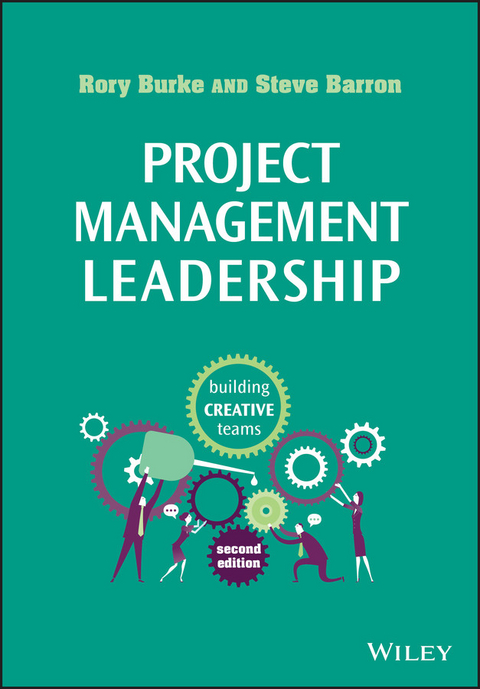
Project Management Leadership (eBook)
John Wiley & Sons (Verlag)
978-1-118-82540-2 (ISBN)
Project Management Leadership is a comprehensive guide to the human factors involved in Project Management, in particular the leadership skills required to ensure successful implementation of current best practice. It provides the latest insights on team building, motivation, collaboration, and networking skills, and the way these can be harnessed to manage a successful project. Exercises and worked examples are provided throughout alongside a fully revised instructor manual.
Project Management Leadership is a comprehensive guide to the human factors involved in Project Management, in particular the leadership skills required to ensure successful implementation of current best practice. It provides the latest insights on team building, motivation, collaboration, and networking skills, and the way these can be harnessed to manage a successful project. Exercises and worked examples are provided throughout.
Rory Burke founded Burke Publishing in 1988 when he wrote his first book on Project Management. Rory has an MSc in Project Management (Henley) and degrees in Naval Architecture (Solent University) and Computer Aided Engineering (Coventry). He has worked internationally on capital projects in Britain, South Africa, the Middle East and New Zealand. Rory is an author, consultant and visiting lecturer to universities in Britain, South Africa, America, Canada, Australia, New Zealand, Hong Kong and Singapore. Steve Barron has worked on large and small engineering, software and construction projects in the military and financial sectors for over twenty years. He has managed project work in the UK, USA and Europe. He has created a number of project management learning programs that focus on application of theory in practical situations, aimed at both novice and experienced project managers. Steve is currently providing a range of project management focused programs at Lancaster University, UK.
Foreword vii
Authors' Notes ix
1 Introduction to Project Management Leadership 1
2 Project Governance and Ethics 19
3 Project Leadership BoK 29
4 Project Organization Structures 53
5 Leadership Behaviors 69
6 Leadership Theories and Styles 81
7 Power to Influence 99
8 Resistance to Change 117
9 Emotional Intelligence 131
10 Leadership vs. Management 141
11 Working with Stakeholders 147
12 Project Teams 159
13 Teams vs. Groups 177
14 Team Roles 193
15 Team Development Phases 209
16 Team-Building Techniques 229
17 Coaching and Mentoring 241
18 Negotiation 255
19 Motivation 265
20 Delegation 279
21 Communication 289
22 Conflict Resolution 303
23 Problem Solving 317
24 Decision Making 337
Appendix - Lost at Sea 351
Glossary 355
Index 361
Chapter 2
Project Governance and Ethics
- Develop a project governance framework.
- Develop a project ethics framework.
Project governance and ethics are part of the corporate vision and values that outline the purpose and aims of the company, together with details of the company’s culture, philosophy and the way the company intends to do business. It is, therefore, essential that the project leader understands the characteristics and features of project governance and ethics to be able to manage the process effectively.
This chapter will explain how to develop a project governance and project ethics framework.
The project leader’s challenge is to develop a project governance and project ethics framework at the project level that aligns with the company values and meets acceptable business and environmental practices.
1. Project Lifecycle
The project lifecycle shows the relative positions of the corporate strategy phases, project phases and operation phases. The corporate vision and values phase (first phase) develops the corporate vision to give the company strategic direction, and also develops the corporate values to outline how the company intends to do business (see Figure 2.1 below).
Figure 2.1: Project Lifecycle – shows the relative position of the corporate strategy phases, project phases, operation phases, together with the extent of the corporate vision and values, and the project governance and project ethics with respect to the other phases
The corporate values statement outlines the organization’s beliefs and culture that are shared amongst the shareholders and stakeholders (employees, contractors, suppliers and even customers). It is these values that drive a company’s behavior and priorities and determine how it intends to do business. The content of the corporate values statement will be discussed under the following headings:
- Project Governance – where the project governance translates the corporate values and governance into a practical framework to govern the project.
- Project Ethics – where the project ethics translate the corporate values and ethics into a project ethics framework for moral conduct and behavior.
2. Project Governance
Corporate governance is an internal safety net that tries to prevent rogue elements within a company going off at a tangent and, particularly, pursuing activities not known about by the company’s executive. There have been recent examples where rogue traders have been involved in off-balance-sheet activities that eventually brought down well-established companies, such as Barings Bank (UK) and Enron (USA). This section will translate corporate governance into project governance as a practical framework for governing projects (see Table 2.1).
Table 2.1: Project Governance
| Project Selection | The corporate governance process ensures that the selected projects align with the business case, statement of requirements and the corporate vision and values. This helps to prevent the company using its resources to pursue projects that do not support the company vision. It could be argued that, even if these projects make a profit, they are diluting the resource pool that should be used to implement the company’s vision. |
| Stakeholders | The selected business cases should align with the stakeholders’ needs and expectations. The stakeholders should be engaged at a level that is commensurate with their importance to the project and the organization. |
| Level of Risk | The level of project risk should be in line with the corporate acceptable level of risk – this filters out unwanted high-risk ventures. Some companies might accept high-risk projects if there is the potential for a good return. Whichever way, this is the place to formally establish the constraints. |
| Project Organization Structure | The project organization structure’s roles, responsibilities, authority and performance criteria are clearly defined, so that everyone working on the project knows who is responsible for what and who is reporting to whom. |
| Authority | The project sponsor and the project manager are given the authority they need to use company resources; this authority is assigned in the agreed manner (outlined in the business case and the project charter). This means that the assigned authority should be commensurate with responsibility, and that the project manager has the authority to make certain decisions that will lead to the consumption of company resources. |
| Statement of Requirements | The needs and opportunities analysis ensures that the statement of requirements is based on relevant and realistic market research data to give an accurate assessment of what the company needs to do to maintain competitive advantage. The statement of requirements underpins the whole project management process; this means that if the needs are inaccurate then the business case and the project will be compromised. |
| Business Case | The business case not only provides a feasible solution to address the identified needs, but also justifies the allocation of company resources and funds. |
| Scope Management | The scope management process ensures that:
|
| Project Initiation | The project is formally initiated by the appointed person (project sponsor). |
| Go/No-Go Decision | The go/no-go decision of each phase is made by the appointed person (project sponsor) in conjunction with the portfolio manager and the project steering board. |
| Project Charter | The project charter clearly outlines what is required and how it will be achieved, and issues authority for the project manager to use company resources. |
| Planning and Control | The project planning and control process follows the steps outlined in the project plan (issue instructions, expedite procurement, measure progress, guide the project to completion). |
| Quality Control | The quality control process mechanism ensures the work is completed to the required condition. |
| Progress Reporting | There are clearly defined criteria for reporting progress to the nominated members of the project organization. |
| Project Success | There are clearly defined critical success factors for the project manager to achieve – certainly time, cost and quality will be defined. |
| Communication | There are clearly defined lines of communication for communicating project information between all the project stakeholders. |
| Documentation | The governance process ensures that the project documents are effectively communicated, controlled and stored for retrieval in the agreed manner. |
| Issues Management | There is a mechanism to capture the issues that arise during the project, with an appropriate mechanism to resolve them. |
| Reviews and Closeout Reports | Formal phase reviews and project closeout reports are conducted to confirm completeness and acceptance as outlined in the phase or project, together with identifying lessons learnt. |
In other words, the benefits realized for the company from its projects must support its corporate objectives (corporate vision and values). Further, the projects must be implemented efficiently to ensure that they are making the best use of company resources and will be sustainable, which means they must align with the company’s values on sustainability.
This list of examples clearly shows that the project...
| Erscheint lt. Verlag | 14.2.2014 |
|---|---|
| Sprache | englisch |
| Themenwelt | Mathematik / Informatik ► Mathematik ► Algebra |
| Mathematik / Informatik ► Mathematik ► Angewandte Mathematik | |
| Technik | |
| Wirtschaft ► Betriebswirtschaft / Management ► Projektmanagement | |
| Schlagworte | Best • Business & Management • Comprehensive • Creative • Exercises • Führung • fundamental • Guide • Human • Information • Key • Knowledge • Leader • Leadership • Manage • Management f. Führungskräfte • Management f. Führungskräfte • Management / Leadership • Managerial • Number • organization • Project Management • Projektmanagement • Side • Skills • Styles • targets • Team • Topics • Ways • Wirtschaft u. Management |
| ISBN-10 | 1-118-82540-3 / 1118825403 |
| ISBN-13 | 978-1-118-82540-2 / 9781118825402 |
| Informationen gemäß Produktsicherheitsverordnung (GPSR) | |
| Haben Sie eine Frage zum Produkt? |
 PDF (Adobe DRM)
Größe: 4,5 MB
Kopierschutz: Adobe-DRM
Adobe-DRM ist ein Kopierschutz, der das eBook vor Mißbrauch schützen soll. Dabei wird das eBook bereits beim Download auf Ihre persönliche Adobe-ID autorisiert. Lesen können Sie das eBook dann nur auf den Geräten, welche ebenfalls auf Ihre Adobe-ID registriert sind.
Details zum Adobe-DRM
Dateiformat: PDF (Portable Document Format)
Mit einem festen Seitenlayout eignet sich die PDF besonders für Fachbücher mit Spalten, Tabellen und Abbildungen. Eine PDF kann auf fast allen Geräten angezeigt werden, ist aber für kleine Displays (Smartphone, eReader) nur eingeschränkt geeignet.
Systemvoraussetzungen:
PC/Mac: Mit einem PC oder Mac können Sie dieses eBook lesen. Sie benötigen eine
eReader: Dieses eBook kann mit (fast) allen eBook-Readern gelesen werden. Mit dem amazon-Kindle ist es aber nicht kompatibel.
Smartphone/Tablet: Egal ob Apple oder Android, dieses eBook können Sie lesen. Sie benötigen eine
Geräteliste und zusätzliche Hinweise
Zusätzliches Feature: Online Lesen
Dieses eBook können Sie zusätzlich zum Download auch online im Webbrowser lesen.
Buying eBooks from abroad
For tax law reasons we can sell eBooks just within Germany and Switzerland. Regrettably we cannot fulfill eBook-orders from other countries.
 EPUB (Adobe DRM)
Kopierschutz: Adobe-DRM
Adobe-DRM ist ein Kopierschutz, der das eBook vor Mißbrauch schützen soll. Dabei wird das eBook bereits beim Download auf Ihre persönliche Adobe-ID autorisiert. Lesen können Sie das eBook dann nur auf den Geräten, welche ebenfalls auf Ihre Adobe-ID registriert sind.
Details zum Adobe-DRM
Dateiformat: EPUB (Electronic Publication)
EPUB ist ein offener Standard für eBooks und eignet sich besonders zur Darstellung von Belletristik und Sachbüchern. Der Fließtext wird dynamisch an die Display- und Schriftgröße angepasst. Auch für mobile Lesegeräte ist EPUB daher gut geeignet.
Systemvoraussetzungen:
PC/Mac: Mit einem PC oder Mac können Sie dieses eBook lesen. Sie benötigen eine
eReader: Dieses eBook kann mit (fast) allen eBook-Readern gelesen werden. Mit dem amazon-Kindle ist es aber nicht kompatibel.
Smartphone/Tablet: Egal ob Apple oder Android, dieses eBook können Sie lesen. Sie benötigen eine
Geräteliste und zusätzliche Hinweise
Buying eBooks from abroad
For tax law reasons we can sell eBooks just within Germany and Switzerland. Regrettably we cannot fulfill eBook-orders from other countries.
aus dem Bereich