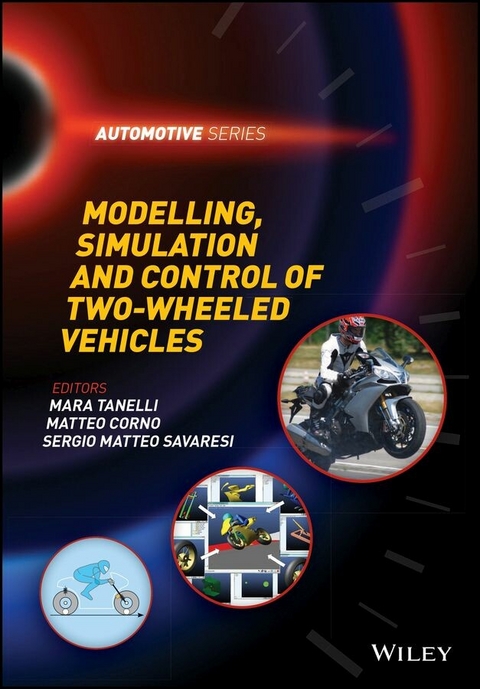
Modelling, Simulation and Control of Two-Wheeled Vehicles (eBook)
Comprehensive presentation of the current methods, tools and approaches available to address two-wheeled vehicle modelling, simulation and control design.
Modelling, Simulation and Control of Two-Wheeled Vehicles collates cutting edge research from leading international researchers in the field; offering the reader a long-awaited, comprehensive overview of the prevailing current methods, tools and existing approaches available to address two-wheeled vehicle modelling, simulation and control design. The authors also offer their perspective on the future trends in the field, providing an insight into future challenges and industrial and academic development scenarios. They present experimental data and closed-loop tests on instrumented motorcycles from real-life industrial experiments, providing added value and interest for an industrial audience.
Modelling, Simulation and Control of Two-Wheeled Vehicles covers all aspects of motorcycle control engineering, thus representing the first solid reference for this increasingly research-intensive subject.
- Presents cutting edge research as well as providing an insight into future challenges and industrial and academic development scenarios
- Includes experimental data and closed-loop tests on instrumented motorcycles from real-life industrial experiments
- Organised into 3 parts - Motorcycle Modelling and Dynamic Analysis, Motorcycle Simulation, and Motorcycle Control and Estimation Problems.
Primary market:
Graduate and postgraduate students in control and mechanical engineering. Academic researchers and professors in automotive control and vehicle dynamics. Industrial practitioners involved in motorcycle dynamics and control.
Secondary market:
R&D engineers in the area of vehicle dynamics and vehicle control engineering.
Mara Tanelli was born in Lodi, Italy, in 1978. She is an Assistant Professor of Automatic Control at the Dipartimento di Elettronica, Informazione e Bioingegneria of the Politecnico di Milano, Italy, where she obtained the Laurea degree in Computer Engineering in 2003 and the Ph.D. in Information Engineering in 2007. She also holds a M.Sc. in Computer Science from the University of Illinois at Chicago. Her main research interests focus on control systems design for vehicles, energy management of electric vehicles, control for energy aware IT systems and sliding mode control. She is co-author of more than 100 peer-reviewed scientific publications and 7 patents in the above research aras. She is also co-author of the monograph “Active braking control systems design for vehicles”, published in 2010 by Springer.
Matteo Corno was born in Italy in 1980. He received his Master of Science degree in Computer and Electrical Engineering (University of Illinois) and his Ph.D. cum laude degree with a thesis on active stability control of two-wheeled vehicles (Politecnico di Milano) in 2005 and 2009. He is currently an Assistant Professor with the Dipartimento di Elettronica, Informazione e Bioingegneria, Politecnico di Milano, Italy. In 2011, his paper “On Optimal Motorcycle Braking” was awarded the best-paper prize for Control Engineering Practice, published in the period 2008-2010. In 2012 and 2013, he co-founded two highly innovative start-ups: E-Novia and Zehus. His current research interests include dynamics and control of vehicles, Lithium-ion battery modelling, estimation and control and modelling and control of human powered electric vehicles. He held research positions at Thales Alenia Space, University of Illinois, Harley Davidson, University of Minnesota, Johannes Kepler University in Linz, and TU Delft.
Born in Manerbio, Italy, in 1968, Sergio Savaresi holds an MSc in Electrical Engineering and a PhD in Systems and Control Engineering, both from the Politecnico di Milano, and an MSc in Applied Mathematics from Università Cattolica. After receiving the PhD, he was a consultant for McKinsey&Co, Milan Office. He is Full Professor in Automatic Control since 2006. He has been visiting scholar at Lund University, Sweden, University of Twente, The Netherlans, Canberra National University, Australia, Minnesota University at Minneapolis, USA, Johannes Kepler University, Linz, Austria. He is Associate Editor of several international journals and he has been in the International Program Committee of many International Conferences. His main research interests are in the areas of vehicles control, automotive systems, data analysis and modeling, non-linear control, and industrial control applications. He is the head of the MoVE research group at the Politecnico di Milano, active in many public and industrial projects in all vehicle-related areas.
Enhanced e-book includes videos Many books have been written on modelling, simulation and control of four-wheeled vehicles (cars, in particular). However, due to the very specific and different dynamics of two-wheeled vehicles, it is very difficult to reuse previous knowledge gained on cars for two-wheeled vehicles. Modelling, Simulation and Control of Two-Wheeled Vehicles presents all of the unique features of two-wheeled vehicles, comprehensively covering the main methods, tools and approaches to address the modelling, simulation and control design issues. With contributions from leading researchers, this book also offers a perspective on the future trends in the field, outlining the challenges and the industrial and academic development scenarios. Extensive reference to real-world problems and experimental tests is also included throughout. Key features: The first book to cover all aspects of two-wheeled vehicle dynamics and control Collates cutting-edge research from leading international researchers in the field Covers motorcycle control a subject gaining more and more attention both from an academic and an industrial viewpoint Covers modelling, simulation and control, areas that are integrated in two-wheeled vehicles, and therefore must be considered together in order to gain an insight into this very specific field of research Presents analysis of experimental data and reports on the results obtained on instrumented vehicles. Modelling, Simulation and Control of Two-Wheeled Vehicles is a comprehensive reference for those in academia who are interested in the state of the art of two-wheeled vehicles, and is also a useful source of information for industrial practitioners.
Mara Tanelli was born in Lodi, Italy, in 1978. She is an Assistant Professor of Automatic Control at the Dipartimento di Elettronica, Informazione e Bioingegneria of the Politecnico di Milano, Italy, where she obtained the Laurea degree in Computer Engineering in 2003 and the Ph.D. in Information Engineering in 2007. She also holds a M.Sc. in Computer Science from the University of Illinois at Chicago. Her main research interests focus on control systems design for vehicles, energy management of electric vehicles, control for energy aware IT systems and sliding mode control. She is co-author of more than 100 peer-reviewed scientific publications and 7 patents in the above research aras. She is also co-author of the monograph "Active braking control systems design for vehicles", published in 2010 by Springer. Matteo Corno was born in Italy in 1980. He received his Master of Science degree in Computer and Electrical Engineering (University of Illinois) and his Ph.D. cum laude degree with a thesis on active stability control of two-wheeled vehicles (Politecnico di Milano) in 2005 and 2009. He is currently an Assistant Professor with the Dipartimento di Elettronica, Informazione e Bioingegneria, Politecnico di Milano, Italy. In 2011, his paper "On Optimal Motorcycle Braking" was awarded the best-paper prize for Control Engineering Practice, published in the period 2008-2010. In 2012 and 2013, he co-founded two highly innovative start-ups: E-Novia and Zehus. His current research interests include dynamics and control of vehicles, Lithium-ion battery modelling, estimation and control and modelling and control of human powered electric vehicles. He held research positions at Thales Alenia Space, University of Illinois, Harley Davidson, University of Minnesota, Johannes Kepler University in Linz, and TU Delft. Born in Manerbio, Italy, in 1968, Sergio Savaresi holds an MSc in Electrical Engineering and a PhD in Systems and Control Engineering, both from the Politecnico di Milano, and an MSc in Applied Mathematics from Università Cattolica. After receiving the PhD, he was a consultant for McKinsey&Co, Milan Office. He is Full Professor in Automatic Control since 2006. He has been visiting scholar at Lund University, Sweden, University of Twente, The Netherlans, Canberra National University, Australia, Minnesota University at Minneapolis, USA, Johannes Kepler University, Linz, Austria. He is Associate Editor of several international journals and he has been in the International Program Committee of many International Conferences. His main research interests are in the areas of vehicles control, automotive systems, data analysis and modeling, non-linear control, and industrial control applications. He is the head of the MoVE research group at the Politecnico di Milano, active in many public and industrial projects in all vehicle-related areas.
Chapter 1
Motorcycle Dynamics
Vittore Cossalter, Roberto Lot, and Matteo Massaro
University of Padova, Italy
This chapter aims at giving a basic insight into the two-wheeled vehicle dynamics to be applied to vehicle modelling and control. The most relevant kinematic properties are discussed in Section 1.1, the peculiarities of motorcycle tyres are reported in Section 1.2, the most popular suspension schemes are presented in Section 1.3, while Sections 1.4 and 1.5 are devoted to the analysis of the vehicle in-plane and out-of-plane vibration modes. Finally, Section 1.6 highlights the coupling between in-plane and out-of-plane dynamics.
1.1 Kinematics
From the kinematic point of view, every mechanical system consists of a number of rigid bodies connected to each other by a number of joints. Each body has six degrees of freedom (DOF) since its position and orientation in the space are fully defined by six parameters, such as the three coordinates of a point and three angles (yaw, roll, pitch). When a joint is included, the number of DOFs reduces according to the type of joint: the revolute joint (e.g., the one defining the motorcycle steering axis) inhibits five DOFs, the prismatic joint (e.g., the one defining the telescopic fork sliding axis) inhibits five DOFs, the wheel–road contact joint inhibits three DOFs when pure rolling is assumed (only three rotations about the contact point are allowed while no sliding is permitted), or one DOF when longitudinal and lateral slippage is allowed (the only constraint being in the vertical direction, where the compenetration between the wheel and the road is avoided).
1.1.1 Basics of Motorcycle Kinematics
Two-wheeled vehicles can be considered spatial mechanisms composed of six bodies:
- the rear wheel;
- the swingarm;
- the chassis (including saddle, tank, drivetrain, etc.);
- the handlebar (including rear view mirrors, headlamp, the upper part of the front suspension, etc.);
- the front usprung mass (i.e., the lower part of the front suspension, front brake calliper, etc.);
- the front wheel.
These bodies are connected each other and with the road surface by seven joints:
- a contact joint between the rear wheel and the road surface;
- a revolute joint between the rear wheel and the swingarm, to give the rear wheel spin axis;
- a revolute joint between the swingarm and the chassis, to give the swingarm pivot on the chassis;
- a revolute joint between the chassis and the handlebar, to give the steering axis;
- a prismatic joint between the handlebar and the front unsprung, to give the sliding axis of the telescopic fork;
- a revolute joint between the front unsprung and the front wheel, to give the front wheel spin axis;
- a contact joint between the front wheel and the road plane.
Therefore, the two-wheeled vehicle has nine DOFs, given the 20 DOFs inhibited by the four revolute joints, five DOFs inhibited by the prismatic joint and the two DOFs inhibited by the two contact joints (tyre slippage allowed), subtracted from the 36 DOFs related to the six rigid bodies. It is also common to include the rear and front tyre deformation due to the tyre compliance, and consequently the number of DOFs rises to 11.
Among the many different sets of 11 parameters that can be selected to define the vehicle configuration, it is common (e.g. Cossalter et al. 2011b, 2011c) to use the ones depicted in Figure 1.1: position and orientation of the chassis, steering angle, front suspension travel, swingarm rotation and wheel spin rotations.
Figure 1.1 Degrees of freedom of a two-wheeled vehicle
Finally, it is worth mentioning that these DOFs are related to the gross motion of the vehicle, while additional DOFs are necessary whenever some kind of vehicle structural flexibility is considered, e.g. Cossalter et al. (2007b).
Some geometric parameters such as the wheelbase , normal trail and caster angle , are very important when it comes to the vehicle stability, manoeuvrability and handling. In more detail, the wheelbase is the distance between the contact points on the road and usually ranges between 1.2 and 1.6 m, the normal trail is the distance between the front contact point and the steering axis (usually 80–120 mm) and the caster angle is the angle between the vertical axis and the steering axis (usually 19–35).
In general, an increase in the wheelbase, assuming that the other parameters remain constant, leads to an unfavourable increase in the flexional and torsional deformability of the frame (this may reduce vehicle manoeuvrability), an unfavourable increase in the minimum curvature radius, a favourable decrease in the load transfer during accelerating and braking (this makes wheelie and stoppie more difficult) and a favourable increase in the directional stability of the motorcycle.
The trail and the caster angle are especially important inasmuch as they define the geometric characteristics of the steering head. The definition of the properties of manoeuvrability and directional stability of two-wheeled vehicles depend on these two parameters, among others. Small values of trail and caster characterize sport vehicles, while higher values are typical of touring and cruiser vehicles. The trail and caster are related to each other by the following relationship:
1.1
where is the front tyre radius and is the fork offset; see Figure 1.2.
Figure 1.2 Wheelbase, caster angle and trail
Finally, it is worth noting that all these parameters are usually given for the nominal (standstill) trim configuration, while they change as the vehicle speed, longitudinal and lateral accelerations change.
1.1.2 Handlebar Steering Angle and Kinematic Steering Angle
While the driver operates the handlebar steering angle, the vehicle cornering behaviour is determined by the projection on the road surface of the angle between the rear and front wheel planes, the so-called kinematic steering angle. In two-wheeled vehicles, the relationship between the handlebar and kinematic steering angles varies appreciably with the roll angle. In particular, the steering mechanism is attenuated (i.e. the kinematic angle is lower than the handlebar angle) up to a certain value of the roll angle (close to the value of the caster angle), then it is amplified (i.e. the kinematic angle is higher than the handlebar angle); see Figure 1.3 for example.
Figure 1.3 Kinematic steering angle as a function of the handlebar steering angle δ for different values of the roll angle
The following simplified expression can be used to estimate the kinematic steering angle from the handlebar steering angle , the caster angle and the roll angle :
The local curvature of the vehicle trajectory (or the turning radius ) can be estimated from the kinematic angle and the wheelbase using the following expression:
Note that Equation 1.3 does not include the effect of tyre slippage, whose contribution will be described in Sections 1.2 and 1.5.2.
1.2 Tyres
The performance of two-wheeled vehicles is largely influenced by the characteristics of their tyres. Indeed, the control of the vehicle's equilibrium and motion occurs through the generation of longitudinal and lateral forces resulting from the rider's actions on the steering mechanism, throttle and braking system. The peculiarity of motorcycle tyres is that they work with camber angles up to 50 and even more, while car tyres rarely reach 10.
1.2.1 Contact Forces and Torques
From a macroscopic viewpoint, the interaction of the tyre with the road can be represented by a system composed of three forces and three torques, as in Figure 1.4:
- a longitudinal force (positive if driving and negative if braking);
- a lateral force ;
- a force normal to the road surface;
- an overturning moment ;
- a rolling resistance moment ;
- a yawing moment .
Figure 1.4 Tyre forces and torques
Experimental observations show that the force and torque generation is mainly related to the following input quantities:
- tyre longitudinal slip ;
- tyre lateral slip ;
- tyre camber angle ;
- tyre radial deflection ;
- tyre spin rate .
Therefore we can write:
1.4
with the longitudinal force mainly related to longitudinal slip , lateral force mainly related to the lateral slip and the camber angle , overturning moment mainly related to the camber angle , rolling resistance mainly related to the wheel spin rate and yawing moment mainly related to the lateral slip and camber angle .
The longitudinal slip (positive when driving and negative when braking) is defined as:
1.5
where is the tyre longitudinal velocity, is the tyre spin rate and is the tyre effective rolling radius. In particular, the effective rolling radius can be computed from the freely rolling tyre as
1.6
Note that the effective rolling radius does not coincide with either the tyre loaded radius or the the tyre unloaded radius ; see Figure 1.5. This should not be surprising since the tyre is not a rigid body. Experimental observations show that . However, a common assumption is .
Figure 1.5 Tyre radii
Sometimes a slightly different formulation of longitudinal slip is...
| Erscheint lt. Verlag | 4.2.2014 |
|---|---|
| Reihe/Serie | Automotive Series | Automotive Series |
| Sprache | englisch |
| Themenwelt | Technik ► Elektrotechnik / Energietechnik |
| Technik ► Fahrzeugbau / Schiffbau | |
| Technik ► Maschinenbau | |
| Schlagworte | automotive engineering • books • CARS • comprehensively • Control • Control Systems Technology • Different • difficult • Due • Dynamics • Electrical & Electronics Engineering • Elektrotechnik u. Elektronik • Fahrzeugtechnik • features • Festkörpermechanik • Festkörpermechanik • fourwheeled • Gained • Knowledge • main methods • many • Maschinenbau • mechanical engineering • Modelling • Motoren u. Antriebe • Motors & Drivers • presents • previous • Regelungstechnik • Reuse • twowheeled • Unique • Vehicles • Zweirad |
| ISBN-13 | 9781118536377 / 9781118536377 |
| Informationen gemäß Produktsicherheitsverordnung (GPSR) | |
| Haben Sie eine Frage zum Produkt? |
 EPUB (Adobe DRM)
Größe: 29,6 MB
Kopierschutz: Adobe-DRM
Adobe-DRM ist ein Kopierschutz, der das eBook vor Mißbrauch schützen soll. Dabei wird das eBook bereits beim Download auf Ihre persönliche Adobe-ID autorisiert. Lesen können Sie das eBook dann nur auf den Geräten, welche ebenfalls auf Ihre Adobe-ID registriert sind.
Details zum Adobe-DRM
Dateiformat: EPUB (Electronic Publication)
EPUB ist ein offener Standard für eBooks und eignet sich besonders zur Darstellung von Belletristik und Sachbüchern. Der Fließtext wird dynamisch an die Display- und Schriftgröße angepasst. Auch für mobile Lesegeräte ist EPUB daher gut geeignet.
Systemvoraussetzungen:
PC/Mac: Mit einem PC oder Mac können Sie dieses eBook lesen. Sie benötigen eine
eReader: Dieses eBook kann mit (fast) allen eBook-Readern gelesen werden. Mit dem amazon-Kindle ist es aber nicht kompatibel.
Smartphone/Tablet: Egal ob Apple oder Android, dieses eBook können Sie lesen. Sie benötigen eine
Geräteliste und zusätzliche Hinweise
Zusätzliches Feature: Online Lesen
Dieses eBook können Sie zusätzlich zum Download auch online im Webbrowser lesen.
Buying eBooks from abroad
For tax law reasons we can sell eBooks just within Germany and Switzerland. Regrettably we cannot fulfill eBook-orders from other countries.
 PDF (Adobe DRM)
Kopierschutz: Adobe-DRM
Adobe-DRM ist ein Kopierschutz, der das eBook vor Mißbrauch schützen soll. Dabei wird das eBook bereits beim Download auf Ihre persönliche Adobe-ID autorisiert. Lesen können Sie das eBook dann nur auf den Geräten, welche ebenfalls auf Ihre Adobe-ID registriert sind.
Details zum Adobe-DRM
Dateiformat: PDF (Portable Document Format)
Mit einem festen Seitenlayout eignet sich die PDF besonders für Fachbücher mit Spalten, Tabellen und Abbildungen. Eine PDF kann auf fast allen Geräten angezeigt werden, ist aber für kleine Displays (Smartphone, eReader) nur eingeschränkt geeignet.
Systemvoraussetzungen:
PC/Mac: Mit einem PC oder Mac können Sie dieses eBook lesen. Sie benötigen eine
eReader: Dieses eBook kann mit (fast) allen eBook-Readern gelesen werden. Mit dem amazon-Kindle ist es aber nicht kompatibel.
Smartphone/Tablet: Egal ob Apple oder Android, dieses eBook können Sie lesen. Sie benötigen eine
Geräteliste und zusätzliche Hinweise
Buying eBooks from abroad
For tax law reasons we can sell eBooks just within Germany and Switzerland. Regrettably we cannot fulfill eBook-orders from other countries.
aus dem Bereich