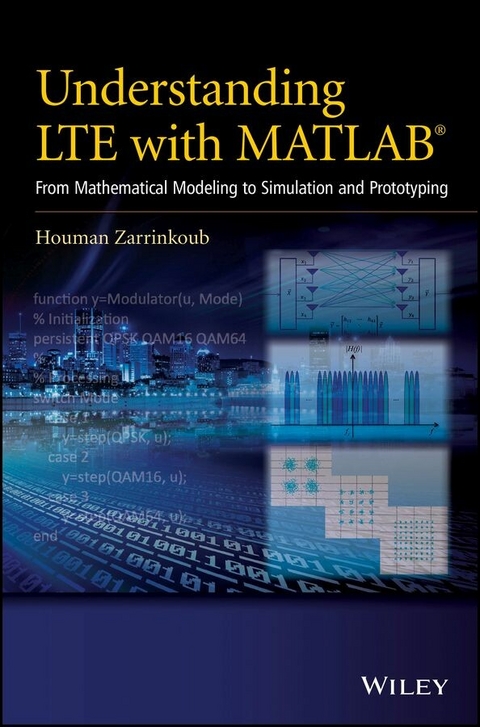
Understanding LTE with MATLAB (eBook)
John Wiley & Sons (Verlag)
978-1-118-44345-3 (ISBN)
An introduction to technical details related to the Physical Layer of the LTE standard with MATLAB®
The LTE (Long Term Evolution) and LTE-Advanced are among the latest mobile communications standards, designed to realize the dream of a truly global, fast, all-IP-based, secure broadband mobile access technology.
This book examines the Physical Layer (PHY) of the LTE standards by incorporating three conceptual elements: an overview of the theory behind key enabling technologies; a concise discussion regarding standard specifications; and the MATLAB® algorithms needed to simulate the standard.
The use of MATLAB®, a widely used technical computing language, is one of the distinguishing features of this book. Through a series of MATLAB® programs, the author explores each of the enabling technologies, pedagogically synthesizes an LTE PHY system model, and evaluates system performance at each stage. Following this step-by-step process, readers will achieve deeper understanding of LTE concepts and specifications through simulations.
Key Features:
• Accessible, intuitive, and progressive; one of the few books to focus primarily on the modeling, simulation, and implementation of the LTE PHY standard
• Includes case studies and testbenches in MATLAB®, which build knowledge gradually and incrementally until a functional specification for the LTE PHY is attained
• Accompanying Web site includes all MATLAB® programs, together with PowerPoint slides and other illustrative examples
Dr Houman Zarrinkoub has served as a development manager and now as a senior product manager with MathWorks, based in Massachusetts, USA. Within his 12 years at MathWorks, he has been responsible for multiple signal processing and communications software tools. Prior to MathWorks, he was a research scientist in the Wireless Group at Nortel Networks, where he contributed to multiple standardization projects for 3G mobile technologies. He has been awarded multiple patents on topics related to computer simulations. He holds a BSc degree in Electrical Engineering from McGill University and MSc and PhD degrees in Telecommunications from the Institut Nationale de la Recherche Scientifique, in Canada.
Dr Houman Zarrinkoub has served as a development manager and now as a senior product manager with MathWorks, based in Massachusetts, USA. Within his 12 years at MathWorks, he has been responsible for multiple signal processing and communications software tools. Prior to MathWorks, he was a research scientist in the Wireless Group at Nortel Networks, where he contributed to multiple standardization projects for 3G mobile technologies. He has been awarded multiple patents on topics related to computer simulations. He holds a BSc degree in Electrical Engineering from McGill University and MSc and PhD degrees in Telecommunications from the Institut Nationale de la Recherche Scientifique, in Canada.
www.wiley.com/go/zarrinkoub
An introduction to technical details related to the Physical Layer of the LTE standard with MATLAB The LTE (Long Term Evolution) and LTE-Advanced are among the latest mobile communications standards, designed to realize the dream of a truly global, fast, all-IP-based, secure broadband mobile access technology. This book examines the Physical Layer (PHY) of the LTE standards by incorporating three conceptual elements: an overview of the theory behind key enabling technologies; a concise discussion regarding standard specifications; and the MATLAB algorithms needed to simulate the standard. The use of MATLAB , a widely used technical computing language, is one of the distinguishing features of this book. Through a series of MATLAB programs, the author explores each of the enabling technologies, pedagogically synthesizes an LTE PHY system model, and evaluates system performance at each stage. Following this step-by-step process, readers will achieve deeper understanding of LTE concepts and specifications through simulations. Key Features: Accessible, intuitive, and progressive; one of the few books to focus primarily on the modeling, simulation, and implementation of the LTE PHY standard Includes case studies and testbenches in MATLAB , which build knowledge gradually and incrementally until a functional specification for the LTE PHY is attained Accompanying Web site includes all MATLAB programs, together with PowerPoint slides and other illustrative examples Dr Houman Zarrinkoub has served as a development manager and now as a senior product manager with MathWorks, based in Massachusetts, USA. Within his 12 years at MathWorks, he has been responsible for multiple signal processing and communications software tools. Prior to MathWorks, he was a research scientist in the Wireless Group at Nortel Networks, where he contributed to multiple standardization projects for 3G mobile technologies. He has been awarded multiple patents on topics related to computer simulations. He holds a BSc degree in Electrical Engineering from McGill University and MSc and PhD degrees in Telecommunications from the Institut Nationale de la Recherche Scientifique, in Canada. http://www.wiley.com/go/zarrinkoub
Dr Houman Zarrinkoub has served as a development manager and now as a senior product manager with MathWorks, based in Massachusetts, USA. Within his 12 years at MathWorks, he has been responsible for multiple signal processing and communications software tools. Prior to MathWorks, he was a research scientist in the Wireless Group at Nortel Networks, where he contributed to multiple standardization projects for 3G mobile technologies. He has been awarded multiple patents on topics related to computer simulations. He holds a BSc degree in Electrical Engineering from McGill University and MSc and PhD degrees in Telecommunications from the Institut Nationale de la Recherche Scientifique, in Canada. www.wiley.com/go/zarrinkoub
Chapter 2
Overview of the LTE Physical Layer
The focus of this book is the LTE (Long Term Evolution) radio access technology and particularly its PHY (Physical Layer). Here, we will highlight the major concepts related to understanding the technology choices made in the design of the LTE PHY radio interface. Focusing on this topic will best explain the remarkable data rates achievable by LTE and LTE-Advanced standards.
LTE specifies data communications protocols for both the uplink (mobile to base station) and downlink (base station to mobile) communications. In the 3GPP (Third Generation Partnership Project) nomenclature, the base station is referred to as eNodeB (enhanced Node Base station) and the mobile unit is referred to as UE (User Equipment).
In this chapter, we will cover topics related to PHY data communication and the transmission protocols of the LTE standards. We will first provide an overview of frequency bands, FDD (Frequency Division Duplex) and TDD (Time Division Duplex) duplex methodologies, flexible bandwidth allocation, time framing, and the time–frequency resource representation of the LTE standard. We will then study in detail both the downlink and uplink processing stacks, which include multicarrier transmission schemes, multi-antenna protocols, adaptive modulation, and coding schemes and channel-dependent link adaptations.
In each case, we will first describe the various channels that connect different layers of the communication stacks and then describe in detail the signal processing in the PHY applied on each of the downlink and uplink physical channels. The amount of detail presented will be sufficient to enables us to model the downlink PHY processing as MATLAB® programs. In the subsequent four chapters we will iteratively and progressively derive a system model from simpler algorithms in MATLAB.
2.1 Air Interface
The LTE air interface is based on OFDM (Orthogonal Frequency Division Multiplexing) multiple-access technology in the downlink and a closely related technology known as Single-Carrier Frequency Division Multiplexing (SC-FDM) in the uplink. The use of OFDM provides significant advantages over alternative multiple-access technologies and signals a sharp departure from the past. Among the advantages are high spectral efficiency and adaptability for broadband data transmission, resistance to intersymbol interference caused by multipath fading, a natural support for MIMO (Multiple Input Multiple Output) schemes, and support for frequency-domain techniques such as frequency-selective scheduling 1.
The time–frequency representation of OFDM is designed to provide high levels of flexibility in allocating both spectra and the time frames for transmission. The spectrum flexibility in LTE provides not only a variety of frequency bands but also a scalable set of bandwidths. LTE also provides a short frame size of 10 ms in order to minimize latency. By specifying short frame sizes, LTE allows better channel estimation to be performed in the mobile, allowing timely feedbacks necessary for link adaptations to be provided to the base station.
2.2 Frequency Bands
The LTE standards specify the available radio spectra in different frequency bands. One of the goals of the LTE standards is seamless integration with previous mobile systems. As such, the frequency bands already defined for previous 3GPP standards are available for LTE deployment. In addition to these common bands, a few new frequency bands are also introduced for the first time in the LTE specification. The regulations governing these frequency bands vary between different countries. Therefore, it is conceivable that not just one but many of the frequency bands could be deployed by any given service provider to make the global roaming mechanism much easier to manage.
As was the case with previous 3GPP standards, LTE supports both FDD and TDD modes, with frequency bands specified as paired and unpaired spectra, respectively. FDD frequency bands are paired, which enables simultaneous transmission on two frequencies: one for the downlink and one for the uplink. The paired bands are also specified with sufficient separations for improved receiver performance. TDD frequency bands are unpaired, as uplink and downlink transmissions share the same channel and carrier frequency. The transmissions in uplink and downlink directions are time-multiplexed.
Release 11 of the 3GPP specifications for LTE shows the comprehensive list of ITU IMT-Advanced (International Telecommunications Union International Mobile Telecommunication) frequency bands 2. It includes 25 frequency bands for FDD and 11 for TDD. As shown in Table 2.1, the paired bands used in FDD duplex mode are numbered from 1 to 25; the unpaired bands used in TDD mode are numbered from 33 to 43, as illustrated in Table 2.2. The band number 6 is not applicable to LTE and bands 15 and 16 are dedicated to ITU Region 1.
Table 2.1 Paired frequency bands defined for E-UTRA
Table 2.2 Unpaired frequency bands defined for E-UTRA
| Operating band index | Uplink and downlink operating band frequency range (MHz) | Duplex mode |
| 33 | 1900–1920 | TDD |
| 34 | 2010–2025 | TDD |
| 35 | 1850–1910 | TDD |
| 36 | 1930–1990 | TDD |
| 37 | 1910–1930 | TDD |
| 38 | 2570–2620 | TDD |
| 39 | 1880–1920 | TDD |
| 40 | 2300–2400 | TDD |
| 41 | 2496–2690 | TDD |
| 42 | 3400–3600 | TDD |
| 43 | 3600–3800 | TDD |
2.3 Unicast and Multicast Services
In mobile communications, the normal mode of transmission is known as a unicast transmission, where the transmitted data are intended for a single user. In addition to unicast services, the LTE standards support a mode of transmission known as Multimedia Broadcast/Multicast Services (MBMS). MBMS delivers high-data-rate multimedia services such as TV and radio broadcasting and audio and video streaming 1.
MBMS has its own set of dedicated traffic and control channels and is based on a multicell transmission scheme forming a Multimedia Broadcast Single-Frequency Network (MBSFN) service area. A multimedia signal is transmitted from multiple adjacent cells belonging to a given MBSFN service area. When the content of a single Multicast Channel (MCH) is transmitted from different cells, the signals on the same subcarrier are coherently combined at the UE. This results in a substantial improvement in the SNR (signal-to-noise ratio) and significantly improves the maximum allowable data rates for the multimedia transmission. Being in either a unicast or a multicast/broadcast mode of transmission affects many parameters and components of the system operation. As we describe various components of the LTE technology, we will highlight how different channels, transmission modes, and physical signals and parameters are used in the unicast and multicast modes of operations. The focus throughout this book will be on unicast services and data transmission.
2.4 Allocation of Bandwidth
The IMT-Advanced guidelines require spectrum flexibility in the LTE standard. This leads to scalability in the frequency domain, which is manifested by a list of spectrum allocations ranging from 1.4 to 20 MHz. The frequency spectra in LTE are formed as concatenations of resource blocks consisting of 12 subcarriers. Since subcarriers are separated by 15 kHz, the total bandwidth of a resource block is 180 kHz. This enables transmission bandwidth configurations of from 6 to 110 resource blocks over a single frequency carrier, which explains how the multicarrier transmission nature of the LTE standard allows for channel bandwidths ranging from 1.4 to 20.0 MHz in steps of 180 kHz, allowing the required spectrum flexibility to be achieved.
Table 2.3 illustrates the relationship between the channel bandwidth and the number of resource blocks transmitted over an LTE RF carrier. For bandwidths of 3–20 MHz, the totality of resource blocks in the transmission bandwidth occupies around 90% of the channel bandwidth. In the case of 1.4 kHz, the percentage drops to around 77%. This helps reduce unwanted emissions outside the bandwidth, as illustrated in Figure 2.1. A formal definition of the time–frequency representation of the spectrum, the resource grid, and the blocks will be presented shortly.
Table 2.3 Channel bandwidths specified in LTE
| Channel bandwidth (MHz) | Number of resource blocks |
| 1.4 | 6 |
| 3 | 15 |
| 5 | 25 |
| 10 | 50 |
| 15 | 75 |
| 20 | 100 |
Figure 2.1 Relationship between channel bandwidth and number of resource blocks
2.5 Time Framing
The time-domain structure of the LTE is illustrated in...
| Erscheint lt. Verlag | 28.1.2014 |
|---|---|
| Sprache | englisch |
| Themenwelt | Technik ► Elektrotechnik / Energietechnik |
| Technik ► Nachrichtentechnik | |
| Schlagworte | ACCESS • Book • Broadband • Communication Technology - Networks • Conceptual • concise • Details • Drahtlose Kommunikation • Dream • Electrical & Electronics Engineering • Elektrotechnik u. Elektronik • Global • incorporating • Introduction • Kommunikationsnetz • Kommunikationsnetze • Layer • Long • LTE • MATLAB • Mobile & Wireless Communications • Overview • phy • Physical • secure • Standard • Standards • Statistical Software / MATLAB • Statistics • Statistik • Statistiksoftware / MATLAB • technical • Term • Three • Truly |
| ISBN-10 | 1-118-44345-4 / 1118443454 |
| ISBN-13 | 978-1-118-44345-3 / 9781118443453 |
| Informationen gemäß Produktsicherheitsverordnung (GPSR) | |
| Haben Sie eine Frage zum Produkt? |
 EPUB (Adobe DRM)
Kopierschutz: Adobe-DRM
Adobe-DRM ist ein Kopierschutz, der das eBook vor Mißbrauch schützen soll. Dabei wird das eBook bereits beim Download auf Ihre persönliche Adobe-ID autorisiert. Lesen können Sie das eBook dann nur auf den Geräten, welche ebenfalls auf Ihre Adobe-ID registriert sind.
Details zum Adobe-DRM
Dateiformat: EPUB (Electronic Publication)
EPUB ist ein offener Standard für eBooks und eignet sich besonders zur Darstellung von Belletristik und Sachbüchern. Der Fließtext wird dynamisch an die Display- und Schriftgröße angepasst. Auch für mobile Lesegeräte ist EPUB daher gut geeignet.
Systemvoraussetzungen:
PC/Mac: Mit einem PC oder Mac können Sie dieses eBook lesen. Sie benötigen eine
eReader: Dieses eBook kann mit (fast) allen eBook-Readern gelesen werden. Mit dem amazon-Kindle ist es aber nicht kompatibel.
Smartphone/Tablet: Egal ob Apple oder Android, dieses eBook können Sie lesen. Sie benötigen eine
Geräteliste und zusätzliche Hinweise
Buying eBooks from abroad
For tax law reasons we can sell eBooks just within Germany and Switzerland. Regrettably we cannot fulfill eBook-orders from other countries.
aus dem Bereich