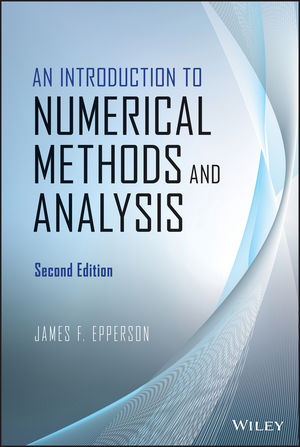
An Introduction to Numerical Methods and Analysis (eBook)
John Wiley & Sons (Verlag)
978-1-118-73096-6 (ISBN)
Praise for the First Edition
'. . . outstandingly appealing with regard to its style, contents, considerations of requirements of practice, choice of examples, and exercises.'—Zentralblatt MATH
'. . . carefully structured with many detailed worked examples.'—The Mathematical Gazette
The Second Edition of the highly regarded An Introduction to Numerical Methods and Analysis provides a fully revised guide to numerical approximation. The book continues to be accessible and expertly guides readers through the many available techniques of numerical methods and analysis.
An Introduction to Numerical Methods and Analysis, Second Edition reflects the latest trends in the field, includes new material and revised exercises, and offers a unique emphasis on applications. The author clearly explains how to both construct and evaluate approximations for accuracy and performance, which are key skills in a variety of fields. A wide range of higher-level methods and solutions, including new topics such as the roots of polynomials, spectral collocation, finite element ideas, and Clenshaw-Curtis quadrature, are presented from an introductory perspective, and the Second Edition also features:
- Chapters and sections that begin with basic, elementary material followed by gradual coverage of more advanced material
- Exercises ranging from simple hand computations to challenging derivations and minor proofs to programming exercises
- Widespread exposure and utilization of MATLAB
- An appendix that contains proofs of various theorems and other material
The book is an ideal textbook for students in advanced undergraduate mathematics and engineering courses who are interested in gaining an understanding of numerical methods and numerical analysis.
JAMES F. EPPERSON, PhD, is Associate Editor of Mathematical Reviews for the American Mathematical Society. He was previously associate professor in the Department of Mathematics at The University of Alabama in Huntsville and assistant professor at the University of Georgia in Athens. He earned his doctorate at Carnegie Mellon University in Pittsburgh and his undergraduate degree from the College of Engineering at the University of Michigan, Ann Arbor.
Praise for the First Edition "e;. . . outstandingly appealing with regard to its style, contents, considerations of requirements of practice, choice of examples, and exercises."e; Zentralblatt MATH "e;. . . carefully structured with many detailed worked examples."e; The Mathematical Gazette The Second Edition of the highly regarded An Introduction to Numerical Methods and Analysis provides a fully revised guide to numerical approximation. The book continues to be accessible and expertly guides readers through the many available techniques of numerical methods and analysis. An Introduction to Numerical Methods and Analysis, Second Edition reflects the latest trends in the field, includes new material and revised exercises, and offers a unique emphasis on applications. The author clearly explains how to both construct and evaluate approximations for accuracy and performance, which are key skills in a variety of fields. A wide range of higher-level methods and solutions, including new topics such as the roots of polynomials, spectral collocation, finite element ideas, and Clenshaw-Curtis quadrature, are presented from an introductory perspective, and the Second Edition also features: Chapters and sections that begin with basic, elementary material followed by gradual coverage of more advanced material Exercises ranging from simple hand computations to challenging derivations and minor proofs to programming exercises Widespread exposure and utilization of MATLAB An appendix that contains proofs of various theorems and other material The book is an ideal textbook for students in advanced undergraduate mathematics and engineering courses who are interested in gaining an understanding of numerical methods and numerical analysis.
JAMES F. EPPERSON, PHD, is Associate Editor of Mathematical Reviews for the American Mathematical Society. He was previously associate professor in the Department of Mathematics at The University of Alabama in Huntsville and assistant professor at the University of Georgia in Athens. He earned his doctorate at Carnegie Mellon University in Pittsburgh and his undergraduate degree from the College of Engineering at the University of Michigan, Ann Arbor.
Preface xiii
1 Introductory Concepts and Calculus Review 1
2 A Survey of Simple Methods and Tools 43
3 Root-Finding 89
4 Interpolation and Approximation 171
5 Numerical Integration 269
6 Numerical Methods for Ordinary Differential Equations 329
7 Numerical Methods for the Solution of Systems of Equations 417
8 Approximate Solution of the Algebraic Eigenvalue Problem 479
9 A Survey of Numerical Methods for Partial Differential Equations 521
10 An Introduction to Spectral Methods 555
Appendix A: Proofs of Selected Theorems, and Other Additional Material 581
Index 587
"This is an excellent textbook for a numerical analysis
course although it will be difficult to cover all the material in
just one course. Because the text is so complete, it could as
well be used for self-study." (American Mathematical
Society, 1 August 2014)
| Erscheint lt. Verlag | 27.1.2014 |
|---|---|
| Sprache | englisch |
| Themenwelt | Mathematik / Informatik ► Mathematik ► Analysis |
| Technik | |
| Schlagworte | algebraic multigrid method • Applied Mathematics in Science • Broyden?s Method • fourier analysis • galerkin/finite element ideas for BVPS • Mathematical Analysis • Mathematics • Mathematik • Mathematik in den Naturwissenschaften • Mathematische Analyse • Monte Carlo methods • Numerical analysis • Numerical Methods • Numerische Mathematik • numerische Methoden • Numerisches Verfahren • polynomials • radical basis function interpolation • spectral/collocation methods for PDEs • Taylor?s Theorem • tension splines • trigonomic interpolation |
| ISBN-10 | 1-118-73096-8 / 1118730968 |
| ISBN-13 | 978-1-118-73096-6 / 9781118730966 |
| Informationen gemäß Produktsicherheitsverordnung (GPSR) | |
| Haben Sie eine Frage zum Produkt? |
 PDF (Adobe DRM)
Kopierschutz: Adobe-DRM
Adobe-DRM ist ein Kopierschutz, der das eBook vor Mißbrauch schützen soll. Dabei wird das eBook bereits beim Download auf Ihre persönliche Adobe-ID autorisiert. Lesen können Sie das eBook dann nur auf den Geräten, welche ebenfalls auf Ihre Adobe-ID registriert sind.
Details zum Adobe-DRM
Dateiformat: PDF (Portable Document Format)
Mit einem festen Seitenlayout eignet sich die PDF besonders für Fachbücher mit Spalten, Tabellen und Abbildungen. Eine PDF kann auf fast allen Geräten angezeigt werden, ist aber für kleine Displays (Smartphone, eReader) nur eingeschränkt geeignet.
Systemvoraussetzungen:
PC/Mac: Mit einem PC oder Mac können Sie dieses eBook lesen. Sie benötigen eine
eReader: Dieses eBook kann mit (fast) allen eBook-Readern gelesen werden. Mit dem amazon-Kindle ist es aber nicht kompatibel.
Smartphone/Tablet: Egal ob Apple oder Android, dieses eBook können Sie lesen. Sie benötigen eine
Geräteliste und zusätzliche Hinweise
Buying eBooks from abroad
For tax law reasons we can sell eBooks just within Germany and Switzerland. Regrettably we cannot fulfill eBook-orders from other countries.
aus dem Bereich