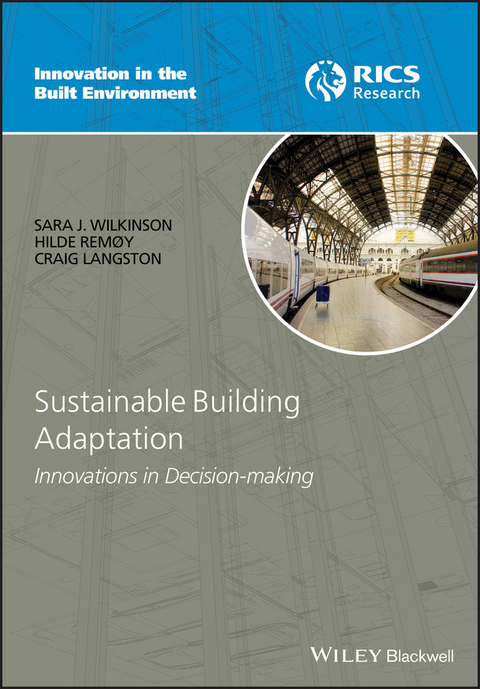
Sustainable Building Adaptation (eBook)
John Wiley & Sons (Verlag)
978-1-118-47718-2 (ISBN)
How to adapt existing building stock is a problem being addressed by local and state governments worldwide. In most developed countries we now spend more on building adaptation than on new construction and there is an urgent need for greater knowledge and awareness of what happens to commercial buildings over time.
Sustainable Building Adaptation: innovations in decision-making is a significant contribution to understanding best practice in sustainable adaptations to existing commercial buildings by offering new knowledge-based theoretical and practical insights. Models used are grounded in results of case studies conducted within three collaborative construction project team settings in Australia and the Netherlands, and exemplars are drawn from the Americas, Asia, Japan, Korea and Europe to demonstrate the application of the knowledge more broadly.
Results clearly demonstrate that the new models can assist with informed decision-making in adaptation that challenges some of the prevailing solutions based on empirical approaches and which do not accommodate the sustainability dimension. The emphasis is on demonstrating how the new knowledge can be applied by practitioners to deliver professionally relevant outcomes.
The book offers guidance towards a balanced approach that incorporates sustainable and optimal approaches for effective management of sustainable adaptation of existing commercial buildings.
How to adapt existing building stock is a problem being addressed by local and state governments worldwide. In most developed countries we now spend more on building adaptation than on new construction and there is an urgent need for greater knowledge and awareness of what happens to commercial buildings over time. Sustainable Building Adaptation: innovations in decision-making is a significant contribution to understanding best practice in sustainable adaptations to existing commercial buildings by offering new knowledge-based theoretical and practical insights. Models used are grounded in results of case studies conducted within three collaborative construction project team settings in Australia and the Netherlands, and exemplars are drawn from the Americas, Asia, Japan, Korea and Europe to demonstrate the application of the knowledge more broadly. Results clearly demonstrate that the new models can assist with informed decision-making in adaptation that challenges some of the prevailing solutions based on empirical approaches and which do not accommodate the sustainability dimension. The emphasis is on demonstrating how the new knowledge can be applied by practitioners to deliver professionally relevant outcomes. The book offers guidance towards a balanced approach that incorporates sustainable and optimal approaches for effective management of sustainable adaptation of existing commercial buildings.
Authors Sara J. Wilkinson is Associate Professor of Property and Construction at the University of Technology, Sydney, Australia Hilde Remøy is Assistant Professor of Real Estate Management at Delft University of Technology, The Netherlands Craig Langston is Professor of Construction and Facilities Management at Bond University, Queensland, Australia
2
Drivers and Barriers for Adaptation
2.1 Introduction
This chapter explains life cycle theory and how it links with adaptation before describing building performance and adaptation theory. From this point drivers and barriers affecting adaptation are detailed. The overarching social, environmental and economic factors are explained as a precursor to a discussion on the specific building attributes associated with adaptations. In this way a comprehensive overview of the theoretical framework in which adaptation decisions are made is provided.
2.2Building Life Cycle Theory
The concept of life cycle is that there is a beginning, middle and an end; all organisms experience life cycles of varying lengths and buildings are the same. The theory is applied to costs and allows practitioners and researchers to evaluate the total costs associated with building construction and operation over an expected life cycle term. Seven layers of change over time were identified within buildings: the site, structure, skin (building envelope), services, space plan (interior layout), stuff (furniture and equipment) and souls (people) (Brand 1994). There is a sliding scale in terms of the time frames before change occurs. While the site is permanent, the structure lasts from 30 to 300 years, the skin lasts for 20 plus years, services last for 7–20 years, the space plan lasts for 5–7 years, stuff lasts for less than 3 years and the souls change daily (Brand 1994). All buildings contain embodied energy or embodied carbon; that is the energy or carbon emissions that arise from extraction of the raw materials plus assembly into building components and transportation to the site. Clearly the longer the life cycle, the lower the total whole life cycle embodied carbon.
What is a typical life cycle for an office building? Estimates vary because of fluctuating conditions and expectations in different property markets globally. For example, an assessment of the Norwegian office market stated that commercial building structures have a usual life cycle of 50 years (Arge 2005). Typically within the 50-year time frame, the building’s services will need to be replaced and upgraded three times, due to improvements in technology and increases in user expectations. In US or UK markets, the typical life cycle for commercial buildings differs. The space plan element will be changed the most frequently, typically every 5–7 years, though often less. In Australia, lease terms for commercial buildings are usually 5 years, and therefore the fit-out will change more frequently than in markets where the norm for lease terms is much longer as say in the UK. This is another important factor that, of course, has a significant impact in the whole life sustainability of the building.
Each element of a building has a typical life cycle. The building structure should last 80–100 years plus, the envelope or skin typically lasts for 60 years or so, services 20–30 years and the interior fit-out 5–10 years (Duffy cited in Brand 1994). Services often represent a substantial proportion of construction costs. Given that the age of Melbourne central business district (CBD) commercial stock is on average approximately 31 years old, most buildings would need a service upgrade which is an opportunity to increase the operational sustainability of the building (Jones Lang LaSalle 2008). Similar age profiles for commercial office building stock exist in Sydney; however, in other European markets, like London, an older age profile is apparent. Over the whole building life cycle, most expenditure and environmental impact occurs during the operational phase of the life cycle. Additionally the economic impact of rising energy and other operating costs has increased significantly over the last three decades (Romain 2008). The need to focus on existing stock is a conclusion many have reached, and in 2008 approximately 71% of Australian investment was used for upgrading and building maintenance (DEWHA 2008; PCA 2008a). This figure indicates the significance of the adaptation sector, where the total value of the PCA/IPD Australian Property Index is 121.4 billion Australian dollars as of March 2011 and covers 1535 investments (IPD 2011).
Initially the total building costs are proportioned fairly evenly with the structure costing slightly more than the services and space plan. This represents the traditional view of building costs that takes account of the initial costs and does not consider the ongoing or life cycle costs of buildings. Over time the expenditure on the services and the space plan mean that at the 50-year point, the total costs are highest for the space plan followed by the services (Duffy and Henney 1989). The structure costs are significantly lower at this point in time. The analogy of theatres has been used to describe the notion that a building needs to have adaptability designed in so that it can be altered easily for future changes to the service and space plan factors (Arge 2005). In theatres, buildings are required to adapt to the needs of current productions, and over time theatres remain little changed, while the sets and arrangements change regularly to accommodate the plays (Arge 2005).
Changes occur within building life cycles and Douglas (2006) adopted a five-stage cycle. The first stage was labelled ‘birth’ when a new activity or process is housed by the building and a new user is accommodated. ‘Expansion’ is stage two where new requirements are accommodated, new services are introduced and the internal layout is adapted. In addition, there is a strain placed on the building fabric, where possible extension may occur and changes in function or spatial performance may result. ‘Maturity’ is the third stage, where either uses continue to fit the building and periodic maintenance and minor adjustments are made or current needs exceed capacity and new space is taken elsewhere. Stage four is ‘redundancy’ due to changes in sources of power, societal cultural values, market needs, technology and/or catchment areas: here the building is partially or totally obsolete and may be partly or totally vacant. The building may be subject to vandalism or occupied by squatters, or it may be mothballed or partially or totally demolished. The final stage is ‘rebirth’ or ‘demolition’ where thought will be given to reuse and the building restored, refurbished or demolished. At this point the building can be made more sustainable or a new building may be provided. In this concept of life cycles, adaptation can take place at every stage after ‘birth’ (Douglas 2006). The level or type of adaptation can and does change according the stage within the life cycle. Minor adaptations give way to more major adaptations over time, and the building meets user needs and the market to a lesser extent. Of course life cycles are closely related to building obsolescence and the issue is covered in detail in Chapter 5.
2.3Building Performance Theory
Since the 1970s work was undertaken to develop best practice and define building performance theory. Building performance evaluation (BPE) is the process of managed, structured and systematic assessment of building performance in areas such as the structure and fabric and services. BPE sits within a cyclical notion of a building’s life cycle. The theoretical framework for BPE evolved out of post-occupancy evaluation (POE). POE is the structured collection of quantitative and qualitative data from building facility managers and users of the building performance. BPE occurs at all stages of the life cycle, whereas POE is undertaken after commissioning of services and initial completion and occupation of the building. According to Preiser (2005), adaptation takes place at the end of the useful building life cycle or at the point where continued current use is no longer perceived to be economically viable (Preiser 2005). For example, Victoria Brewery in Melbourne was adapted to retail and residential apartments after the existing brewery became unprofitable and the site was sold (see Figure 2.1).
Figure 2.1 Former Victoria Brewery site, Melbourne.
Robust, structured and meaningful methods of building appraisal and evaluation have been developed. Owners and consultants can opt for ‘off the shelf’ evaluation tools, custom made, or adapt existing tools to suit their needs. It is the extension and evolution of these BPE tools that researchers in building adaptation seek to achieve. The goal is to replicate some of the best practice approaches and strengths of the BPE tools while avoiding the weaknesses. A limitation of some BPE techniques is that they tell appraisers the ‘what’ of BPE but do not extend to decision-making tools.
2.4Building Adaptation Theory and Sustainability
The arguments for and against building adaptation are categorised broadly under the headings social, economic and environmental. In addition, there are regulatory and legal, location and site, and physical factors which affect adaptation, and the notion of sustainability sits within these factors to varying degrees. Figure 2.2 shows a model of the factors that have been identified as influencing the decision to undertake adaptation. All factors have a direct relationship with adaptation; however, some factors have links with other factors (shown as the dotted line in Figure 2.2).
In addition, many studies have identified attribute(s) that makes a building adaptation ‘successful’, though the concept of ‘successful’ varies. The categories of attributes typically...
| Erscheint lt. Verlag | 21.1.2014 |
|---|---|
| Reihe/Serie | Innovation in the Built Environment |
| Innovation in the Built Environment | Innovation in the Built Environment |
| Sprache | englisch |
| Themenwelt | Technik ► Architektur |
| Technik ► Bauwesen | |
| Schlagworte | Adaptation • Adaptations • Architecture • Architektur • Bauentwurf • Bauingenieur- u. Bauwesen • Best • Building • Building Design • CASE • Civil Engineering & Construction • commercial • Construction: Sustainability • contribution • Countries • Decisionmaking • developed • existing • Facilities Management • Gebäudeausrüstung u. -management • Gebäudeausrüstung u. -management • Innovations • Local • Models • Nachhaltiges Bauen • new construction • Practice • Problem • significant • Stock • Sustainable • urgent • Worldwide |
| ISBN-10 | 1-118-47718-9 / 1118477189 |
| ISBN-13 | 978-1-118-47718-2 / 9781118477182 |
| Informationen gemäß Produktsicherheitsverordnung (GPSR) | |
| Haben Sie eine Frage zum Produkt? |
 EPUB (Adobe DRM)
Kopierschutz: Adobe-DRM
Adobe-DRM ist ein Kopierschutz, der das eBook vor Mißbrauch schützen soll. Dabei wird das eBook bereits beim Download auf Ihre persönliche Adobe-ID autorisiert. Lesen können Sie das eBook dann nur auf den Geräten, welche ebenfalls auf Ihre Adobe-ID registriert sind.
Details zum Adobe-DRM
Dateiformat: EPUB (Electronic Publication)
EPUB ist ein offener Standard für eBooks und eignet sich besonders zur Darstellung von Belletristik und Sachbüchern. Der Fließtext wird dynamisch an die Display- und Schriftgröße angepasst. Auch für mobile Lesegeräte ist EPUB daher gut geeignet.
Systemvoraussetzungen:
PC/Mac: Mit einem PC oder Mac können Sie dieses eBook lesen. Sie benötigen eine
eReader: Dieses eBook kann mit (fast) allen eBook-Readern gelesen werden. Mit dem amazon-Kindle ist es aber nicht kompatibel.
Smartphone/Tablet: Egal ob Apple oder Android, dieses eBook können Sie lesen. Sie benötigen eine
Geräteliste und zusätzliche Hinweise
Buying eBooks from abroad
For tax law reasons we can sell eBooks just within Germany and Switzerland. Regrettably we cannot fulfill eBook-orders from other countries.
aus dem Bereich