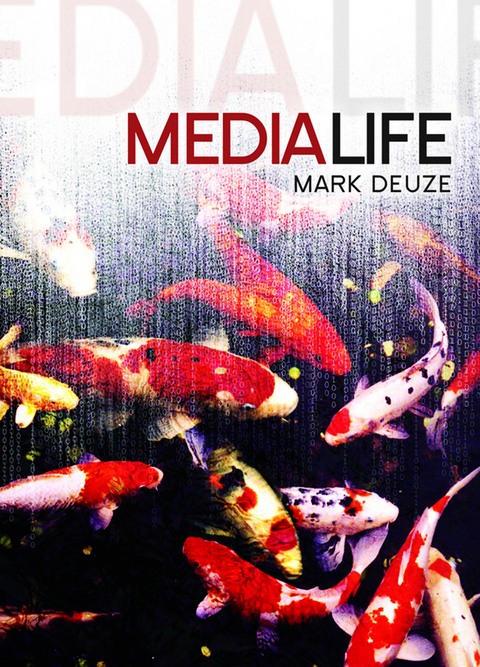
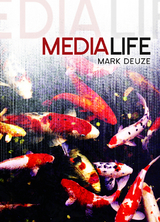
Media Life is a primer on how we may think of our lives as lived in rather than with media. The book uses the way media function today as a prism to understand key issues in contemporary society, where reality is open source, identities are - like websites - always under construction, and where private life is lived in public forever more.
Ultimately, media are to us as water is to fish. The question is: how can we live a good life in media like fish in water? Media Life offers a compass for the way ahead.
Research consistently shows how through the years more of our time gets spent using media, how multitasking our media has become a regular feature of everyday life, and that consuming media for most people increasingly takes place alongside producing media. Media Life is a primer on how we may think of our lives as lived in rather than with media. The book uses the way media function today as a prism to understand key issues in contemporary society, where reality is open source, identities are - like websites - always under construction, and where private life is lived in public forever more. Ultimately, media are to us as water is to fish. The question is: how can we live a good life in media like fish in water? Media Life offers a compass for the way ahead.
Mark Deuze is Associate Professor in the Department of Telecommunications at Indiana University.
Preface: In Media
1. Media Life
2. Media Today
3. What Media Do
4. No Life Outside Media
5. Society in Media
6. Together Alone
7. In Media We Fit
8. Life in Media
References
Endnotes
"Media Life is a daring, provocative and mindful
analysis of the many ways in which media have become an irreducible
component of the social. It is written in a very approachable
style, presented in an impeccable typographic design, and is
impressive in its scope of concepts, terminologies, and the body of
examples from market research, art and popular
culture."
Christoph Raetzsch, Digital Journalism
"Draws on a wide array of sometimes sharply original ideas about
both entrapment and opportunity, organizing them vigorously and
often with wit."
European Journal of Communication
"This innovative interpretation of our relationship to media is
both coherent and the fruit of much thought. It contains the
promise of a long-sought-for new paradigm to replace the original
causal-linear model of mass communication."
Denis McQuail, University of Amsterdam
"Media Life is a fresh and inspiring book, dense in
original ideas and intuitions. It is an outstanding book to read,
to study, to cite, to have on the shelves of your library, to lend
to friends, to suggest to students, and to think about when you
yourself take part in media life."
Leopoldina Fortunati, University of Udine
"In Media Life Mark Deuze gives us an immediate sense of
the embedded, interconnected, and multi-modal character and
necessity of media in contemporary life. It is also a window into
the next generation of communication research and scholarship,
where the familiar divides between channel and content,
interpersonal interaction and mediated communication, the personal,
the institutional, and the systemic will fade and reconfigure. Just
as we cannot not communicate, today we cannot not mediate. An
indispensable tour of the emerging boundaries of media
studies."
Leah Lievrouw, University of California Los Angeles
CHAPTER ONE
Media Life
where we go beyond human–machine differences and focus on living a good media life
Wandering through the streets of Amsterdam, Johannesburg and Los Angeles, one cannot help but witness media life everywhere. The way people move through public space while wearing or wielding private media (such as mobile phones, digital cameras, and portable music players). How town precincts, historic buildings, parks and monuments get signposted by brightly colored maps urging onlookers to visit websites for more information. Restaurants that label their menus with pictures of delicacies next to clothing stores that blare out tailor-made soundtracks to match their fashion profile. Explorers who navigate the urban jungle by moving from wireless internet hotspot to hotspot – coffeeshop, public library, pop-up store, hotel lobbies. Drivers in cars passing by interacting with talkative personal navigation systems, children on back seats dividing their attention between the images of the city whizzing by and a movie playing on front-seat-mounted screens. A street vendor conducting her business while tunes from a small transistor radio play in the background, the sounds competing with those from a group of busking guitarists across the street – amplified by mini portable electric loudspeakers.
Even though it may be possible to disentangle the tighly woven web of humans and machines at work in this scenario, none of these practices, activities and forms of communication takes place without media. The place of the city has become the space of media – not completely, not without problems, and most definitely not outside of such natural conditions as the sun in the sky and the concrete pavement under our feet. What guides our experience of this world are the ongoing interactions between their constituent elements: people, places and spaces, all of which both produced and consumed in media. This is a life as lived in, rather than with, media.
The world in media resembles what British media scholar Roger Silverstone (2007) appropriately labels a mediapolis: a comprehensively mediated public space where media underpin and overarch the experiences and expressions of everyday life. “The mediapolis … signals the presence in everyday life, both empirically and potentially, of that mediated space within which as participants we confront the world, and where, as citizens, we might confront each other” (111). In this space, media have become infinitely intertwined with every single way of being, seeing, moving and acting – without replacing the world of lived experience. It is one thing to describe a media life in terms of the kind of media people use, how people generally go about doing things with media, and how all of these practices are oriented around media. It is another thing, as Ien Ang articulates, to clarify and understand “what it means, or what it is like, to live in a media-saturated world” (1995: 72; italics in original). This is not a life simply lived with more media than before the age of internet and mobile telephony. It is a way of living that fuses life with material and mediated conditions of living in ways that bypass the real or perceived dichotomy between such constituent elements of human existence.
A media life is much more than just having an endless variety of electronic gadgets at our disposal, spending a lot of time watching television and surfing the web, and being confronted with networked technologies when we check-out at the store or when we drive new cars. What Russian new-media artist and theorist Lev Manovich headlines as “the practice of everyday (media) life” (2009: 319) has all kinds of consequences for the way we look at the world, and how we are inclined or supposed to make sense of it. Manovich suggests this is a life of constant communication and conversation, part of a reality that is supposedly hackable and remixable by everyone, that is therefore always dynamic, unpredictable and permanently under construction. It forces each and every one of us to reconstruct our lifestyles to adapt to a world where the results of our actions are almost impossible to foresee, given that we live in a world that is inextricably networked, confronting everyone with an almost limitless supply of fragile forms of reality and truth – simply by switching on a radio or television, by consulting a website or opening an e-mail. As German philosopher Peter Sloterdijk (2004) argues, the bubble of everyday life in media is instantly globalized as well as deeply provincial, where people – because of what colleague and countryman Ulrich Beck sees as a process of “ironic-tragic” (2009: 54) individualization – have to figure everything out on their own, fend for themselves, and are left to their own devices to find the social in an otherwise seemingly fragmented and atomized world.
Continuing with the theme of a suggested or expected malleability of the individual in everyday media life, Danish media scientist Lars Qvortrup (2003) proposes that our media life takes place in the context of a hypercomplex world in which social complexity is the cardinal challenge of our current society. It is not just that the world is complex – people observe their own lives and those of people around them (including those whose lives they witness in media) as ever more complex. The only way to survive, Qvortrup states, is to strive for a global dynamic state of equilibrium in which mechanisms and procedures for mutual observation and communication are developed. Italian feminist theorist Leopoldina Fortunati adds that the ever expanding range of choices people have in their communicative contexts – switching back and forth from body-to-body communication to mediated forms of interaction – “is intimately connected to management of complexity of everyday life. This complexity makes it increasingly necessary for us to resort to artificiality and to underdeveloped ‘naturalness’ of mediated communication” (2005: 56). In this world digital media operate as complexity-management mechanisms that are instrumental both in promoting the complicated and often problematic aspects of a globalized, individualized and networked world, and in providing the tools necessary to tackle such difficulties. The profound role media play in managing life’s complexities disappears in this process. The embrace of multiple realities (and ontologies) as the byproduct of media life – as the inevitable consequence of a worldview articulated with media – is reminiscent of Jean Baudrillard’s treatise “Simulacres et Simulation” (1981), in which he poses that people, when faced with the ubiquity and pervasiveness of a massively mediated reality, cannot meaningfully take on such a system with something outside of media. As Fortunati signals, once we turn to media “to patch up the rips and holes in the net of our social relations” (2005: 57), at some point it becomes impossible to disentangle whether we use media, or media use us. All of this does not necessarily mean there is no more truth or reality, or that our world today is unavoidably multifarious or complex. A media life suggests that the ways we experience, make sense of and act upon the world (including ourselves) are always already tied up in media. In this process we become media.
Caught in the grip of the immediate
If everyday life can be seen as a moral and social space where people create and sustain a common humanity, writes Silverstone, the interactive, live and immediate nature of contemporary media and their profound role in shaping and being shaped by the relations between fellow human beings “not only preserve separation in the same breath as they appear to deny it, but such illusory connection has significant consequences for how we understand the world, and above all how we relate to the mediated other in a world where more and more of our significant others are indeed mediated” (2002: 769). John Tomlinson comes to similar conclusions in his discussion of telemediatization, which he defines as the more or less immediate “reach of global connectivity into everyday experience, and the ‘accessing of the world’ by locally situated individuals” (2007: 156). For Tomlinson our telemediated practices are both discrete – texting, calling, watching television, surfing the Web – and integrated with lived experience. Such immediacy does seem to be the benchmark for understanding our time in media. In the second volume of his trilogy on “Technics and Time” (2009[1996]), French philosopher Bernard Stiegler proposes that the essential nature of instantaneity and speed in digital communications profoundly disorientates us, as it dislocates our experiences from temporal and spatial contexts, reducing all daily situations in the context of mediated interaction to a direct and real-time present governed by technology.
What thinkers such as Stiegler and Tomlinson advocate is a kind of detachment from the seductions and desires of the here-and-now so readily supplied in media. Perhaps we are, as Paul Auster subtly notes in his short story “The Locked Room” (1990[1986]), living “too fully in the grip of the immediate” (251) to truly appreciate and take responsibility for the wants and needs we act out in media. American writer and poet Hakim Bey proposes a counter-philosophy of immediatism, suggesting that the mediation of all experience alienates us increasingly...
| Erscheint lt. Verlag | 23.1.2014 |
|---|---|
| Sprache | englisch |
| Themenwelt | Naturwissenschaften |
| Sozialwissenschaften ► Kommunikation / Medien ► Allgemeines / Lexika | |
| Sozialwissenschaften ► Kommunikation / Medien ► Kommunikationswissenschaft | |
| Sozialwissenschaften ► Kommunikation / Medien ► Medienwissenschaft | |
| Sozialwissenschaften ► Politik / Verwaltung | |
| Sozialwissenschaften ► Soziologie | |
| Technik ► Elektrotechnik / Energietechnik | |
| Schlagworte | Communication & Media Studies • Cultural Studies • Digital Culture & the Information Age • Digitale Kultur im Informationszeitalter • Kommunikation u. Medienforschung • Kulturwissenschaften • Media, digital, society • Media Studies • Medienforschung |
| ISBN-10 | 0-7456-8053-4 / 0745680534 |
| ISBN-13 | 978-0-7456-8053-8 / 9780745680538 |
| Informationen gemäß Produktsicherheitsverordnung (GPSR) | |
| Haben Sie eine Frage zum Produkt? |
 EPUB (Adobe DRM)
Kopierschutz: Adobe-DRM
Adobe-DRM ist ein Kopierschutz, der das eBook vor Mißbrauch schützen soll. Dabei wird das eBook bereits beim Download auf Ihre persönliche Adobe-ID autorisiert. Lesen können Sie das eBook dann nur auf den Geräten, welche ebenfalls auf Ihre Adobe-ID registriert sind.
Details zum Adobe-DRM
Dateiformat: EPUB (Electronic Publication)
EPUB ist ein offener Standard für eBooks und eignet sich besonders zur Darstellung von Belletristik und Sachbüchern. Der Fließtext wird dynamisch an die Display- und Schriftgröße angepasst. Auch für mobile Lesegeräte ist EPUB daher gut geeignet.
Systemvoraussetzungen:
PC/Mac: Mit einem PC oder Mac können Sie dieses eBook lesen. Sie benötigen eine
eReader: Dieses eBook kann mit (fast) allen eBook-Readern gelesen werden. Mit dem amazon-Kindle ist es aber nicht kompatibel.
Smartphone/Tablet: Egal ob Apple oder Android, dieses eBook können Sie lesen. Sie benötigen eine
Geräteliste und zusätzliche Hinweise
Buying eBooks from abroad
For tax law reasons we can sell eBooks just within Germany and Switzerland. Regrettably we cannot fulfill eBook-orders from other countries.
aus dem Bereich