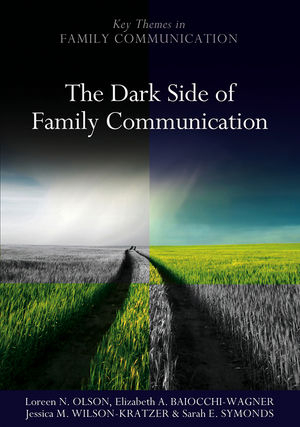
The Dark Side of Family Communication (eBook)
John Wiley & Sons (Verlag)
978-0-7456-8086-6 (ISBN)
Chapter topics include:
- an overview of the 'dark side' of family communication
- individual influences on the darkness of family communication
- the dark side of dyadic family life
- familial interaction structure and the dark side
- dark family communication in a context of darkness - socio-cultural influences on family life
- concluding reflections on the study of dark family communication
The Dark Side of Family Communication offers an integrative understanding of the dark side of family communication and a theoretical mechanism for understanding related scholarship. It will be essential reading for all students and scholars of family communication.
This text provides for the first time in book form an exploration of the communicative aspects of the darker side of family life, ranging from, for example, severe acts of violence to more subtle forms of conflict. In addition to offering a working definition of the concept of the "e;dark side"e; in the family context, the authors propose the Darkness Model of Family Communication that integrates relevant literature in new and significant ways. Researchers, teachers and advanced students alike will benefit from the holistic and theoretical approach to the topic advanced through this volume. Readers are also encouraged to process the material by reviewing discussion questions and the case study of the Moore family at the end of each chapter. Chapter topics include: an overview of the "e;dark side"e; of family communication individual influences on the darkness of family communication the dark side of dyadic family life familial interaction structure and the dark side dark family communication in a context of darkness - socio-cultural influences on family life concluding reflections on the study of dark family communication The Dark Side of Family Communication offers an integrative understanding of the dark side of family communication and a theoretical mechanism for understanding related scholarship. It will be essential reading for all students and scholars of family communication.
Loreen N. Olson is an Associate Professor of Communication Studies at the University of North Carolina-Greensboro. Elizabeth A. Baiocchi-Wagner is Visiting Assistant Professor at the University of Missouri-Columbia Jessica M. W. Kratzer is an Assistant Professor in the Department of Speech and Theatre at Middle Tennessee State University Sarah E. Symonds is a doctoral candidate at the University of Missouri-Columbia
List of Tables and Figures
Prologue
Chapter 1: Conceptualizing the "Dark Side" of Family Communication
Chapter 2: Individual Influence on the Darkness of Family Communication
Chapter 3: The Dark Side of Dyadic Family Life
Chapter 4: Familial Interaction Structure and the Dark Side
Chapter 5: Dark Family Communication in a Context of Darkness's Sociocultural Influences on Family Life
Chapter 6: Concluding Thoughts
Bibliography
Index
"In this volume Loreen N. Olson, Elizabeth A. Baiocchi-Wagner,
Jessica M. W. Kratzer, and Sarah E. Symonds shed much needed light
on the dark side of family communication. By unearthing the layers
of familial relating to reveal numerous caverns of darkness, they
generate new landscapes for students and scholars of the dark side
and family communication."
Erin Willer, University of Denver
"Much has been written on the 'dark side' of
communication. This is the first book actually to define what dark
communication is, explain how it forms, identify what effect it
has, recommend how to 'brighten it,' and tie all this
together in a Darkness Model of Family Communication."
Dudley Cahn, SUNY at New Paltz
Prologue
Vangelisti (2004) not ed that “the family is the crucible of society” (p. ix). As such, the family system is a key site where lives are formed, developed, and changed across time. For many, their lives are nurtured and sustained by their families, providing them with a source of security, comfort, and support. Unfortunately, however, many others may find that their family system is a site of much pain, suffering, stress, maltreatment, and perhaps even abuse. Statistics support such claims. For instance, the Family Violence Prevention Fund (2010) reports that more than fifteen million children in the United States live in families in which partner violence occurred at least once in the past year; and 61 percent of homeless girls and 19 percent of homeless boys reported experiencing sexual abuse prior to leaving home. Sadly, 93 percent of sexual assault and rape cases that occur in children under twelve are carried out by someone they know, and 34 percent of these cases by someone in the family (RAINN, 2010).
The communicative aspects of these darker sides of family life are the focus of our book entitled The Dark Side of Family Communication. According to Spitzberg and Cupach (1994), “the dark side metaphor is useful for understanding interpersonal relationships because it focuses on important, yet neglected, phenomena and helps to discern new and useful connections among concepts” (p. 315). Due in part to some authors’ (Duck, 1994; Spitzberg & Cupach, 1994) push for applying a darker lens to relationship studies, numerous scholars have answered the call, investigating areas such as teasing and bullying (Kowalski, 2007), jealousy and envy (Guerrero & Anderson, 1998a, 1998b), relational partner violence (Lloyd & Emery, 1999; Olson, 2002a, 2002b), and parent–child violence (Eckstein, 2004; Morgan & Wilson, 2007) –both in face-to-face relationships and in cyberspace (Whitty, 2007).
With what appears to be an unending string of dark topics, scholars intrigued with the dark side of relationships are rarely without subject matter. However, the plethora of potential research areas gives way to the problem of dark side boundary management. For instance, although most would agree that certain topics (e.g., family violence) would fall into a darker category, what about topics that blur dark and bright (e.g., a marriage strengthened by conflict)? What is the common denominator in all that is dark? Ironically, the “dark side of relationships” metaphor can be described best as a “gray” area. Scholars’ theorizing about the dark side of communication in interpersonal literature ranges from merely overlooked or obscured topic areas (e.g., Spitzberg & Cupach, 1994) to the sabotaging, spoiling, or quotidian hassles of relationships (Duck, 1994).
Narrowing the focus of the metaphor to one particular area of relationship study (e.g., the family) only exacerbates the problem. While many publications have focused on the broader domain of interpersonal and family relationships, to the best of our knowledge articulating a theoretical framework for understanding the dark side of family communication has yet to be undertaken. Of course, this is not to say that family communication scholars have been completely deterred from studying darker aspects of family life. Researchers have looked into various negativities in the family system, including sibling violence (Eriksen & Jensen, 2006), jealousy (Aune & Comstock, 2002), depression (Paolucci & Violato, 2004; Straus, 1996), child and elder abuse (Barnett, Miller-Perrin, & Perrin, 2005; Jacobson, Gottman, Waltz, Rushe, Babcock, & Holtzworth-Munroe, 1994), adolescent-to-parent abuse (Eckstein, 2004, 2007), critiques of “normal” family interaction (Stafford & Dainton, 1994), conflict and power struggles (Sillars, Canary, & Tafoya, 2004: Solomon, Knobloch, & Fitzpatrick, 2004) and spousal abuse (Olson, 2004; Stamp & Sabourin, 1995).
Yet, even with the diversity of scholarship, we arrive at where we began: how does one theorize –comprehensively –the dark side of communication within the family? Given the powerful influence of the family on one’s self, one’s familial relationships, and one’s non-familial relationships (Vangelisti, 2004), exploring this area in a way that highlights interconnections between macro-level and micro-level theorizing is merited. As we noted, communication scholars have conducted a good deal of research on the dark side of family communication, but have yet to weave together theoretical conceptualizations. Thus, a major goal of this book is to present a definition and perspective that articulate the systemic and specific factors associated with the dark side of family communication. In Chapter 6, we combine the material summarized in the earlier chapters into what we call the Darkness Model of Family Communication. We assert that the model will enhance the examination of family communication by (a) thoroughly examining the interdependent levels and factors involved in dark family communication, and (b) providing a unifying theoretical framework for family communication researchers and/or practitioners.
Specifically, this book discusses major research on the dark side of family communication organized in such a way as to elucidate the processes involved in the construction, processing, and effects of dark messages within the family system. The Dark Side of Family Communication integrates research and theories that explore the communicative “shades of darkness” within family systems and elucidates how a positivity/negativity dialectic (Duck, 1994; Spitzberg & Cupach, 1998) may be present in many, albeit not all, of these processes. For example, as noted by Stafford and Dainton (1994), “normal,” ordinary families experience darker interactions from time to time. Conversely, healthy interactions exist within dysfunctional or unhealthy families. In addition to reviewing research and theory on the more common dark familial processes (e.g., intimate violence, incest, and sibling violence), this text also relies on scholarship that illuminates how some dark interactions between family members may co-exist alongside positive ones or may function in both positive and negative ways. We also explore the darkness dynamic at a social level, examining more specifically, the role of religion, politics, and the media on the social construction and enactment of family life in the United States.
Each chapter of The Dark Side of Family Communication will include a narrative of a fictional family experiencing the dynamics explained in the chapter. The reader will be introduced to the Moore family in the first chapter and will read more about the members and their communication interactions in subsequent chapters. Each narrative entry will build upon the previous, paralleling the interlocking, interdependent nature of the material reviewed in the chapters. This unique feature is utilized to bring the theory and research alive for you, the reader. Finally, discussion questions at the end of each chapter are presented as a means of facilitating discussion and generating ideas for further consideration.
In closing, we think it is important to acknowledge that studying the dark side of family communication has the potential to stir emotions within us, to illicit thoughts and memories of interactions we wish to forget, or to judge others negatively for living in a dark family environment. In fact, the potential for such negativity may prompt one to ask how could we, as dark side scholars, dedicate our intellectual energies to the darker side of human life? Without a doubt, each of us has asked that question of ourselves at least once. Our response to this “why” question is, because it matters so much. Our families form the bedrock of our existence. As noted by Floyd and Mormon (2006), families “enjoy a level of permanence unparalleled by almost anything else in our lives . . . the family is situated at the focal point of nearly all relational encounters. It is, truly, a masterpiece of human experience” (p. xi). With family playing such a prominent role in our lives, we believe it is essential to understand it in its entirety –warts and all. We hope that you too will come to see the value in studying family foibles, anticipating that such knowledge can increase the likelihood of more family follies.
Like any true research project, this book could not have been completed without the assistance of family, friends, and colleagues, who have supported us through this adventure. As a group, the authors would like to thank: Wanjiru Mbure, an original author and contributor to the Darkness Model (described more fully in subsequent chapters); our editor (Andrea Drugan) and the staff of Polity books; and the scholars who are cited throughout the book whose research has made this project possible. We would also like to thank the anonymous reviewers of earlier versions of our Darkness Model and our book proposal, whose contributions we found of great assistance.
Finally, each author would like to thank individually those who supported us throughout this endeavor.
• I would like to extend a heartfelt thanks to my biggest fan and life partner, Mark Fine. His patience, combined with his own expertise in family studies, were qualities often tapped during the writing of this book. Thanks, too, to my forever babies,...
| Erscheint lt. Verlag | 22.1.2014 |
|---|---|
| Reihe/Serie | Key Themes in Family Communication |
| PKOS - Polity Key Themes in Family Communication series | PKOS - Polity Key Themes in Family Communication series |
| Sprache | englisch |
| Themenwelt | Naturwissenschaften |
| Sozialwissenschaften ► Kommunikation / Medien ► Allgemeines / Lexika | |
| Sozialwissenschaften ► Kommunikation / Medien ► Kommunikationswissenschaft | |
| Sozialwissenschaften ► Kommunikation / Medien ► Medienwissenschaft | |
| Sozialwissenschaften ► Politik / Verwaltung | |
| Sozialwissenschaften ► Soziologie ► Mikrosoziologie | |
| Technik ► Elektrotechnik / Energietechnik | |
| Schlagworte | Communication & Media Studies • Communication Studies • Communication theory • family, communication, conflict, interpersonal • Kommunikationstheorie • Kommunikationswissenschaft • Kommunikation u. Medienforschung |
| ISBN-10 | 0-7456-8086-0 / 0745680860 |
| ISBN-13 | 978-0-7456-8086-6 / 9780745680866 |
| Informationen gemäß Produktsicherheitsverordnung (GPSR) | |
| Haben Sie eine Frage zum Produkt? |
 EPUB (Adobe DRM)
Kopierschutz: Adobe-DRM
Adobe-DRM ist ein Kopierschutz, der das eBook vor Mißbrauch schützen soll. Dabei wird das eBook bereits beim Download auf Ihre persönliche Adobe-ID autorisiert. Lesen können Sie das eBook dann nur auf den Geräten, welche ebenfalls auf Ihre Adobe-ID registriert sind.
Details zum Adobe-DRM
Dateiformat: EPUB (Electronic Publication)
EPUB ist ein offener Standard für eBooks und eignet sich besonders zur Darstellung von Belletristik und Sachbüchern. Der Fließtext wird dynamisch an die Display- und Schriftgröße angepasst. Auch für mobile Lesegeräte ist EPUB daher gut geeignet.
Systemvoraussetzungen:
PC/Mac: Mit einem PC oder Mac können Sie dieses eBook lesen. Sie benötigen eine
eReader: Dieses eBook kann mit (fast) allen eBook-Readern gelesen werden. Mit dem amazon-Kindle ist es aber nicht kompatibel.
Smartphone/Tablet: Egal ob Apple oder Android, dieses eBook können Sie lesen. Sie benötigen eine
Geräteliste und zusätzliche Hinweise
Buying eBooks from abroad
For tax law reasons we can sell eBooks just within Germany and Switzerland. Regrettably we cannot fulfill eBook-orders from other countries.
aus dem Bereich