


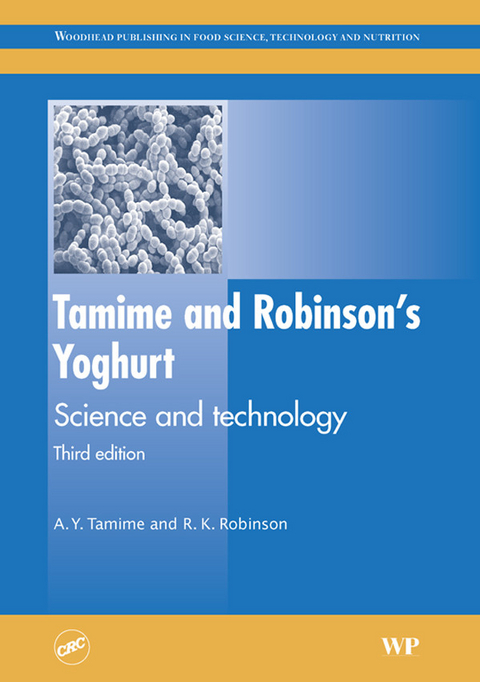
Tamime and Robinson's Yoghurt (eBook)
808 Seiten
Elsevier Science (Verlag)
978-1-84569-261-2 (ISBN)
A. Y. Tamime, formerly of the Scottish Agricultural College, is a internationally renowned scientist within the field of yoghurt quality and production.
Previous editions of Yoghurt: Science and Technology established the text as an essential reference underpinning the production of yoghurt of consistently high quality. The book has been completely revised and updated to produce this third edition, which combines coverage of recent developments in scientific understanding with information about established methods of best practice to achieve a comprehensive treatment of the subject. General acceptance of a more liberal definition by the dairy industry of the term yoghurt has also warranted coverage in the new edition of a larger variety of gelled or viscous fermented milk products, containing a wider range of cultures.Developments in the scientific aspects of yoghurt covered in this new edition include polysaccharide production by starter culture bacteria and its effects on gel structure, acid gel formation and advances in the analysis of yoghurt in terms of its chemistry, rheology and microbiology. Significant advances in technology are also outlined, for example automation and mechanisation. There has also been progress in understanding the nutritional profile of yoghurt and details of clinical trials involving yoghurts are described.This book is a unique and essential reference to students, researchers and manufacturers in the dairy industry. - Includes developments in the understanding of the biochemical changes involved in yoghurt production- Outlines significant technological advances in mechanisation and automation- Discusses the nutritional value of yoghurt
Background to manufacturing practice
2.1 Introduction
The process of yoghurt making is an ancient craft which dates back thousands of years and possibly even to the domestication of the cow, sheep or goat, but it is safe to assume that, prior to the nineteenth century, the various stages were little understood. The survival of the process through the ages can be attributed, therefore, to the fact that the scale of manufacture was relatively small, and hence the craft was handed down from parents to children. However, over the last few decades the process has become more rational, mainly due to various discoveries and/or improvements in such disciplines as:
• microbiology and enzymology;
• physics and engineering;
• chemistry and biochemistry.
Yet by today’s standards of industrial technology, the process of yoghurt making is still a complex process which combines both art and science.
The microorganisms of the yoghurt starter cultures play an important role during the production of yoghurt, for example, in the development of acid and flavour. Their classification, behaviour and characteristics are discussed in detail in Chapter 7. However, in order to understand the principles of yoghurt making, it will be useful to describe separately the various stages of manufacture and their consequent effects on the quality of yoghurt. The technology of the process, that is, the equipment required for small-and large-scale production, will be discussed in Chapter 3.
The traditional and the improved methods for the manufacture of yoghurt are illustrated in Fig. 2.1. It can be observed that the former process has several drawbacks:
• Successive inoculations of the starter culture tend to upset the ratio between Streptococcus thermophilus and Lactobacillus delbrueckii subsp. bulgaricus, or may lead to mutation beyond the 15–20th subculturing.
• The low incubation temperature, for example, ambient, results in slow acidification of the milk (18 h or more), compared with the optimum conditions of 40–45 °C for 12−3h.
• The slow rate of acid development may promote undesirable side effects, for example, whey syneresis, which can adversely affect the quality of yoghurt.
• The traditional process provides no control over the level of lactic acid produced during the fermentation stage.
Nevertheless, despite these drawbacks it is obvious that the traditional process has laid the basic foundation for the production of yoghurt as practised in the industry at the present time (see Fig. 2.1). In reality, the basic changes depend on the following:
• The purity of the yoghurt starter cultures which can be obtained from commercial starter manufacturers, starter banks or research establishments.
• The ability of dairies to propagate these cultures in sterile milk under aseptic conditions, so giving rise to active reliable starters. However, at present direct-to-vat inoculation (DVI; alternatively, it is known as direct-to-vat set - DVS) of the starter culture is widely used.
• The temperature of incubation can be accurately controlled, so that the rate of acid development and the processing time is known in advance.
• The cooling of the yoghurt can be carried out quickly at the desired level of acidity, and the quality of yoghurt is more uniform.
• The development of easy methods for measuring the rate of acid development in milk (using pH meters and/or acidimeters) enables even a semi-skilled operator to control the process adequately.
2.2 Preliminary treatment of the milk base
The chemical composition of milk is mainly water, but it also contains a complex mixture of components such as proteins, carbohydrate, fats, minerals and vitamins which are the main source of food for the young mammal. The characteristics of each chemical component have been discussed elsewhere in detail and the reader is referred to some reviews for a more complete discussion (Jakob, 1994; Pearce, 1995; Swaisgood, 1996; Fox, 1997; Fox and McSweeney, 2003, 2006; Farrell et al.,2004).
2.2.1 Milk as a raw material
Milks of different species of mammals have been used for the production of yoghurt, and Table 2.1 illustrates the major differences in the chemical composition of these milks. As a result, variations in the quality of yoghurt do occur, depending on the type of milk used. For example, milk containing a high percentage of fat (sheep, buffalo and reindeer) produces a rich and creamy yoghurt with an excellent ‘mouthfeel’ compared with yoghurt manufactured from milk containing a low level of fat, or milk deprived of its fat content, for example skimmed milk. The lactose in milk provides the energy source for the yoghurt starter organisms, but the protein plays an important role in the formation of the coagulum and hence the consistency/viscosity of the product is directly proportional to the level of protein present; yoghurt produced from unfortified mare’s and ass’s milk would be less viscous than yoghurt made from sheep’s or reindeer’s milk. Although the flavour of yoghurt is mainly the result of complex biochemical reactions initiated by microbial activity, the flavour of the milk base varies from species to species and this characteristic is reflected in the end product.
Table 2.1
Chemical composition (g 100 g–1) of milk of different species of mammals
| Ass | 89.0 | 2.5 | 2.0 | 6.0 | 0.5 |
| Buffalo | 82.1 | 8.0 | 4.2 | 4.9 | 0.8 |
| Camel | 87.1 | 4.2 | 3.7 | 4.1 | 0.9 |
| Cow | 87.4 | 3.9 | 3.3 | 4.7 | 0.7 |
| Goat | 87.0 | 4.5 | 3.3 | 4.6 | 0.6 |
| Horse | 88.8 | 1.9 | 2.6 | 6.2 | 0.5 |
| Reindeer | 63.3 | 22.5 | 10.3 | 2.5 | 1.4 |
| Sheep | 81.6 | 7.5 | 5.6 | 4.4 | 0.9 |
| Yak | 82.7 | 6.5 | 5.3 | 4.6 | 0.9 |
| Zebu | 86.5 | 4.8 | 3.3 | 4.7 | 0.7 |
Adapted from Lentner (1981), Jenness (1988) and Holland et al. (1991).
Since cow’s milk is widely available in most countries around the world, the emphasis will be on the use of this type of milk for the manufacture of yoghurt, although even when considering cow’s milk, there are quite large differences in composition (Table 2.2). The major constituents of milk are: water, fat, protein, lactose and minerals (ash), and a detailed breakdown of these components is shown in Fig. 2.2.
Table 2.2
Commercial (average expected) composition of cow’s milk (g 100 g–1) from different breeds
| Ayrshire | 3.85 | 3.35 | 4.95 | 0.69 |
| Friesian | 3.40 | 3.15 | 4.60 | 0.73 |
| Guernsey | 4.90 | 3.85 | 4.95 | 0.75 |
| Jersey | 5.14 | 3.80 | 5.00 | 0.75 |
| Shorthorn | 3.65 | 3.30 | 4.80 | 0.69 |
After Scott (1986) and Robinson and Wilbey (1998).
Reproduced by permission of Elsevier Applied Science Publishers.
Inevitably, the chemical composition of fresh milk varies over time within any particular breed depending on such factors as stage of lactation and age of the cow, milking intervals, season of the year and environmental temperature, breed of cows and breeding policy, efficiency of milking, intervals...
| Erscheint lt. Verlag | 22.3.2007 |
|---|---|
| Sprache | englisch |
| Themenwelt | Technik ► Lebensmitteltechnologie |
| ISBN-10 | 1-84569-261-6 / 1845692616 |
| ISBN-13 | 978-1-84569-261-2 / 9781845692612 |
| Informationen gemäß Produktsicherheitsverordnung (GPSR) | |
| Haben Sie eine Frage zum Produkt? |
 EPUB (Adobe DRM)
Kopierschutz: Adobe-DRM
Adobe-DRM ist ein Kopierschutz, der das eBook vor Mißbrauch schützen soll. Dabei wird das eBook bereits beim Download auf Ihre persönliche Adobe-ID autorisiert. Lesen können Sie das eBook dann nur auf den Geräten, welche ebenfalls auf Ihre Adobe-ID registriert sind.
Details zum Adobe-DRM
Dateiformat: EPUB (Electronic Publication)
EPUB ist ein offener Standard für eBooks und eignet sich besonders zur Darstellung von Belletristik und Sachbüchern. Der Fließtext wird dynamisch an die Display- und Schriftgröße angepasst. Auch für mobile Lesegeräte ist EPUB daher gut geeignet.
Systemvoraussetzungen:
PC/Mac: Mit einem PC oder Mac können Sie dieses eBook lesen. Sie benötigen eine
eReader: Dieses eBook kann mit (fast) allen eBook-Readern gelesen werden. Mit dem amazon-Kindle ist es aber nicht kompatibel.
Smartphone/Tablet: Egal ob Apple oder Android, dieses eBook können Sie lesen. Sie benötigen eine
Geräteliste und zusätzliche Hinweise
Buying eBooks from abroad
For tax law reasons we can sell eBooks just within Germany and Switzerland. Regrettably we cannot fulfill eBook-orders from other countries.
aus dem Bereich


