


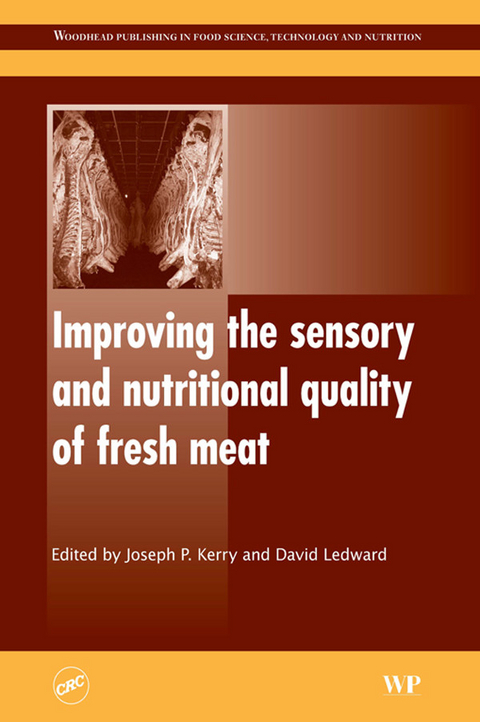
Improving the Sensory and Nutritional Quality of Fresh Meat (eBook)
680 Seiten
Elsevier Science (Verlag)
9781845695439 (ISBN)
Understanding of the scientific basis of quality attributes in meat is becoming more advanced, providing more effective approaches to the control of meat eating and technological quality. This important collection reviews essential knowledge of the mechanisms underlying quality characteristics and methods to improve meat sensory and nutritional quality.Part one analyses the scientific basis of meat quality attributes, such as texture and tenderness, colour, water-holding capacity and flavour development. Chapters on the nutritional quality of meat and meat sensory evaluation complete the section. Part two discusses significant insights into the biology of meat quality obtained from genomic and proteomic perspectives, with chapters focussing on different types of meat. Parts three and four then review production and processing strategies to optimise meat quality, considering aspects such as production practices and meat nutritional quality, dietary antioxidants and antimicrobials, carcass interventions, chilling and freezing and packaging. Methods of meat grading and quality analysis are also included.With its distinguished editors and international team of contributors, Improving the sensory and nutritional quality of fresh meat is a standard reference for those industrialists and academics interested in optimising meat quality. - Reviews methods to improve meat sensory and nutritional quality considering the effects of different production practices such as chilling, freezing and packaging- Analyses the scientific basis of meat quality attributes covering texture, tenderness, colour and water-holding capacity- Examines production and processing strategies to optimise meat quality, including the current state of development and future potential
Contributor contact details
(* = main contact)
Editors
Dr J.P. Kerry, joe.kerry@ucc.ie Department of Food and Nutritional Sciences, University College Cork, Ireland
Professor Emeritus D.A. Ledward, Ledwarddav@aol.com University of Reading, UK
Dr M.D. Aaslyng, mas@danishmeat.dk Danish Meat Research Institute, Maglegårdsvej 2, DK-4000, Roskilde, Denmark
Dr P.L. Greenwood*, paul.greenwood@dpi.nsw.gov.au NSW Department of Primary Industries, Beef Industry Centre of Excellence, University of New England, Armidale, NSW 2351, Australia
Professor F.R. Dunshea, fdunshea@unimelb.edu.au Department of Agriculture and Food Systems, Graduate School of Land and Environment, University of Melbourne, Parkville, VIC 3052, Australia
D.A. King*, andy.king@ars.usda.gov; T.L. Wheeler; S.D. Shackelford; Dr M. Koohmaraie, koohmaraie@email.marc.usda.gov USDA-ARS, US Meat Animal Research Center, PO Box 166, Clay Center, NE, USA
Assistant Professor R.A. Mancini, richard.mancini@uconn.edu University of Connecticut, Dept.of Animal Science, Storrs, CT 06269, USA
Dr J. Stephen Elmore*, J.S.Elmore@reading.ac.uk; Professor Donald S. Mottram Department of Food Biosciences, University of Reading, Whiteknights, Reading, RG6 6AP, UK
Professor E. Huff-Lonergan, ELONERGA@IASTATE.EDU Professor of Animal Science, Iowa State University, 2372 Kildee Hall, Ames, IA 50011–3150, USA
Professor H.K. Biesalski*, biesal@uni-hohenheim.de; Professor D. Nohr, nohr@uni-hohenheim.de Department of Biological Chemistry and Nutrition, University of Hohenheim, Garbenstrasse 30, 70593 Stuttgart, Germany
M.G. O’Sullivan*, maurice.osullivan@ucc.ie; Dr J.P. Kerry Department of Food and Nutritional Sciences, University College Cork, Ireland
Dr Anne Maria Mullen*, anne.mullen@teagasc.ie; Dr Liselotte Pannier; Dr Ruth Hamill Meat Technology Department, Ashtown Food Research Centre, Teagasc, Ashtown, Dublin 15, Ireland
Dr M.T. Cairns, michael.cairns@nuigalway.ie National Centre for Biomedical Engineering Science/Martin Ryan Institute (NCBES/MRI), University Road, NUI Galway, Ireland
Professor S.C. Bishop*, Stephen.Bishop@Roslin.ed.ac.uk; E. Karamichou The Roslin Institute and R(D)SVS, University of Edinburgh, Midlothian EH25 9PS, UK
Professor G. Simm*, Geoff.Simm@sac.ac.uk; N. Lambe, Nicola.Lambe@sac.ac.uk; L. Bünger; E. Navajas; R. Roehe Sustainable Livestock Systems Group, Scottish Agricultural College (SAC), Sir Stephen Watson Building, Bush Estate, Penicuik, EH26 0PH, UK
Dr W. Barendse, Bill.Barendse@csiro.au CSIRO Livestock Industries, Queensland Bioscience Precinct, 306 Carmody Road, St.Lucia 4067, Queensland, Australia
Dr K. Nuernberg, knuernbg@fbn-dummerstorf.de Research Institute for the Biology of Farm Animals, Wilhelm-Stahl-Allee 2, D-18196 Dummerstorf, Germany
J. Mourot, jacques.mourot@rennes.inra.fr INRA, UMR 1079 Systèmes d’Elevage Nutrition Animale et Humaine, F-35590 Saint Gilles, France
Dr M.N. O’Grady*, Michael.OGrady@ucc.ie; Dr J.P. Kerry Department of Food and Nutritional Sciences, University College Cork, Cork, Ireland
Dr A. Braghieri*, ada.braghieri@unibas.it; Professor F. Napolitano, fabio.napolitano@unibas.it Dipartimento di Scienze delle Produzioni Animali – Università degli Studi della Basilicata, Viale dell’Ateneo Lucano 10, 85100 Potenza, Italy
K.W. McMillin School of Animal Sciences, Louisiana State University, Agricultural Center, Francioni Hall, Baton Rouge, Louisiana 70803-4210, USA
Dr L.C. Hoffman*, lch@maties.sun.ac.za Department of Animal Sciences, Stellenbosch University, PO Box X1, Matieland, 7602, South Africa
Dr L.C. Hoffman*, lch@maties.sun.ac.za Department of Animal Sciences, Stellenbosch University, PO Box X1, Matieland, 7602, South Africa
K.W. McMillin School of Animal Sciences, Louisiana State University Agricultural Center, Francioni Hall, Baton Rouge, Louisiana 70803–4210, USA
Dr Paul Allen, paul.allen@teagasc.ie Ashtown Food Research Centre, Teagasc, Ashtown, Dublin 15, Ireland
Dr C. Pomar*, pomarc@agr.gc.ca; M. Marcoux Dairy and Swine Research and Development Centre, Agriculture and Agri-Food Canada, Sherbrooke, Québec, Canada, J1M 1Z3
M. Gispert; M. Font i Furnols IRTA, Finca Camps i Armet, 17121 Monells, Spain
G. Daumas IFIP Institut du Porc, La Motte au Vicomte, BP 35104, 35651 Le Rheu Cedex, France
Vegard H. Segtnan*, vegard.segtnan@nofima.no; Dr Kjell Ivar Hildrum, kjell.ivar.hildrum@nofima.no; Jens Petter Wold, jens.petter.wold@nofima.no Nofima Food, Matforsk AS, N-1430 Ås, Osloveien 1, Norway
Dr S.J. James*, steve.james@bristol.ac.uk; Dr C. James, chris.james@bristol.ac.uk Food Refrigeration & Process Engineering Research Centre (FRPERC), University of Bristol, Churchill Building, Langford, Somerset, BS40 5DU, UK
Dr M.M. Farouk*, mustafa.farouk@agresearch.co.nz; Dr E. Wiklund; Dr K. Rosenvold AgResearch MIRINZ, East Street, Private Bag 3123, Hamilton 3240, New Zealand
M.G. O’Sullivan*, maurice.osullivan@ucc.ie; Dr J.P. Kerry Department of Food and Nutritional Sciences, University College Cork, Ireland
Professor C.R. Calkins*, ccaLkins1@unl.edu University of Nebraska, Department of Animal Science, A213 AnS, Box 830908, Lincoln, NE 68583-0908, USA
Dr D.D. Johnson, dwainj@unl.edu
University of Florida, Department of Animal Science, PO Box 110910, Gainesville, FL 32611
USA
Professor J. Hartung*,...
| Erscheint lt. Verlag | 22.1.2009 |
|---|---|
| Sprache | englisch |
| Themenwelt | Technik ► Lebensmitteltechnologie |
| ISBN-13 | 9781845695439 / 9781845695439 |
| Informationen gemäß Produktsicherheitsverordnung (GPSR) | |
| Haben Sie eine Frage zum Produkt? |
 EPUB (Adobe DRM)
Kopierschutz: Adobe-DRM
Adobe-DRM ist ein Kopierschutz, der das eBook vor Mißbrauch schützen soll. Dabei wird das eBook bereits beim Download auf Ihre persönliche Adobe-ID autorisiert. Lesen können Sie das eBook dann nur auf den Geräten, welche ebenfalls auf Ihre Adobe-ID registriert sind.
Details zum Adobe-DRM
Dateiformat: EPUB (Electronic Publication)
EPUB ist ein offener Standard für eBooks und eignet sich besonders zur Darstellung von Belletristik und Sachbüchern. Der Fließtext wird dynamisch an die Display- und Schriftgröße angepasst. Auch für mobile Lesegeräte ist EPUB daher gut geeignet.
Systemvoraussetzungen:
PC/Mac: Mit einem PC oder Mac können Sie dieses eBook lesen. Sie benötigen eine
eReader: Dieses eBook kann mit (fast) allen eBook-Readern gelesen werden. Mit dem amazon-Kindle ist es aber nicht kompatibel.
Smartphone/Tablet: Egal ob Apple oder Android, dieses eBook können Sie lesen. Sie benötigen eine
Geräteliste und zusätzliche Hinweise
Buying eBooks from abroad
For tax law reasons we can sell eBooks just within Germany and Switzerland. Regrettably we cannot fulfill eBook-orders from other countries.
aus dem Bereich


