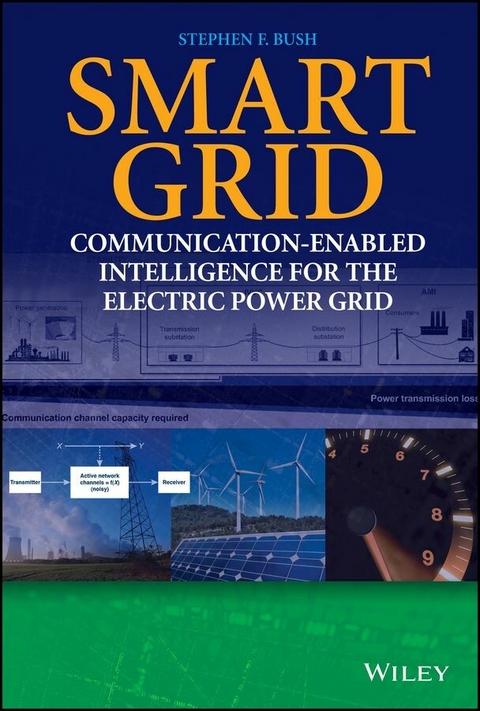
Smart Grid (eBook)
Written by an expert with vast experience in the field, this book explores the smart grid from generation to consumption, both as it is planned today and how it will evolve tomorrow. The book focuses upon what differentiates the smart grid from the 'traditional' power grid as it has been known for the last century. Furthermore, the author provides the reader with a fundamental understanding of both power systems and communication networking. It shows the complexity and operational requirements of the evolving power grid, the so-called 'smart grid,' to the communication networking engineer; and similarly, it shows the complexity and operational requirements for communications to the power systems engineer.
The book is divided into three parts. Part One discusses the basic operation of the electric power grid, covering fundamental knowledge that is assumed in Parts Two and Three. Part Two introduces communications and networking, which are critical enablers for the smart grid. It also considers how communication and networking will evolve as technology develops. This lays the foundation for Part Three, which utilizes communication within the power grid. Part Three draws heavily upon both the embedded intelligence within the power grid and current research, anticipating how and where computational intelligence will be implemented within the smart grid. Each part is divided into chapters and each chapter has a set of questions useful for exercising the readers' understanding of the material in that chapter.
Key Features:
- Bridges the gap between power systems and communications experts
- Addresses the smart grid from generation to consumption, both as it is planned today and how it will likely evolve tomorrow
- Explores the smart grid from the perspective of traditional power systems as well as from communications
- Discusses power systems, communications, and machine learning that all define the smart grid
- It introduces the new field of power system information theory
Dr Stephen F. Bush, General Electric Global Research, USA
Stephen received the B.S. degree in electrical and computer engineering from Carnegie Mellon University, Pittsburgh, PA, the M.S. degree in computer science from Cleveland State University, Cleveland, OH, and the Ph.D. degree from the University of Kansas, Lawrence. He is currently a Researcher at General Electric Global Research, Niskayuna, NY. Before joining GE Global Research, he was a Researcher at the Information and Telecommunications Technologies Center (ITTC), University of Kansas. He has been the Principal Investigator for many DARPA and Lockheed Martin sponsored research projects including: Active Networking (DARPA/ITO), Information Assurance and Survivability Engineering Tools (DARPA/ISO), Fault Tolerant Networking (DARPA/ATO), and most recently, Connectionless Networks (DARPA/ATO), an energy aware sensor network project.
This book bridges the divide between the fields of power systems engineering and computer communication through the new field of power system information theory. Written by an expert with vast experience in the field, this book explores the smart grid from generation to consumption, both as it is planned today and how it will evolve tomorrow. The book focuses upon what differentiates the smart grid from the "e;traditional"e; power grid as it has been known for the last century. Furthermore, the author provides the reader with a fundamental understanding of both power systems and communication networking. It shows the complexity and operational requirements of the evolving power grid, the so-called "e;smart grid,"e; to the communication networking engineer; and similarly, it shows the complexity and operational requirements for communications to the power systems engineer. The book is divided into three parts. Part One discusses the basic operation of the electric power grid, covering fundamental knowledge that is assumed in Parts Two and Three. Part Two introduces communications and networking, which are critical enablers for the smart grid. It also considers how communication and networking will evolve as technology develops. This lays the foundation for Part Three, which utilizes communication within the power grid. Part Three draws heavily upon both the embedded intelligence within the power grid and current research, anticipating how and where computational intelligence will be implemented within the smart grid. Each part is divided into chapters and each chapter has a set of questions useful for exercising the readers' understanding of the material in that chapter. Key Features: Bridges the gap between power systems and communications experts Addresses the smart grid from generation to consumption, both as it is planned today and how it will likely evolve tomorrow Explores the smart grid from the perspective of traditional power systems as well as from communications Discusses power systems, communications, and machine learning that all define the smart grid It introduces the new field of power system information theory
Dr Stephen F. Bush, General Electric Global Research, USA Stephen received the B.S. degree in electrical and computer engineering from Carnegie Mellon University, Pittsburgh, PA, the M.S. degree in computer science from Cleveland State University, Cleveland, OH, and the Ph.D. degree from the University of Kansas, Lawrence. He is currently a Researcher at General Electric Global Research, Niskayuna, NY. Before joining GE Global Research, he was a Researcher at the Information and Telecommunications Technologies Center (ITTC), University of Kansas. He has been the Principal Investigator for many DARPA and Lockheed Martin sponsored research projects including: Active Networking (DARPA/ITO), Information Assurance and Survivability Engineering Tools (DARPA/ISO), Fault Tolerant Networking (DARPA/ATO), and most recently, Connectionless Networks (DARPA/ATO), an energy aware sensor network project.
Acronyms
| 6LoWPAN | IPv6 over low-power wireless personal area networks |
| ACE | area control error |
| ACFFI | average communication failure frequency index |
| ACIDI | average communication interruption duration index |
| ACK | acknowledgment |
| ACO | ant colony optimization |
| ACSE | association control service element |
| ACSR | aluminum conductor steel-reinforced cable |
| ADA | advanced distribution automation |
| ADI | advanced distribution infrastructure |
| ADP | adaptive dynamic programming |
| AGC | automatic grid control |
| AHP | analytical hierarchical programming |
| AIEE | American Institute of Electrical Engineers |
| AMI | advanced metering infrastructure |
| AMR | automated meter reading |
| ANSI | American National Standards Institute |
| AODV | ad hoc on-demand distance-vector |
| APDU | application protocol data unit |
| API | application program interface |
| ARQ | automatic repeat-request |
| ASCII | American Standard Code for Information Interchange |
| ASK | amplitude-shift keying |
| ASN.1 | abstract syntax notation 1 |
| ATM | asynchronous transfer mode |
| BAN | body-area network |
| BAS | building automation system |
| BCS | Bardeen–Cooper–Schrieffer |
| BE | best-effort |
| BFSK | binary frequency-shift keying |
| BMC | best master clock |
| BPL | broadband over power line |
| BPSK | binary phase-shift keying |
| BS | base station |
| CA | contingency analysis |
| CAES | compressed air energy storage |
| CAIDI | customer average interruption duration index |
| CAIFI | customer average interruption frequency index |
| CAN | controller-area network |
| CBR | constant-bit rate |
| CC | control center |
| CCITT | Comité Consultatif International Téléphonique et Télégraphique (International Telegraph and Telephone Consultative Committee) |
| CID | connection identifier |
| CIGRE | Conseil International des Grands Reseaux Electriques (International Council on Large Electric Systems) |
| CIM | common information model |
| ComSoc | IEEE Communications Society |
| COSEM | companion specification for energy metering |
| CRC | cyclic redundancy checksum |
| CSM | common signaling mode |
| CSMA | carrier-sense multiple-access |
| CSMA-CA | carrier-sense multiple-access with collision avoidance |
| CSMA-CD | carrier-sense multiple-access with collision detection |
| CT | current transformer |
| CTAIDI | customer total average interruption duration index |
| CVR | conservation voltage reduction |
| CVT | constant voltage transformer |
| DA | distribution automation |
| DAG | directed acyclic graph |
| DAU | data aggregation unit |
| DCF | distribution coordination function |
| DCT | discrete cosine transform |
| DESS | distribution energy storage system |
| DG | distributed generation |
| DHP | dual heuristic programming dielectric |
| DIO | DODAG information object |
| DLMS | device language message specification |
| DMI | distribution management infrastructure |
| DMS | distribution management system |
| DNP | distributed network protocol |
| DNP3 | distributed network protocol 3 |
| DODAG | destination-oriented directed acyclic graph |
| DR | demand-response |
| DSL | digital subscriber line |
| DSM | demand-side management |
| DSP | digital signal processor |
| DSSS | direct-sequence spread-spectrum |
| DVR | dynamic voltage restorer |
| EDFA | erbium-doped fiber-optic amplifier |
| EHV | extra-high voltage |
| EIA | United States Energy Information Agency |
| EMC | electromagnetic compatibility |
| EMF | electromotive force |
| EMS | energy management system |
| ENS-C | energy not served due to communication failure |
| EPRI | Electric Power Research Institute |
| EPS | electric power system |
| ertPS | extended-real-time-polling service |
| ESI | energy services interface |
| ETSI | European Telecommunications Standards Institute |
| EPSEM | extended protocol specification for electronic metering |
| FACTS | flexible alternating current transmission system |
| FAN | field-area network |
| FCL | fault current limiter |
| FCS | frame check sequence |
| FDIR | fault detection, isolation, and restoration |
| FDM | frequency-division multiplexing |
| FERC | Federal Energy Regulatory Commission |
| FET | field-effect transistor |
| FFD | full function device |
| FFT | fast Fourier transform |
| FHSS | frequency-hopping spread-spectrum |
| FN | false-negative isolated fault segment vector |
| FSK | frequency-shift keying |
| GenCo | generating company |
| GFCI | ground-fault circuit interrupter |
| GIC | geomagnetically induced current |
| GIS | geographic information system |
| GOOSE | generic object-oriented substation events |
| GPS | global positioning system |
| HAN | home-area network |
| HART | highway addressable remote transducer |
| HDP | heuristic dynamic programming |
| HEMP | high-altitude electromagnetic pulse |
| HMAC | keyed-hash message authentication code |
| HTS | high-temperature superconductor |
| HTS-ISM | high-temperature superconducting induction-synchronous machine |
| HVDC | high-voltage direct-current |
| IAE | integral absolute error |
| ICCP | inter-control center communications protocol |
| ICT | information and communications technology |
| IE | information element |
| IEC | International Electrotechnical... |
| Erscheint lt. Verlag | 13.1.2014 |
|---|---|
| Reihe/Serie | IEEE Press |
| Wiley - IEEE | Wiley - IEEE |
| Sprache | englisch |
| Themenwelt | Technik ► Elektrotechnik / Energietechnik |
| Technik ► Nachrichtentechnik | |
| Schlagworte | Book • book focuses • Communication • Communication technology • Computer Science • consumption • divide • Electrical & Electronics Engineering • Elektrotechnik u. Elektronik • Energie • Energietechnik • Energy • Engineering • Expert • Field • Fields • Generation • GRID • Informatik • known • Kommunikationstechnik • New • Parallel and Distributed Computing • Paralleles u. Verteiltes Rechnen • Planned • Power • Power Systems • Reader • Smart • Smart Grid • Today • Tomorrow • Traditional • vast experience |
| ISBN-10 | 1-118-82024-X / 111882024X |
| ISBN-13 | 978-1-118-82024-7 / 9781118820247 |
| Informationen gemäß Produktsicherheitsverordnung (GPSR) | |
| Haben Sie eine Frage zum Produkt? |
 EPUB (Adobe DRM)
Kopierschutz: Adobe-DRM
Adobe-DRM ist ein Kopierschutz, der das eBook vor Mißbrauch schützen soll. Dabei wird das eBook bereits beim Download auf Ihre persönliche Adobe-ID autorisiert. Lesen können Sie das eBook dann nur auf den Geräten, welche ebenfalls auf Ihre Adobe-ID registriert sind.
Details zum Adobe-DRM
Dateiformat: EPUB (Electronic Publication)
EPUB ist ein offener Standard für eBooks und eignet sich besonders zur Darstellung von Belletristik und Sachbüchern. Der Fließtext wird dynamisch an die Display- und Schriftgröße angepasst. Auch für mobile Lesegeräte ist EPUB daher gut geeignet.
Systemvoraussetzungen:
PC/Mac: Mit einem PC oder Mac können Sie dieses eBook lesen. Sie benötigen eine
eReader: Dieses eBook kann mit (fast) allen eBook-Readern gelesen werden. Mit dem amazon-Kindle ist es aber nicht kompatibel.
Smartphone/Tablet: Egal ob Apple oder Android, dieses eBook können Sie lesen. Sie benötigen eine
Geräteliste und zusätzliche Hinweise
Buying eBooks from abroad
For tax law reasons we can sell eBooks just within Germany and Switzerland. Regrettably we cannot fulfill eBook-orders from other countries.
aus dem Bereich