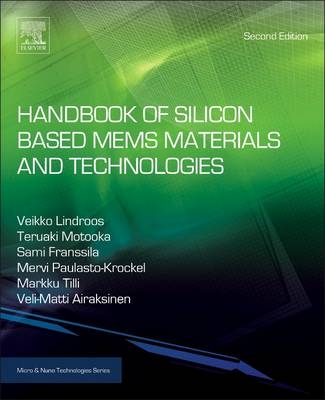
Handbook of Silicon Based MEMS Materials and Technologies
William Andrew Publishing (Verlag)
9780323299657 (ISBN)
- Titel erscheint in neuer Auflage
- Artikel merken
The book explains the fundamentals, properties (mechanical, electrostatic, optical, etc.), materials selection, preparation, manufacturing, processing, system integration, measurement, and materials characterization techniques, sensors, and multi-scale modeling methods of MEMS structures, silicon crystals, and wafers, also covering micromachining technologies in MEMS and encapsulation of MEMS components.
Furthermore, it provides vital packaging technologies and process knowledge for silicon direct bonding, anodic bonding, glass frit bonding, and related techniques, shows how to protect devices from the environment, and provides tactics to decrease package size for a dramatic reduction in costs.
Markku Tilli obtained a degree in Materials Science (Physical Metallurgy) at Helsinki University of Technology (HUT) in 1974. Until 1980 he had various research and teaching positions at HUT specializing in crystal growth technologies. From 1981 to 1984 he managed process research and development in Silicon project at HUT silicon wafer manufacturing pilot plant. Since 1985 he has had various managing positions at Okmetic in research, development and customer support areas, and held a position of Senior Vice President, Research until his retirement in 2018. His MEMS related activities started in 1982 when he developed a process to make double side polished silicon wafers for bulk micromachined sensors. Since then he has developed advanced new silicon wafer types for MEMS, including special epitaxial wafers, SOI and SOI wafers with buried cavities. His publication topics include oxygen precipitation in silicon, silicon crystal growth, wafer cleaning as well as silicon wafer manufacturing technologies and applications in MEMS. He is member of the Technology Academy of Finland and has received the honorary degree of Doctor of Science in Engineering from Aalto University. Dr. Mervi Paulasto-Kröckel is professor at Aalto University School of Electrical Engineering in Finland. She studied materials science and semiconductor technology in Helsinki University of Technology, and gradudated as MSc Tech in 1990. She continued her studies in the Technical Universities of Aachen (RWTH Aachen) and Helsinki and attained her doctoral degree in 1995. After a 2-years post-doctoral appointment at the Joint Research Centre of European Commission in the Netherlands, her professional career continued in the electronics industry. She was a Staff Principal Engineer at Motorola Semiconductor Products Sector in Munich. In 2004 Paulasto-Kröckel joined Infineon Technologies where she was the Director Package Development responsible for semiconductor assembly and interconnect development for automotive products worldwide. At the end of 2018 Dr. Paulasto-Kröckel became a professor at Helsinki University of Technology, which is now called Aalto University after a merger with two other leading universities in the Helsinki area. Her current research focus is on advanced materials and interconnect technologies for MEMS/NEMS and power electronics, as well as multi-material assemblies behavior under different loads and their characteristic failure mechanisms. Her group has extensive experience in studying interactions and interfacial reactions between dissimilar materials, such as different oxide and nitride materials, metals and semiconductors. The group has developed a combined methodology approach to solve multi-materials compatibility issues in microelectronics and microsystems. Prof. Paulasto-Kröckel has over 110 international publications in the fields of microelectronics packaging and interfacial compatibility of dissimilar materials. She is IEEE EPS Distinguished Lecturer and a member of the Finnish Academy of Technical Sciences. Teruaki Motooka received PhD degree in 1981 in Applied Physics from Kyushu University. He was a research scientist in the Central Research Laboratory, Hitachi Ltd. for 1971-1984, a visiting research assistant professor at University of Illinois at Urbana-Champaign, USA for 1984-1988, an associate professor in the Institute of Applied Physics at University of Tsukuba, Japan for 1988-1993, and became a full professor at Kyushu University in 1993. He retired from Kyushu University in 2010. He has published more than 150 scientific papers on various international journals and these papers have been cited more than 2000 times. Veikko Lindroos is Professor Emeritus, Physical Metallurgy and Materials Science, Aalto University, Finland. His research covers a broad spectrum of materials science and technology, such as metallic materials, silicon technology and MEMS materials magnetic, electronic and composite materials as well as shape memory effect and materials.
Impact of Silicon MEMS
Section I: Silicon as MEMS Material
1. Properties of Silicon
2. Czochralski Growth of SiliconCrystals
3. Properties of Silicon Crystals
4. Silicon Wafers: Preparation and Properties
5. Epi Wafers: Preparation and Properties
6. Thin Films on Silicon
6.1 Thin films on Silicon: Silicon dioxide
6.2 Thin films on Silicon: Silicon nitride
6.3 Thin Films on Silicon: Poly-Si and SiGe
6.4 Thin films on Silicon: AlD
6.5 Thin Films on Silicon: Piezofilms
6.6 Thin Films on Silicon: Metal films
7. Thick-Film SOI Wafers: Preparation and Properties
Section II: Modeling in MEMS
8. Multiscale Modeling Methods
9. Mechanical Properties of Silicon Microstuctures
10. Electrostatic and RF-properties of MEMS Structures
11. Optical Modeling of MEMS
12. Simulations of Etching Processes for MEMS Fabrication
13. Gas Damping in Vibrating MEMS Structures
Section III: Measuring MEMS
14. Introduction to Measuring MEMS
15. Silicon Wafer and Thin Film Measurements
16. Optical Measurement of Static and Dynamic Displacement in MEMS
17. MEMS Residual Stress Characterization: Methodology and Perspective
18. Strength of Bonded Interfaces
19. Oxygen and Bulk Microdefects in Silicon
Section IV: Micromachining Technologies in MEMS
20. MEMS Lithography
21. Deep Reactive Ion Etching
22. Wet Etching of Silicon
23. Porous Silicon Based MEMS
24. Surface Micromachining
25. Vapour Phase Etch Processes for Silicon MEMS
26. 2 3-D Printing for MEMS
27. Microfluidics and Biomems in Silicon
Section V: Encapsulation of MEMS Components
28. Introduction to encapsulation of MEMS
29. Silicon Direct Bonding
30. Anodic Bonding
31. Glass Frit Bonding
32. Metallic Alloy Seal Bonding
33. Bonding of CMOS Processed Wafers
34. Wafer Bonding: Tools and Processes
35. Encapsulation by Film Deposition
36. Dicing of MEMS Devices
37. 3D Integration of MEMS
38. Via Technologies for MEMS
39. Outgassing and Gettering
40. Hermeticity Tests
41. MEMS Reliability
42. Appendix 1: Common Abbreviations and Acronyms
43. Appendix 2: Nanoindentation Characterization of Silicon and other MEMS Materials
| Reihe/Serie | Micro & Nano Technologies |
|---|---|
| Verlagsort | Norwich |
| Sprache | englisch |
| Maße | 216 x 276 mm |
| Gewicht | 2420 g |
| Themenwelt | Technik ► Elektrotechnik / Energietechnik |
| Technik ► Maschinenbau | |
| ISBN-13 | 9780323299657 / 9780323299657 |
| Zustand | Neuware |
| Informationen gemäß Produktsicherheitsverordnung (GPSR) | |
| Haben Sie eine Frage zum Produkt? |
aus dem Bereich