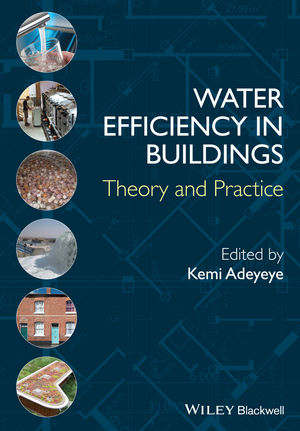
Water Efficiency in Buildings (eBook)
John Wiley & Sons (Verlag)
978-1-118-45660-6 (ISBN)
A roadmap to water efficiency in buildings.
- provides comprehensive and up-to-date information on water efficiency in buildings all in one book
- includes both research and showcases of innovations, systems and approaches for water efficiency in buildings
- collates learning and evidence that can be used to understand and apply solutions for water efficiency in buildings
- presents a multi-disciplinary viewpoint, from architecture to environmental science and socio-psychology
- demonstrates how to engage stakeholders in a systems approach to tackling the challenges
The book is presented in five sections: Policy, People, Building Design and Planning, Alternative Water Technologies and, Practical Examples and Case Studies. The final section of the book presents new and current practise as well as lessons learnt from case examples on the use of water saving technologies and user engagement.
Current evidence is vital for effective policy making. The dynamic nature of issues pertaining to water resource management creates a higher need for robust and reliable data and research information that can inform or guide policy and regulatory decisions.
This compendium aims to providea signpost to the knowledge, expertise and evidence that currently exist on the subject of water efficiency in buildings. The research and case studies fall within the water supply and demand spectrum, especially those that focus on process efficiency, resource management, building performance, customer experiences and user participation, sustainable practises, scientific and technological innovation. The benefit and impact of the research is at the local and national level, as well as in the global context.
The Editor Kemi Adeyeye is Senior Lecturer in Architecture Technology at the University of Brighton; she is also Principal Investigator and Coordinator of the Water Efficiency in Buildings Network
Chapter authors provide a balance of academic and practitioner views, from leading design and engineering practice to systems developed with manufacturing companies.
This reference source on water efficiency in buildings provides comprehensive and up-to-date information. Both multi-disciplinary and practical, it signposts current knowledge, innovation, expertise and evidence on an important subject which is high in the resource management debate. Water Efficiency in Buildings: a review of theory and practice is structured into five sections: Policy; People; Building Design and Planning; Alternative Water Technologies; and Practical Examples & Case Studies. This final section of the book presents new and current practice as well as lessons learnt from case examples on the use of water saving technologies and user engagement. Current evidence is vital for effective policy making. The dynamic nature of issues around water resource management creates a higher need for robust and reliable data and research information that can inform policy and regulations. This compendium provides a roadmap for researchers and building professionals on water efficiency as well as for policy makers and regulators. The case studies and research presented fall within the water supply and demand spectrum, especially those that focus on process efficiency, resource management, building performance, customer experiences and user participation, sustainable practises, scientific and technological innovation. The benefit and impact of the research is at the localandnational level, as well as in the global context.
The Editor Kemi Adeyeye is Senior Lecturer in Architecture Technology at the University of Brighton; she is also Principal Investigator and Coordinator of the Water Efficiency in Buildings Network Chapter authors provide a balance of academic and practitioner views, from leading design and engineering practice to systems developed with manufacturing companies.
'This is the first book that pulls together the social, political,
practical and academic aspects of water efficiency for the built
environment it is essential reading for anyone working in the water
resources or building sectors'
--Jacob Tompkins, Managing Director of Waterwise
About the Contributors
Ilan Adler is founder and chairman of the International Renewable Resources Institute (IRRI-Mexico), a non-governmental association specialising in the promotion of renewable energies and sustainable water practices throughout rural and urban areas in Mexico. He has lectured to a wide variety of audiences, teaching at universities as well as workshops in Puerto Rico, Ecuador, the USA and different areas of Mexico, also as a Solar Energy International (SEI) instructor. In 2004, he worked for the UNEP as a consultant in waste-water management for Latin America and the Caribbean. Through a number of start-up companies he has also been involved in consulting, design and implementation of appropriate technologies such as rainwater harvesting, biogas and solar systems. His publications include articles, stories and children’s books related to water conservation and environmentalism. He has a Master’s degree in Environmental Science from Wageningen University, the Netherlands and is currently pursuing his PhD in rainwater quality and purification technologies at University College London, where he also works as a teaching assistant.
Ben Anderson is originally from a natural sciences background. He has a BSc in Biology and Computer Science (Southampton University, UK) and a PhD in Computer Studies (Loughborough University, UK). He has used techniques from computer science, cognitive psychology, anthropology, economics, sociology and social geography during his time as an academic and commercial research scientist engaged in conducting and managing basic and applied social research programmes. His main research interest is the relationship between social practices and infrastructural change with a particular focus on social communication, resource (energy, water) consumption, micro-social resilience and sustainable living with cross-cutting interests in temporal and spatial variation. He is currently a Visiting Research Fellow at the Lancaster Environment Centre and a Senior Research Fellow in the Sustainable Energy Research Group at the University of Southampton.
Jean Balnave is the administrator for the Water Efficiency in Buildings Network, a multidisciplinary network of academics, industry practitioners and NGOs funded by DEFRA. She is the interface between the network, members and the general public. She is involved in promoting the network’s activities to various audiences and at relevant international events. Her study and research interests include earth and environmental sciences, water-efficient technologies and water user behaviours and practices. Recent projects included a water efficiency and community resilience study, and she is currently responsible for the network’s recently launched water messaging programme.
Stewart Barr obtained his PhD from the University of Exeter in 2001 and is now Associate Professor in the Geography Department at the university. His research interests focus on how environmental social science can lead academic discussions on social transformation in an age of accelerated environmental change. He teaches both undergraduate and postgraduate courses in Geography and runs a final-year undergraduate specialist module on Geographies of Transport and Mobility.
Cara Beal obtained her PhD from the University of Queensland in Soil Science. She is a research fellow at the Smart Water Research Centre, Griffith University, Queensland, Australia. A recognised expert in smart metering and residential water end-use studies, she also has over 20 years’ experience in integrated water resource management. She has managed a number of large research projects in the private, government and academic sectors and has authored more than 50 peer-reviewed publications across a range of topics including urban water planning, social analysis of water consumption, decentralised waste-water treatment systems, demand forecasting and the water–energy nexus.
Lee Bint earned her PhD from Victoria University, Wellington, New Zealand. She graduated from her doctoral studies on water performance in commercial office buildings in 2012, supervised by Professor Robert Vale and Mr Nigel Isaacs. She has since been working at BRANZ Ltd, investigating energy and water use across New Zealand non-residential buildings. Her research interests centre on improving water and energy performance of commercial buildings.
David Brindley is Business Support Manager at the Bathroom Manufacturers Association and has worked in the bathroom industry for over 40 years. His previous roles of Technical Manager and Engineering CAD Draughtsman at one of the UK’s major bathroom manufacturing companies have provided a wealth of experience in all aspects of the industry including product design, manufacturing and marketing. He brings this vast product knowledge to his current position of administering the Water Label Scheme and other areas of the BMA business.
Andrew Brohier studied at the University of Western Sydney where he completed a Bachelor of Construction Management (Honours). His honours thesis focused on sustainable innovations which optimise water efficiency in dwellings. After completing his studies he is now working within the construction industry as an Accredited Building Surveyor, where he endeavours to promote awareness regarding innovations which can improve water efficiency in all forms of construction.
Alison Browne is a Research Fellow at the Sustainable Consumption Institute, University of Manchester with interests in water, climate change adaptation, everyday practice and sustainable consumption, and the community and social impacts of large-scale resource development (agriculture, mining, rural and urban development). Prior to joining the SCI in September 2012 she was a Senior Research Associate at the Lancaster Environment Centre, Lancaster University (2010–2012). Here she managed two large interdisciplinary projects on climate change, water resource management and everyday practice (the EPSRC-funded ARCC-Water and the ESRC/DEFRA/Scottish Government SPRG Patterns of Water projects). She has also been involved in a range of consultancy projects for the UK water industry (Thames Water, UKWIR) focused on climate change, demand management and water efficiency. Prior to moving to the UK she obtained her PhD from Curtin University, was a Research Fellow at the Research Centre for Stronger Communities, Curtin University (2009–2010) and a Research Scientist at CSIRO Australia (2007–2009) working on urban water management, sustainable agriculture and resource development.
David Butler is Director of the Centre for Water Systems, University of Exeter. He is Professor of Water Engineering at the University of Exeter and an Engineering & Physical Sciences Research Council (EPSRC) Established Career Fellow. He is a chartered civil engineer, a chartered environmentalist and a Fellow of the IWA, Institution of Civil Engineers and CIWEM. He specialises in sustainable urban water management, has published over 250 technical papers and is co-editor-in-chief of the Urban Water Journal. His research has been funded continuously by EPSRC since 1995.
Luiza Cintra Campos is a Senior Lecturer in Environmental Engineering, University College London. She has a PhD in Environmental Engineering from Imperial College. She is a civil engineer specialising in environmental engineering and has over 8 years of practical experience working for a state water and waste-water company and over 10 years of experience working as a lecturer at various universities in Brazil. She joined University College London (UCL) in 2007 as a lecturer in the Department of Civil, Environmental and Geomatic Engineering where she is currently the Programme Director for Environmental Engineering UG. Her research interests lies in water and sanitation, varying from modelling purification mechanisms of slow sand filtration to sustainable and resilient sanitation services. Some of her research projects include the impact of rainwater harvesting on urban flood attenuation and water supply, the reduction of risks in sanitation infrastructure, health built environments, the treatment and disinfection of water/rainwater and the modelling the next generation of sanitation systems.
Susanne M. Charlesworth is a Reader in Urban Physical Geography and Director of SuDs Applied Research Group; Geography, Environment and Disaster Management, Coventry University. She gained her PhD in ‘The retention of pollutant history in the sediments of two urban lakes, Coventry, UK’ from Coventry University in 1994 and has been Director of the SuDs Applied Research Group at Coventry University for the past 6 years. Whilst she has undertaken research and development in SuDs and has publications in that subject area, she has also published in urban geochemistry, risk assessments for children associated with urban contaminants and urban hydrology.
Stephen J. Coupe is an environmental scientist with an interest in storm-water management, sustainability and environmental microbiology. He has a PhD in sustainable drainage water quality and worked as research manager for Hanson Formpave between 2006 and 2011. Working as a research fellow at Coventry University, he teaches on undergraduate and postgraduate programmes and is fully engaged in multidisciplinary research activities.
Amal S. Faraj has a background in civil engineering, having worked for Repsol/Akakus Oil Operations, a Spanish–Libyan joint enterprise in Tripoli. In 2007, she achieved an MSc in Environmental Management from Coventry University. She was recently awarded a PhD from...
| Erscheint lt. Verlag | 23.12.2013 |
|---|---|
| Sprache | englisch |
| Themenwelt | Naturwissenschaften ► Biologie ► Ökologie / Naturschutz |
| Naturwissenschaften ► Geowissenschaften | |
| Technik ► Bauwesen | |
| Technik ► Umwelttechnik / Biotechnologie | |
| Schlagworte | Alternative • Baubetrieb • Bauingenieur- u. Bauwesen • buildings • case examples • Civil Engineering & Construction • Construction Management • Construction: Sustainability • Current • Debate • Efficiency • Environmental Management, Policy & Planning • Environmental Studies • High • important • Information • Knowledge • Nachhaltiges Bauen • Policy • Practice • provides • Reference • resource • Review • section • sections • source • Studies • Subject • theory • Umweltforschung • Umweltmanagement, Politik u. -Planung • Water |
| ISBN-10 | 1-118-45660-2 / 1118456602 |
| ISBN-13 | 978-1-118-45660-6 / 9781118456606 |
| Informationen gemäß Produktsicherheitsverordnung (GPSR) | |
| Haben Sie eine Frage zum Produkt? |
 EPUB (Adobe DRM)
Kopierschutz: Adobe-DRM
Adobe-DRM ist ein Kopierschutz, der das eBook vor Mißbrauch schützen soll. Dabei wird das eBook bereits beim Download auf Ihre persönliche Adobe-ID autorisiert. Lesen können Sie das eBook dann nur auf den Geräten, welche ebenfalls auf Ihre Adobe-ID registriert sind.
Details zum Adobe-DRM
Dateiformat: EPUB (Electronic Publication)
EPUB ist ein offener Standard für eBooks und eignet sich besonders zur Darstellung von Belletristik und Sachbüchern. Der Fließtext wird dynamisch an die Display- und Schriftgröße angepasst. Auch für mobile Lesegeräte ist EPUB daher gut geeignet.
Systemvoraussetzungen:
PC/Mac: Mit einem PC oder Mac können Sie dieses eBook lesen. Sie benötigen eine
eReader: Dieses eBook kann mit (fast) allen eBook-Readern gelesen werden. Mit dem amazon-Kindle ist es aber nicht kompatibel.
Smartphone/Tablet: Egal ob Apple oder Android, dieses eBook können Sie lesen. Sie benötigen eine
Geräteliste und zusätzliche Hinweise
Buying eBooks from abroad
For tax law reasons we can sell eBooks just within Germany and Switzerland. Regrettably we cannot fulfill eBook-orders from other countries.
aus dem Bereich