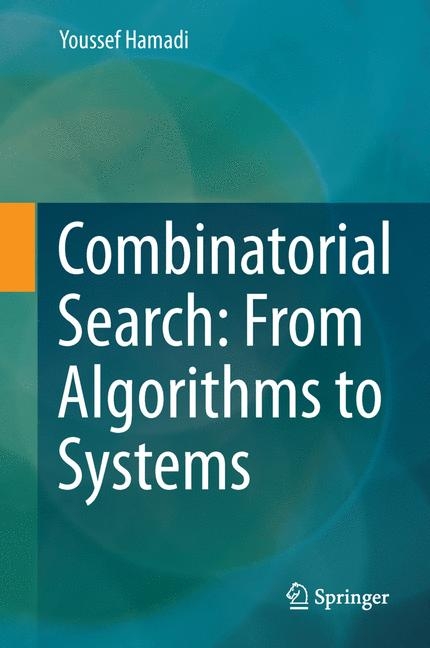
Combinatorial Search: From Algorithms to Systems (eBook)
XIII, 139 Seiten
Springer Berlin (Verlag)
9783642414824 (ISBN)
Although they are believed to be unsolvable in general, tractability results suggest that some practical NP-hard problems can be efficiently solved. Combinatorial search algorithms are designed to efficiently explore the usually large solution space of these instances by reducing the search space to feasible regions and using heuristics to efficiently explore these regions. Various mathematical formalisms may be used to express and tackle combinatorial problems, among them the constraint satisfaction problem (CSP) and the propositional satisfiability problem (SAT). These algorithms, or constraint solvers, apply search space reduction through inference techniques, use activity-based heuristics to guide exploration, diversify the searches through frequent restarts, and often learn from their mistakes.
In this book the author focuses on knowledge sharing in combinatorial search, the capacity to generate and exploit meaningful information, such as redundant constraints, heuristic hints, and performance measures, during search, which can dramatically improve the performance of a constraint solver. Information can be shared between multiple constraint solvers simultaneously working on the same instance, or information can help achieve good performance while solving a large set of related instances. In the first case, information sharing has to be performed at the expense of the underlying search effort, since a solver has to stop its main effort to prepare and commu
nicate the information to other solvers; on the other hand, not sharing information can incur a cost for the whole system, with solvers potentially exploring unfeasible spaces discovered by other solvers. In the second case, sharing performance measures can be done with little overhead, and the goal is to be able to tune a constraint solver in relation to the characteristics of a new instance - this corresponds to the selection of the most suitable algorithm for solving a given instance.The book is suitable for researchers, practitioners, and graduate students working in the areas of optimization, search, constraints, and computational complexity.
Dr. Youssef Hamadi is the head of the Constraint Reasoning Group at Microsoft Research Cambridge, and his research interests include combinatorial optimization in alternative frameworks (parallel and distributed architectures); the application of machine learning to search; autonomous search; and parallel propositional satisfiability.
Dr. Youssef Hamadi is the head of the Constraint Reasoning Group at Microsoft Research Cambridge, and his research interests include combinatorial optimization in alternative frameworks (parallel and distributed architectures); the application of machine learning to search; autonomous search; and parallel propositional satisfiability.
Chap. 1 - Introduction.- Chap. 2 - Boosting Distributed Constraint Networks.- Chap. 3 - Parallel Tree Search for Satisfiability.- Chap. 4 - Parallel Local Search for Satisfiability.- Chap. 5 - Learning Variables Dependencies.- Chap. 6 - Continuous Search.- Chap. 7 - Autonomous Search.- Chap. 8 - Conclusion and Perspectives.
| Erscheint lt. Verlag | 29.10.2013 |
|---|---|
| Zusatzinfo | XIII, 139 p. 30 illus., 16 illus. in color. |
| Verlagsort | Berlin |
| Sprache | englisch |
| Themenwelt | Informatik ► Theorie / Studium ► Künstliche Intelligenz / Robotik |
| Mathematik / Informatik ► Mathematik | |
| Technik | |
| Schlagworte | Autonomous search • constraint networks • Constraint programming (CP) • constraints • Constraint satisfaction problem (CSP) • Continuous search • knowledge sharing • machine learning • Satisfiability problem (SAT) • Search |
| ISBN-13 | 9783642414824 / 9783642414824 |
| Informationen gemäß Produktsicherheitsverordnung (GPSR) | |
| Haben Sie eine Frage zum Produkt? |
 PDF (Wasserzeichen)
DRM: Digitales Wasserzeichen
Dieses eBook enthält ein digitales Wasserzeichen und ist damit für Sie personalisiert. Bei einer missbräuchlichen Weitergabe des eBooks an Dritte ist eine Rückverfolgung an die Quelle möglich.
Dateiformat: PDF (Portable Document Format)
Mit einem festen Seitenlayout eignet sich die PDF besonders für Fachbücher mit Spalten, Tabellen und Abbildungen. Eine PDF kann auf fast allen Geräten angezeigt werden, ist aber für kleine Displays (Smartphone, eReader) nur eingeschränkt geeignet.
Systemvoraussetzungen:
PC/Mac: Mit einem PC oder Mac können Sie dieses eBook lesen. Sie benötigen dafür einen PDF-Viewer - z.B. den Adobe Reader oder Adobe Digital Editions.
eReader: Dieses eBook kann mit (fast) allen eBook-Readern gelesen werden. Mit dem amazon-Kindle ist es aber nicht kompatibel.
Smartphone/Tablet: Egal ob Apple oder Android, dieses eBook können Sie lesen. Sie benötigen dafür einen PDF-Viewer - z.B. die kostenlose Adobe Digital Editions-App.
Buying eBooks from abroad
For tax law reasons we can sell eBooks just within Germany and Switzerland. Regrettably we cannot fulfill eBook-orders from other countries.
aus dem Bereich