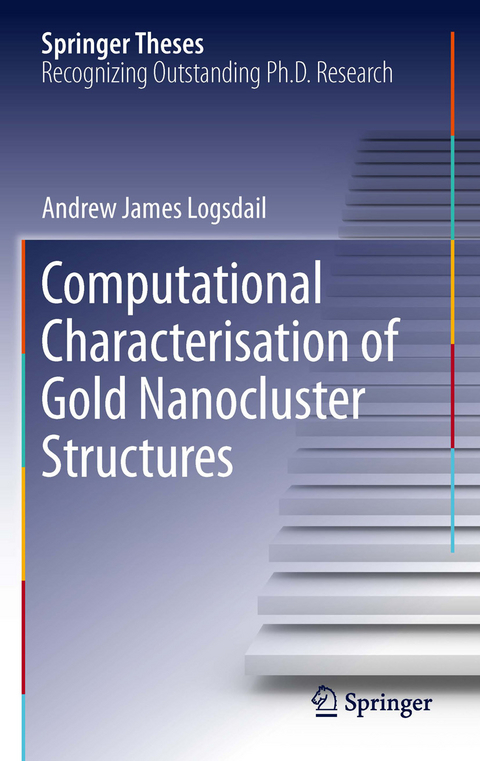
Computational Characterisation of Gold Nanocluster Structures (eBook)
XVI, 209 Seiten
Springer International Publishing (Verlag)
978-3-319-01493-7 (ISBN)
Dr. Andrew J. Logsdail studied his BSc (2003 - 2006), MRes (2006 - 2008) and PhD (2008 - 2012) in the School of Chemistry at the University of Birmingham, UK, with the latter two focused on characterising metallic nanoparticles, performed under the guidance of Professor Roy L. Johnston. In 2012 he moved to the Department of Chemistry at University College London, UK, working to develop novel methods for the characterisation of bulk defects in technologically important materials as a Postdoctoral Associate in the group of Professor C. Richard A. Catlow.
Dr. Andrew J. Logsdail studied his BSc (2003 - 2006), MRes (2006 - 2008) and PhD (2008 - 2012) in the School of Chemistry at the University of Birmingham, UK, with the latter two focused on characterising metallic nanoparticles, performed under the guidance of Professor Roy L. Johnston. In 2012 he moved to the Department of Chemistry at University College London, UK, working to develop novel methods for the characterisation of bulk defects in technologically important materials as a Postdoctoral Associate in the group of Professor C. Richard A. Catlow.
Introduction.- Calculating the Structural Preference of High Symmetry Clusters for PdN, AuN, and (PdAu)N.- Method Development for comparing Scanning Transmission Electron Microscope Images to Theoretical Structures.- A First-Principles Study of the Soft-landing of Au16 on Graphite.- Simulating the Optical Properties of Au Nanoclusters and Nanoalloys.- Concluding Remarks.- Plot of Gupta Potential and Cutoff.- Data from the Development of a Genetic Algorithm to Characterise Scanning Transmission Electron Microscope Images.- First-Principles Calculations of an Au16 Nanocluster on Graphite.- Extinction Spectra Plots from Optical Calculations.
| Erscheint lt. Verlag | 31.8.2013 |
|---|---|
| Reihe/Serie | Springer Theses | Springer Theses |
| Zusatzinfo | XVI, 209 p. 99 illus., 84 illus. in color. |
| Verlagsort | Cham |
| Sprache | englisch |
| Themenwelt | Naturwissenschaften ► Chemie |
| Technik | |
| Schlagworte | Carbon Graphite Supported Gold • Genetic Algorithm • Gold Clusters • Gold Nanoclusters • gold nanoparticles • Nanoclusters • Optical Properties of Gold Nanoparticles • Search Algorithm • Structural Properties of Gold Nanoclusters |
| ISBN-10 | 3-319-01493-5 / 3319014935 |
| ISBN-13 | 978-3-319-01493-7 / 9783319014937 |
| Informationen gemäß Produktsicherheitsverordnung (GPSR) | |
| Haben Sie eine Frage zum Produkt? |
 PDF (Wasserzeichen)
DRM: Digitales Wasserzeichen
Dieses eBook enthält ein digitales Wasserzeichen und ist damit für Sie personalisiert. Bei einer missbräuchlichen Weitergabe des eBooks an Dritte ist eine Rückverfolgung an die Quelle möglich.
Dateiformat: PDF (Portable Document Format)
Mit einem festen Seitenlayout eignet sich die PDF besonders für Fachbücher mit Spalten, Tabellen und Abbildungen. Eine PDF kann auf fast allen Geräten angezeigt werden, ist aber für kleine Displays (Smartphone, eReader) nur eingeschränkt geeignet.
Systemvoraussetzungen:
PC/Mac: Mit einem PC oder Mac können Sie dieses eBook lesen. Sie benötigen dafür einen PDF-Viewer - z.B. den Adobe Reader oder Adobe Digital Editions.
eReader: Dieses eBook kann mit (fast) allen eBook-Readern gelesen werden. Mit dem amazon-Kindle ist es aber nicht kompatibel.
Smartphone/Tablet: Egal ob Apple oder Android, dieses eBook können Sie lesen. Sie benötigen dafür einen PDF-Viewer - z.B. die kostenlose Adobe Digital Editions-App.
Buying eBooks from abroad
For tax law reasons we can sell eBooks just within Germany and Switzerland. Regrettably we cannot fulfill eBook-orders from other countries.
aus dem Bereich