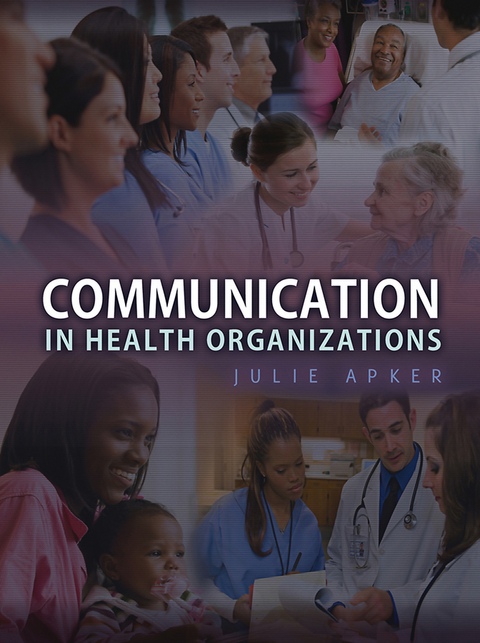
Communication in Health Organizations (eBook)
John Wiley & Sons (Verlag)
978-0-7456-8069-9 (ISBN)
The author explains the complexities and contingencies of communication in health settings using systems theory, an approach that enhances reader understanding of health organizing. The reader will gain greater familiarity with how health institutions function communicatively, and why the people who work in health professions interact as they do. The text provides multiple opportunities to analyze communication occurring in health organizations and to apply communication skills to personal experiences. This knowledge may improve communication between patients, employees, or consumers. Understanding and applying the concepts discussed in this book can enhance communication in health organizations, which ultimately benefits health care delivery.
Communication in Health Organizations offers students, researchers, and health practitioners a unique multi-disciplinary perspective that invites stimulating reflection, discussion, and application of communication issues affecting today's health system.
Communication in Health Organizations explores the communication processes, issues, and concepts that comprise the organization of health care, focusing on the interactions that influence the lives of patients, health professionals, and other members of health institutions. This book integrates scholarship from communication, medicine, nursing, public health, and allied health, to provide a comprehensive review of the research literature. The author explains the complexities and contingencies of communication in health settings using systems theory, an approach that enhances reader understanding of health organizing. The reader will gain greater familiarity with how health institutions function communicatively, and why the people who work in health professions interact as they do. The text provides multiple opportunities to analyze communication occurring in health organizations and to apply communication skills to personal experiences. This knowledge may improve communication between patients, employees, or consumers. Understanding and applying the concepts discussed in this book can enhance communication in health organizations, which ultimately benefits health care delivery. Communication in Health Organizations offers students, researchers, and health practitioners a unique multi-disciplinary perspective that invites stimulating reflection, discussion, and application of communication issues affecting today's health system.
Julie Apker is Associate Professor of Communication at Western Michigan University.
List of Figures and Tables.
Acknowledgements.
Introduction
Chapter 1 Landscape of Healthcare Delivery
Chapter 2 Organizational Assimilation.
Chapter 3 Identity and Power.
Chapter 4 Stress, Burnout, and Social Support.
Chapter 5 Change and Leadership.
Chapter 6 Health Teams.
Chapter 7 Health Organization Quality.
Chapter 8 Health Communication Technologies.
References.
Name Index.
Subject Index.
"Julie Apker addresses the landscape of health care environment in a way that captures its complexity and honors the experiences of both providers and patients. Her consideration of contemporary events will help readers to make sense of their professional and personal encounters with health care organizations."
Katherine Miller, Texas A&M University
"Apker has done an outstanding job in integrating and synthesizing a large body of research on the subject of communication in health organizations, and making it relevant to students. This is an excellent companion text for general health communication courses, or courses specific to health organizations."
Eileen Berlin Ray, Cleveland State University
"At last, a well-written and compelling book that surveys the forms and functions of communication in health organizations! Apker offers a timely and masterful analysis that is theoretically grounded and comprehensive in scope. For anyone working in a caring profession or interested in the communicative challenges of complex health systems, this is a must-read."
Lynn Harter, Ohio University
Introduction
Students in the communication courses I teach often ask me, “Why study communication in health organizations?” While there are many answers to this question, the main reason is that the communication in these contexts influences human lives in profound ways, by affecting health and well-being. Perhaps the most visible example of this is the patient who turns to a health institution during a vulnerable moment. Patients depend on health professionals to display clear, timely, accurate, and responsive communication. A communication failure can have serious results and perhaps even life or death consequences.
The importance of communication in health organizations extends beyond the patient’s bedside. For those who work in health professions, good communication builds cohesive, positive work environments. Bad communication creates barriers that reduce the quality of work life and job satisfaction. Negative communication experiences can ultimately affect healthcare delivery (e.g., turnover, staff shortage). For the public, communication in health organizations produces credible and reliable information that can be used to raise awareness of illness, disease, and wellness. This data can help consumers make more informed health decisions about treatment and prevention.
Communication in health organizations spans a wide range of topics and levels of interaction. Here are a few examples:
A diverse yet cohesive hospital team communicates to solve a complicated medical problem.
The use of an electronic medical record (EMR) allows a physician to quickly access information from a specialist at another institution during a patient crisis.
A health organization’s leader struggles with communicating changes that will dramatically affect quality of work life for her employees.
A social worker seeks mentorship and social support from supervisors and colleagues to ease the strain of job burnout.
After reading this book, you will know more about the communication principles, processes, and behaviors present in United States health organizations. Using the systems approach of organizational communication, you will gain greater familiarity with how health institutions function communicatively and why the people who work in health professions interact as they do. You will be able to analyze communication occurring in health organizations and apply communication skills to health organization experiences. This knowledge may enable you to improve your own communication as a patient, employee, or consumer and, ultimately, enhance communication in health organizations.
This introduction will define the characteristics of organizations, describe the role of communication, explain the systems approach, and preview chapter topics.
Definitional Issues
Organizations take many forms and have multiple purposes. Your personal experience with various types of organizations may include: a company that you work for, a non-profit organization where you volunteer, or an online organization from which you make regular purchases or that advocates for social issues you consider important. Despite their differences, these organizations share several common themes.
Organizational communication researcher Katherine Miller (2009) offers five defining features of organizations. First, organizations are social entities that consist of two or more people who are organizational members. Second, these individuals participate in activities that require coordination or synchronization. Third, organizational members’ activities create and maintain structure, such as vertical hierarchies or flat, collaborative teams. Structure explicates who is in charge of particular responsibilities, who reports to whom, the priority of actions, etc. Fourth, organizational members work to achieve individual and organizational goals. Finally, organizations are situated within an embedded environment consisting of other organizations, and varied social, economic, and political forces.
Organizational communication consists of the dynamic interactions used to accomplish goals that satisfy individual and/or collective needs (Jablin and Putnam, 2001). Health communication is the “symbolic processes by which people, individually and collectively, understand, shape, and accommodate health and illness” (Geist-Martin, Ray, and Sharf, 2003, p. 3). Taken together, organizational health communication refers to the individual and collective communicative behaviors that constitute health organizations.
To summarize, organizations are complex, dynamic entities inextricably intertwined with the greater environment, and communication plays a central role in organizing healthcare processes. Next, you will learn more about the systems approach, including theoretical principles, evolution in organizational studies, and key concepts.
Systems Principles and Evolution
The systems approach is an enduring framework in organizational studies useful to understanding complex entities such as health organizations (Ray and Donohew, 1990; Wright, Sparks, and O’Hair, 2008). A system is a set of components, typically people, which interrelate with one another through sending and receiving messages. The interactions of these components form subsystems, such as work teams and departments, which form system structure. System components, and thus the system itself, form relationships with the embedded environment (Deetz, 2000).
Consider HealthWest, a large, comprehensive medical practice in the Southwest that has multiple components and subsystems: clinical (physicians and nurses representing different medical specialties), administrative (finance workers, medical record clerks) and service (receptionists, customer service employees). Working together, the subsystems form an overarching structure that cares for patients. In addition to forming internal relationships, HealthWest employees develop connections with people from outside the organization. For instance, physicians and nurses provide care to patients; receptionists take external phone calls to book appointments and answer questions; and billing clerks talk with insurance representatives about medical claims. HealthWest’s internal and external openness allows the organization to work effectively and, ultimately, promote its survival.
The systems approach originated in biology and engineering and was later used in other academic disciplines. Ludwig von Bertalanffy (1968) developed general systems theory to explore the interrelationships which constitute biological organisms (such as human beings) and to investigate the connections linking an organism to its environment. Bertalanffy argued that systems principles could also inform understandings of non-biological systems.
In the 1970s and 1980s, researchers in organizational studies used systems theory principles to better understand social relations and structures of organizations (Deetz, 2000). Scholars recognized its utility for describing how organizations function at multiple levels. At the broad interorganizational level or macro-level, systems principles explain how organizations interrelate with environmental contingencies. The systems approach also provides a micro-level perspective that examines how complex, interrelated components such as dyads and groups function in organizations. The range of ideas associated with systems theory also supplied scholars with a rich, conceptual vocabulary to more fully explain the intricacies of organizational life.
Systems Approach in Organizational Communication
The systems approach has been particularly influential on the study of organizational communication. Papa, Daniels, and Spiker (2008) argue that a systems perspective sheds new light on the organizing role of communication. As they explain, “communication is not merely an activity that occurs “within” an organization, nor is it merely a tool for managerial control. Rather, all of the human processes that define an organization arise from communication . . . The linkages and connections among subsystems depend on communication and information flow” (p. 109).
Modaff, DeWine, and Butler (2008) take this argument a step further, identifying specific communication functions inherent to organizational systems:
Constitutive function: Communication creates connections and acts as a binder that allows the system to coordinate activities and integrate components into a unified whole.
Adaptive function: Feedback allows organizations to adapt to environmental change. Individuals who perform boundary spanning take center stage, giving and receiving information between the organizational system and the environment.
Maintenance function: Communication provides information throughout organizational systems to ensure a dynamic steady state.
The systems approach has a substantial research history that informs our understanding of many different types of organizations. A systems approach to...
| Erscheint lt. Verlag | 15.11.2013 |
|---|---|
| Sprache | englisch |
| Themenwelt | Medizin / Pharmazie ► Gesundheitswesen |
| Naturwissenschaften | |
| Sozialwissenschaften ► Kommunikation / Medien ► Allgemeines / Lexika | |
| Sozialwissenschaften ► Kommunikation / Medien ► Kommunikationswissenschaft | |
| Sozialwissenschaften ► Kommunikation / Medien ► Medienwissenschaft | |
| Sozialwissenschaften ► Politik / Verwaltung | |
| Technik ► Elektrotechnik / Energietechnik | |
| Schlagworte | Communication & Media Studies • heath, organizations, communication, applied communication, communication studies, public health • Kommunikation • Kommunikation u. Medienforschung |
| ISBN-10 | 0-7456-8069-0 / 0745680690 |
| ISBN-13 | 978-0-7456-8069-9 / 9780745680699 |
| Informationen gemäß Produktsicherheitsverordnung (GPSR) | |
| Haben Sie eine Frage zum Produkt? |
 EPUB (Adobe DRM)
Kopierschutz: Adobe-DRM
Adobe-DRM ist ein Kopierschutz, der das eBook vor Mißbrauch schützen soll. Dabei wird das eBook bereits beim Download auf Ihre persönliche Adobe-ID autorisiert. Lesen können Sie das eBook dann nur auf den Geräten, welche ebenfalls auf Ihre Adobe-ID registriert sind.
Details zum Adobe-DRM
Dateiformat: EPUB (Electronic Publication)
EPUB ist ein offener Standard für eBooks und eignet sich besonders zur Darstellung von Belletristik und Sachbüchern. Der Fließtext wird dynamisch an die Display- und Schriftgröße angepasst. Auch für mobile Lesegeräte ist EPUB daher gut geeignet.
Systemvoraussetzungen:
PC/Mac: Mit einem PC oder Mac können Sie dieses eBook lesen. Sie benötigen eine
eReader: Dieses eBook kann mit (fast) allen eBook-Readern gelesen werden. Mit dem amazon-Kindle ist es aber nicht kompatibel.
Smartphone/Tablet: Egal ob Apple oder Android, dieses eBook können Sie lesen. Sie benötigen eine
Geräteliste und zusätzliche Hinweise
Buying eBooks from abroad
For tax law reasons we can sell eBooks just within Germany and Switzerland. Regrettably we cannot fulfill eBook-orders from other countries.
aus dem Bereich