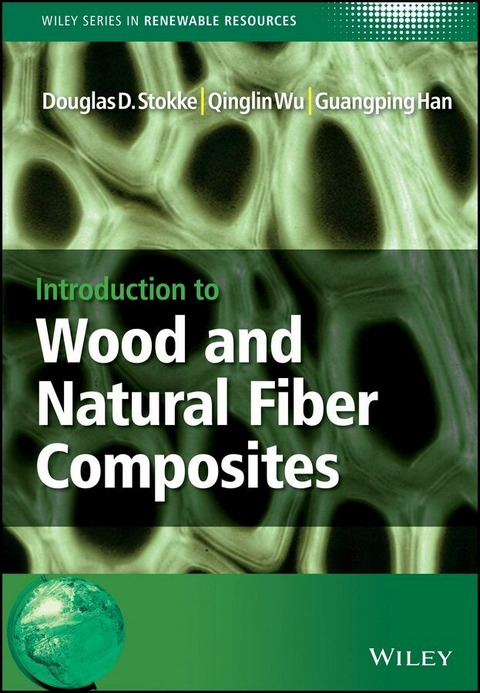
Introduction to Wood and Natural Fiber Composites (eBook)
John Wiley & Sons (Verlag)
978-0-470-71179-8 (ISBN)
Over the past two decades, there has been a shift in research and industrial practice, and products traditionally manufactured primarily from wood are increasingly combined with other nonwood materials of either natural or synthetic origin. Wood and other plant-based fiber is routinely combined with adhesives, polymers, and other “ingredients” to produce composite materials.
Introduction to Wood and Natural Fiber Composites draws together widely scattered information concerning fundamental concepts and technical applications, essential to the manufacture of wood and natural fiber composites. The topics addressed include basic information on the chemical and physical composition of wood and other lignocellulosic materials, the behavior of these materials under thermocompression processes, fundamentals of adhesion, specific adhesive systems used to manufacture composite materials, and an overview of the industrial technologies used to manufacture major product categories. The book concludes with a chapter on the burgeoning field of natural fiber-plastic composites.
Introduction to Wood and Natural Fiber Composites is a valuable resource for upper-level undergraduate students and graduate students studying forest products and wood science, as well as for practicing professionals working in operational areas of wood- and natural-fiber processing.
For more information on the Wiley Series in Renewable Resources, visit www.wiley.com/go/rrs
Topics covered include:
- Overview of lignocellulosic material, their chemical and physical composition
- Consolidation behavior of wood and fiber in response to heat and pressure
- Fundamentals of adhesion
- Adhesives used to bond wood and lignocellulosic composites
- Manufacturing technology of major product types
- Fiber/plastic composites
Over the past two decades, there has been a shift in research and industrial practice, and products traditionally manufactured primarily from wood are increasingly combined with other nonwood materials of either natural or synthetic origin. Wood and other plant-based fiber is routinely combined with adhesives, polymers, and other "e;ingredients"e; to produce composite materials. Introduction to Wood and Natural Fiber Composites draws together widely scattered information concerning fundamental concepts and technical applications, essential to the manufacture of wood and natural fiber composites. The topics addressed include basic information on the chemical and physical composition of wood and other lignocellulosic materials, the behavior of these materials under thermocompression processes, fundamentals of adhesion, specific adhesive systems used to manufacture composite materials, and an overview of the industrial technologies used to manufacture major product categories. The book concludes with a chapter on the burgeoning field of natural fiber-plastic composites. Introduction to Wood and Natural Fiber Composites is a valuable resource for upper-level undergraduate students and graduate students studying forest products and wood science, as well as for practicing professionals working in operational areas of wood- and natural-fiber processing. For more information on the Wiley Series in Renewable Resources, visit www.wiley.com/go/rrs Topics covered include: Overview of lignocellulosic material, their chemical and physical composition Consolidation behavior of wood and fiber in response to heat and pressure Fundamentals of adhesion Adhesives used to bond wood and lignocellulosic composites Manufacturing technology of major product types Fiber/plastic composites
Douglas D. Stokke Department of Natural Resource Ecology and Management, Iowa State University, Ames, USA Qinglin Wu School of Renewable Natural Resources, Louisiana State University AgCenter, Baton Rouge, USA Guangping Han College of Material Science and Engineering, Northeast Forestry University, Harbin, China Series Editor Christian Stevens Faculty of Bioscience Engineering, Ghent University, Ghent, Belgium
Series Preface xi
Preface xiii
Acknowledgments xv
1 Wood and Natural Fiber Composites: An Overview 1
1.1 Introduction 1
1.2 What Is Wood? 1
1.3 Natural Fibers 2
1.4 Composite Concept 6
1.5 Cellular Solids 13
1.6 Objectives and Organization of This Book 15
References 16
2 Lignocellulosic Materials 19
2.1 Introduction 19
2.2 Chemical Composition of Lignocellulosic Materials 19
2.3 The Woody Cell Wall as a Multicomponent Polymer System
35
2.4 Anatomical Structure of Representative Plants 40
2.5 Comparison of Representative Plant Stems 57
2.6 Cellular Solids Revisited 57
References 57
3 Wood as a Lignocellulose Exemplar 61
3.1 Introduction 61
3.2 Wood as a Representative Lignocellulosic Material: Important
Physical Attributes 61
3.3 Moisture Interactions 61
3.4 Density and Specific Gravity of Wood 74
3.5 Wood: A Cellular Solid 79
3.6 Mechanical Properties 80
3.7 Wood Is the Exemplar: Extending Principles to Other Plant
Materials 83
References 83
4 Consolidation Behavior of Lignocellulosic Materials 85
4.1 Introduction 85
4.2 Synthetic Crystalline and Amorphous Polymers 85
4.3 Glass Transition Temperature of Wood Polymers 89
4.4 Viscoelastic Behavior of Lignocellulosic Materials 97
4.5 Heat and Mass Transfer 104
4.6 Consolidation Behavior: Viscoelasticity Manifested During
Hot Pressing 112
4.7 Press Cycles 119
4.8 Horizontal Density Distribution 123
References 125
5 Fundamentals of Adhesion 129
5.1 Introduction 129
5.2 Overview of Adhesion as a Science 129
5.3 Adhesion Theories 136
5.4 Surface Interactions 143
5.5 Work of Adhesion: Dupr´e Equation 152
5.6 Lignocellulosic Adherends 153
References 166
6 Adhesives Used to Bond Wood and Lignocellulosic Composites
169
6.1 Introduction 169
6.2 The Nature of Wood Adhesives 169
6.3 Adhesives Used to Bond Wood and Other Natural Fibers 175
6.4 Amino Resins 178
6.5 Phenolic Resins 184
6.6 Resorcinol Resins 188
6.7 Polymeric Isocyanate Adhesives 190
6.8 Epoxy Adhesives 193
6.9 Polyvinyl Acetate Adhesives 196
6.10 Hot Melts and Mastics 197
6.11 Adhesives from Renewable Natural Resources 199
References 206
7 Technology of Major Wood- and Fiber-Based Composites: An
Overview 209
7.1 Introduction 209
7.2 Wood and Natural Fiber Composites as a Material Class
210
7.3 Taxonomy of Adhesive-Bonded Composites Technology 210
7.4 A Generic Process Flow 212
7.5 Technology of Adhesive-Bonded Materials Based on Form of Raw
Material Input 213
7.6 Laboratory Panel Calculations 219
7.7 Measurement Conventions for Production Capacity and Output
222
7.8 Technology of Inorganic-Bonded Materials 225
References 234
8 Natural Fiber and Plastic Composites 237
8.1 Introduction 237
8.2 Natural Fibers and Their Temperature-Related Performance
242
8.3 Plastic Composite Processing Technology 247
8.4 Overcoming Incompatibility of Synthetic Polymers and Natural
Fibers 252
8.5 Melt Compounding Natural Fibers and Thermoplastics 257
8.6 Performance of Natural Fiber and Plastic Composites 263
References 280
Index
| Erscheint lt. Verlag | 21.10.2013 |
|---|---|
| Reihe/Serie | Wiley Series in Renewable Resource | Wiley Series in Renewable Resources |
| Mitarbeit |
Herausgeber (Serie): Christian V. Stevens |
| Sprache | englisch |
| Themenwelt | Naturwissenschaften ► Chemie |
| Technik ► Maschinenbau | |
| Schlagworte | Adhesives • Applications • Cellulose/Paper/Textile Chemistry • Cellulose-, Papier- u. Textilchemie • Chemie • Chemistry • Combined • composite • Composites • Draws • either • fundamental concepts • Increasingly • Information • Introduction • manufactured primarily • Materials • Materials Science • Materialwissenschaften • Nachhaltige u. Grüne Chemie • Nachhaltige u. Grüne Chemie • NATURAL • nonwood • origin • Research • Shift • Sustainable Chemistry & Green Chemistry • Synthetic • traditionally • Verbundwerkstoffe • Wood |
| ISBN-10 | 0-470-71179-5 / 0470711795 |
| ISBN-13 | 978-0-470-71179-8 / 9780470711798 |
| Informationen gemäß Produktsicherheitsverordnung (GPSR) | |
| Haben Sie eine Frage zum Produkt? |
 EPUB (Adobe DRM)
Größe: 6,3 MB
Kopierschutz: Adobe-DRM
Adobe-DRM ist ein Kopierschutz, der das eBook vor Mißbrauch schützen soll. Dabei wird das eBook bereits beim Download auf Ihre persönliche Adobe-ID autorisiert. Lesen können Sie das eBook dann nur auf den Geräten, welche ebenfalls auf Ihre Adobe-ID registriert sind.
Details zum Adobe-DRM
Dateiformat: EPUB (Electronic Publication)
EPUB ist ein offener Standard für eBooks und eignet sich besonders zur Darstellung von Belletristik und Sachbüchern. Der Fließtext wird dynamisch an die Display- und Schriftgröße angepasst. Auch für mobile Lesegeräte ist EPUB daher gut geeignet.
Systemvoraussetzungen:
PC/Mac: Mit einem PC oder Mac können Sie dieses eBook lesen. Sie benötigen eine
eReader: Dieses eBook kann mit (fast) allen eBook-Readern gelesen werden. Mit dem amazon-Kindle ist es aber nicht kompatibel.
Smartphone/Tablet: Egal ob Apple oder Android, dieses eBook können Sie lesen. Sie benötigen eine
Geräteliste und zusätzliche Hinweise
Buying eBooks from abroad
For tax law reasons we can sell eBooks just within Germany and Switzerland. Regrettably we cannot fulfill eBook-orders from other countries.
 PDF (Adobe DRM)
Kopierschutz: Adobe-DRM
Adobe-DRM ist ein Kopierschutz, der das eBook vor Mißbrauch schützen soll. Dabei wird das eBook bereits beim Download auf Ihre persönliche Adobe-ID autorisiert. Lesen können Sie das eBook dann nur auf den Geräten, welche ebenfalls auf Ihre Adobe-ID registriert sind.
Details zum Adobe-DRM
Dateiformat: PDF (Portable Document Format)
Mit einem festen Seitenlayout eignet sich die PDF besonders für Fachbücher mit Spalten, Tabellen und Abbildungen. Eine PDF kann auf fast allen Geräten angezeigt werden, ist aber für kleine Displays (Smartphone, eReader) nur eingeschränkt geeignet.
Systemvoraussetzungen:
PC/Mac: Mit einem PC oder Mac können Sie dieses eBook lesen. Sie benötigen eine
eReader: Dieses eBook kann mit (fast) allen eBook-Readern gelesen werden. Mit dem amazon-Kindle ist es aber nicht kompatibel.
Smartphone/Tablet: Egal ob Apple oder Android, dieses eBook können Sie lesen. Sie benötigen eine
Geräteliste und zusätzliche Hinweise
Buying eBooks from abroad
For tax law reasons we can sell eBooks just within Germany and Switzerland. Regrettably we cannot fulfill eBook-orders from other countries.
aus dem Bereich