


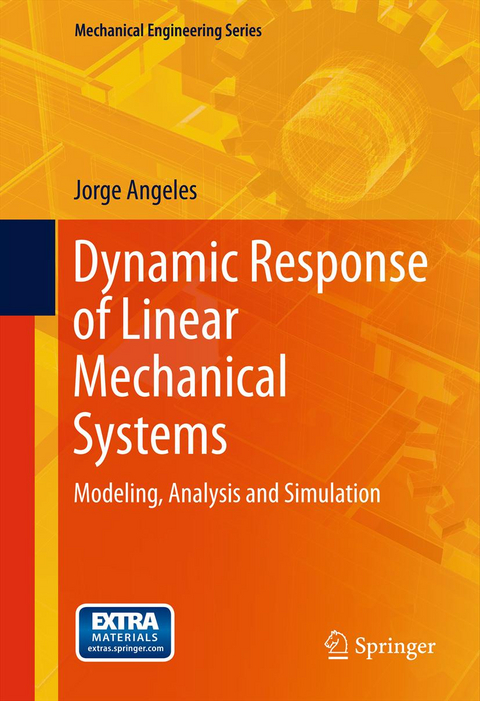
Dynamic Response of Linear Mechanical Systems
Modeling, Analysis and Simulation
Seiten
2013
|
2012 ed.
Birkhauser Boston Inc (Verlag)
978-1-4614-2946-3 (ISBN)
Birkhauser Boston Inc (Verlag)
978-1-4614-2946-3 (ISBN)
Dynamic Response of Linear Mechanical Systems: Modeling, Analysis and Simulation can be utilized for a variety of courses, including junior and senior-level vibration and linear mechanical analysis courses. The author connects, by means of a rigorous, yet intuitive approach, the theory of vibration with the more general theory of systems. The book features:
A seven-step modeling technique that helps structure the rather unstructured process of mechanical-system modeling
A system-theoretic approach to deriving the time response of the linear mathematical models of mechanical systems
The modal analysis and the time response of two-degree-of-freedom systems—the first step on the long way to the more elaborate study of multi-degree-of-freedom systems—using the Mohr circle
Simple, yet powerful simulation algorithms that exploit the linearity of the system for both single- and multi-degree-of-freedom systems
Examples and exercises that rely on modern computational toolboxes for both numerical and symbolic computations as well as a Solutions Manual for instructors, with complete solutions of a sample of end-of-chapter exercises
Chapters 3 and 7, on simulation, include in each “Exercises” section a set of miniprojects that require code-writing to implement the algorithms developed in these chapters
A seven-step modeling technique that helps structure the rather unstructured process of mechanical-system modeling
A system-theoretic approach to deriving the time response of the linear mathematical models of mechanical systems
The modal analysis and the time response of two-degree-of-freedom systems—the first step on the long way to the more elaborate study of multi-degree-of-freedom systems—using the Mohr circle
Simple, yet powerful simulation algorithms that exploit the linearity of the system for both single- and multi-degree-of-freedom systems
Examples and exercises that rely on modern computational toolboxes for both numerical and symbolic computations as well as a Solutions Manual for instructors, with complete solutions of a sample of end-of-chapter exercises
Chapters 3 and 7, on simulation, include in each “Exercises” section a set of miniprojects that require code-writing to implement the algorithms developed in these chapters
1. The Modeling of Single-DOF Mechanical Systems.- 2. Time Response of First- and Second-Order Dynamical Systems.- 3. Simulation of Single-DOF Systems.- 4. Modeling of Multi-DOF Mechanical Systems.- 5. Vibration Analysis of Two-DOF Systems.- 6. Vibration Analysis of n-DOF Systems.- 7. Simulation of n-DOF Systems.- 8. Vibration Analysis of Continuous Systems.
| Reihe/Serie | Mechanical Engineering Series |
|---|---|
| Zusatzinfo | XX, 560 p. |
| Verlagsort | Secaucus |
| Sprache | englisch |
| Maße | 155 x 235 mm |
| Themenwelt | Informatik ► Theorie / Studium ► Künstliche Intelligenz / Robotik |
| Technik ► Elektrotechnik / Energietechnik | |
| Technik ► Maschinenbau | |
| ISBN-10 | 1-4614-2946-3 / 1461429463 |
| ISBN-13 | 978-1-4614-2946-3 / 9781461429463 |
| Zustand | Neuware |
| Informationen gemäß Produktsicherheitsverordnung (GPSR) | |
| Haben Sie eine Frage zum Produkt? |
Mehr entdecken
aus dem Bereich



aus dem Bereich
Eine praxisorientierte Einführung
Buch | Softcover (2025)
Springer Vieweg (Verlag)
CHF 53,15
Künstliche Intelligenz, Macht und das größte Dilemma des 21. …
Buch | Softcover (2025)
C.H.Beck (Verlag)
CHF 25,20
Buch | Softcover (2025)
Reclam, Philipp (Verlag)
CHF 11,20


