


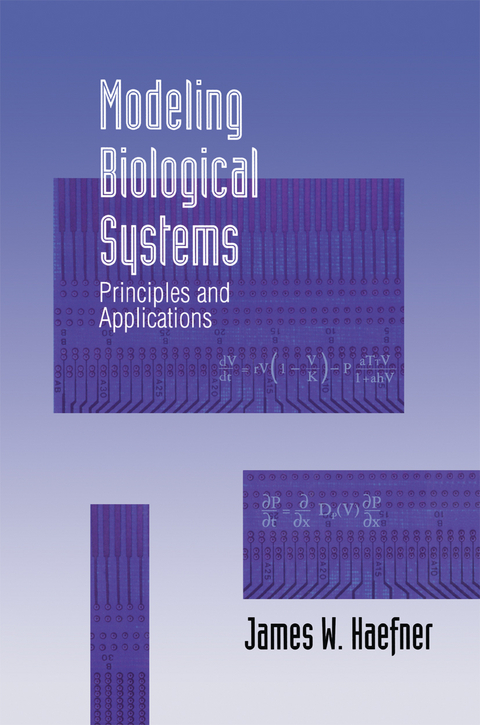
Modeling Biological Systems
Principles and Applications
Seiten
2012
|
Softcover reprint of the original 1st ed. 1996
Springer-Verlag New York Inc.
978-1-4613-6847-2 (ISBN)
Springer-Verlag New York Inc.
978-1-4613-6847-2 (ISBN)
This book is intended as a text for a first course on creating and analyzing computer simulation models of biological systems. I have stressed the relationship between the models and the biology over mathematical analysis in order to give the reader a sense that mathematical models really are useful to biologists.
This book is intended as a text for a first course on creating and analyzing computer simulation models of biological systems. The expected audience for this book are students wishing to use dynamic models to interpret real data mueh as they would use standard statistical techniques. It is meant to provide both the essential principles as well as the details and equa tions applicable to a few particular systems and subdisciplines. Biological systems, however, encompass a vast, diverse array of topics and problems. This book discusses only a select number of these that I have found to be useful and interesting to biologists just beginning their appreciation of computer simulation. The examples chosen span classical mathematical models of well-studied systems to state-of-the-art topics such as cellular automata and artificial life. I have stressed the relationship between the models and the biology over mathematical analysis in order to give the reader a sense that mathematical models really are useful to biologists. In this light, I have sought examples that address fundamental and, I think, interesting biological questions. Almost all of the models are directly COIIl pared to quantitative data to provide at least a partial demonstration that some biological models can accurately predict.
This book is intended as a text for a first course on creating and analyzing computer simulation models of biological systems. The expected audience for this book are students wishing to use dynamic models to interpret real data mueh as they would use standard statistical techniques. It is meant to provide both the essential principles as well as the details and equa tions applicable to a few particular systems and subdisciplines. Biological systems, however, encompass a vast, diverse array of topics and problems. This book discusses only a select number of these that I have found to be useful and interesting to biologists just beginning their appreciation of computer simulation. The examples chosen span classical mathematical models of well-studied systems to state-of-the-art topics such as cellular automata and artificial life. I have stressed the relationship between the models and the biology over mathematical analysis in order to give the reader a sense that mathematical models really are useful to biologists. In this light, I have sought examples that address fundamental and, I think, interesting biological questions. Almost all of the models are directly COIIl pared to quantitative data to provide at least a partial demonstration that some biological models can accurately predict.
I Principles.- 1 Models of Systems.- 2 The Modeling Process.- 3 Qualitative Model Formulation.- 4 Quantitative Model Formulation.- 5 Simulation Paradigms.- 6 Numerical Techniques.- 7 Parameter Estimation.- 8 Model Validation.- 9 Model Analysis.- 10 Stochastic Models.- II Applications.- 11 Photosynthesis and Plant Growth.- 12 Hormonal Control in Mammals.- 13 Populations and Individuals.- 14 Chemostats.- 15 Spatial Patterns and Processes.- 16 Scaling Models.- 17 Chaos in Biology.- 18 Cellular Automata and Recursive Growth.- 19 Evolutionary Computation.- 20 Complex Adaptive Systems.- References.
| Erscheint lt. Verlag | 16.10.2012 |
|---|---|
| Zusatzinfo | XIX, 473 p. |
| Verlagsort | New York, NY |
| Sprache | englisch |
| Maße | 155 x 235 mm |
| Themenwelt | Naturwissenschaften ► Biologie ► Ökologie / Naturschutz |
| Naturwissenschaften ► Biologie ► Zoologie | |
| Naturwissenschaften ► Chemie | |
| Technik ► Umwelttechnik / Biotechnologie | |
| ISBN-10 | 1-4613-6847-2 / 1461368472 |
| ISBN-13 | 978-1-4613-6847-2 / 9781461368472 |
| Zustand | Neuware |
| Informationen gemäß Produktsicherheitsverordnung (GPSR) | |
| Haben Sie eine Frage zum Produkt? |
Mehr entdecken
aus dem Bereich


aus dem Bereich
Methoden – Lösungen – Anwendungen
Buch | Hardcover (2025)
Hanser (Verlag)
CHF 69,95


