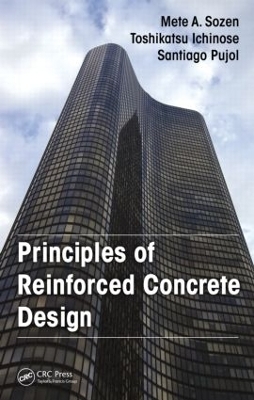
Principles of Reinforced Concrete Design
Crc Press Inc (Verlag)
978-1-4822-3148-9 (ISBN)
- Titel erscheint in neuer Auflage
- Artikel merken
The book presents design choices that fall in line with the boundaries defined by professional consensus (building codes), and provides reference material outlining the design criteria contained in building codes. It includes applications for both building and bridge structural design, and it is applicable worldwide, as it is not dependent upon any particular codes.
Contains concise coverage that can be taught in one semester
Underscores the fundamental principles of behavior
Provides students with an understanding of the principles upon which codes are based
Assists in navigating the labyrinth of ever-changing codes
Fosters an inherent understanding of design
The text also provides a brief history of reinforced concrete. While the initial attraction for using reinforced concrete in building construction has been attributed to its fire resistance, its increase in popularity was also due to the creativity of engineers who kept extending its limits of application. Along with height achievement, reinforced concrete gained momentum by providing convenience, plasticity, and low-cost economic appeal.
Principles of Reinforced Concrete Design
provides undergraduate students with the fundamentals of mechanics and direct observation, as well as the concepts required to design reinforced concrete (RC) structures, and applies to both building and bridge structural design.
Mete A. Sozen, S.E. (IL), a graduate of Bogazici University (Istanbul) and the University of Illinois at Urbana–Champaign, is the Kettelhut Professor in the Department of Civil Engineering at Purdue University, West Lafayette, Indiana. He teaches courses on reinforced concrete and earthquake-resistant design. He is a member of the U.S. National Academy of Engineering and the Royal Swedish Academy of Engineering Sciences. He is an honorary member of the Turkish Society for Engineers and Scientists, the American Society of Civil Engineers, the American Concrete Institute, the Architectural Institute of Japan, and the International Association for Earthquake Engineering. Dr. Sozen has been granted honorary degrees by Bogazici University (Turkey), Janus Pannonius University (Hungary), and the Tbilisi Technical University (Georgia). He was included in the Applied Technology Council and the Engineering News-Record lists of the top ten seismic engineers of the 20th century. Dr. Sozen has worked as a consultant with the Veterans Administration, the Department of State, Bechtel, Brookhaven National Laboratory, Consumers Power Co., Electric Power Research Institute, ERICO, Lawrence Livermore Laboratories, Los Alamos National Laboratory, Nuclear Regulatory Commission, SANDIA National Laboratories, U.S. Army Engineering R & D Center in Vicksburg, WJE Engineers, and Westinghouse Savannah River Site. He has worked on design and evaluation of concrete dams with the U.S. Bureau of Reclamation, Pacific Gas and Electric Co., and Southern California Edison.Toshikatsu Ichinose completed his undergraduate education in architectural engineering at Nagoya Institute of Technology and earned graduate degrees at the University of Tokyo. In 1982, he returned to Nagoya Institute of Technology, where he now teaches structural mechanics and reinforced concrete. Dr. Ichinose has been chairing the committee in charge of RC building code of the Architectural Institute of Japan since 2004. He is proud to be a coauthor of Understanding Structures (CRC Press, 2008). Santiago Pujol is from Medellín, Colombia, where he was first exposed to the reinforced concrete industry by his father, an architect who designed and directed the construction of a number of residential and commercial buildings in the city. He completed his undergraduate education in civil engineering at the School of Mines at the National University of Colombia in 1996. At the time, the School of Mines had a five-year undergraduate program designed after European academic models. Damage caused by earthquakes in Colombia motivated him to earn an MS and PhD from Purdue University, West Lafayette, Indiana. Dr. Pujol worked with a forensic firm in San Francisco, California, from 2002 to 2005. During that time, he traveled to Japan and started lasting collaborations with Japanese engineers whose wisdom and attention to proportions and aesthetics have a strong influence on his views. In 2005, he returned to Purdue University, where he currently teaches reinforced concrete and experimental methods and conducts research dealing with the effects of blasts and earthquakes on buildings, and basic questions on the mechanics of concrete structures.
A Brief History of Reinforced Concrete. Structural Framing in Reinforced Concrete. The Design Process. Properties of Steel Reinforcement. Concrete. Time-Dependent Volume Changes of Concrete: Shrinkage and Creep. Tied Columns. Axial Strength of Laterally Confined Concrete. Spiral Columns. Measures of Flexural Response. A General Description of Flexural Response. Moment-Curvature Relationship before Flexural Cracking. Linear Response of Cracked Sections. Limiting Moment and Unit Curvature. Development of a Quantitative Relationship between Moment and Unit Curvature. Maximum and Minimum Amounts of Longitudinal Reinforcement for Beams. Beams with Compression Reinforcement. Beams with Flanges. Deflection under Short-Time Loading. Effects of Time-Dependent Variables on Deflection. Continuous Beam. Limiting Load. Combinations of Limiting Axial Force and Bending Moment for a Reinforced Concrete Section. Bond Properties of Plain Bars in Concrete. Bond between Deformed Bars and Concrete. Factors That Affect Bond. Design Examples for Bond. Control of Flexural Cracks. Combined Bending and Shear. Transverse Reinforcement. Index.
| Zusatzinfo | 4 Tables, black and white; 224 Illustrations, black and white |
|---|---|
| Verlagsort | Bosa Roca |
| Sprache | englisch |
| Maße | 156 x 234 mm |
| Gewicht | 632 g |
| Themenwelt | Technik ► Bauwesen |
| ISBN-10 | 1-4822-3148-4 / 1482231484 |
| ISBN-13 | 978-1-4822-3148-9 / 9781482231489 |
| Zustand | Neuware |
| Informationen gemäß Produktsicherheitsverordnung (GPSR) | |
| Haben Sie eine Frage zum Produkt? |
aus dem Bereich