


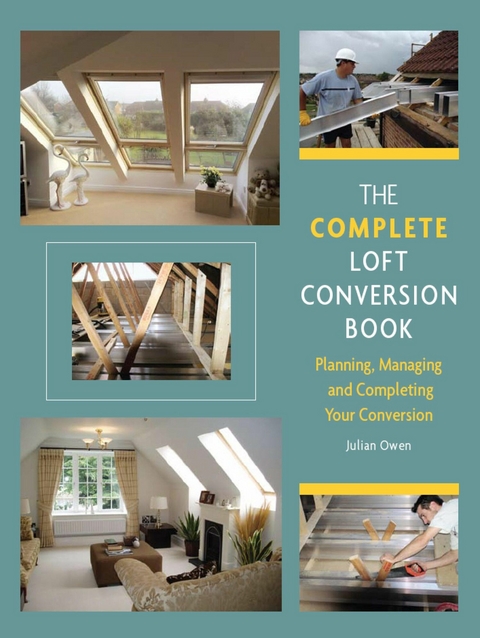
Complete Loft Conversion Book (eBook)
224 Seiten
Crowood (Verlag)
978-1-84797-580-5 (ISBN)
Before getting too far into the process of converting a loft or incurring the cost of hiring professionals the suitability of your roof should be assessed. For many, the best way of doing this may be to contact a builder or architect and ask them to take a look at it. However, it does no harm to do your own research first. Some aspects of the roof design and construction, such as the headroom available, may prevent a loft conversion from being carried out at all unless the roof is rebuilt. Other limitations, such as the structure of the roof, may not prevent a conversion, just make it more expensive. Provided that they can get into the loft safely, most people are able to check the key elements themselves. The detailed design work that will be needed is covered in later chapters, but at this early stage it is possible to visualize how a finished conversion might look and identify the area of the existing construction that will have to be altered.
The key questions to ask when considering a loft conversion:
- Is there enough headroom?
- Where will the staircase go?
- Where will windows go?
- Is the roof structure in the way?
- Are there any services to be altered, for example electrical wiring, water tank?
- How easily can it be insulated?
- What will happen to all the junk currently stored in the loft?
HEADROOM
The first, basic test for the feasibility of a loft conversion is to go up into the roof and try to stand up without bumping your head. If you can’t, conversion is unlikely to be cost-effective because you will have to put on a new roof or lower the ceiling of the floor below to get enough space. This may seem an obvious point to check, but some lofts can be inaccessible because there is no loft hatch. Also the infirm or disabled are not able to climb up a ladder easily, or if the house is being inspected by a potential buyer access may not be immediately available. Roofs look higher than they actually are if only seen through a loft hatch whilst standing on the landing.
This loft has sufficient headroom, but will need some structural alterations to carry out a conversion. Attic Designs Ltd
Assuming that it is possible to stand up comfortably, the next question is, ‘How much space is there above your head?’ If your head is tucked into the space under the ridge of the roof, with little space around it, a conversion is going to be difficult. Even if you have reasonable clearance, the finished conversion will need a stronger floor, raising the floor level, and the roof must be insulated, which usually means that the insulation will be deeper than the existing rafters. The result is that the space that you stand in before the conversion will shrink once the work is complete. There are ways to add more space, such as adding dormer windows, but if the roof is too low in the first place, they will not necessarily help unless they involve extensive alterations to the roof.
What to look for in a loft.
The minimum height that you need from the top of the existing ceiling joists to the underside of the ridge (the highest point of the roof) is about 2.3m. In most cases this will allow just enough width to move around in the narrow corridor of full height space under the ridge and should allow some dormer designs to extend the volume of the room. If the height is less than this, some roofs may still be convertible, but it will depend on the design and construction of the alteration work. Because the Building Regulations require that there is at least 2m clear headroom over most of the top of the new staircase, if the clear height under the ridge would be less than this once the work is complete, the roof is not suitable for conversion into a habitable room and a new roof structure would be the only way to create sufficient space.
How to Estimate a Roof Pitch
If you want to work out the approximate pitch of your roof, there is a simple method using the ‘3:4:5’ relationship between the sides of a 90-degree triangle that you may have learned at school: that is, if one of the angles of a triangle is 90 degrees, then the ratio of the length of the sides is 3:4:5. If this is too complicated, the following chart will help make a more approximate estimate. If you measure 1m from the point where the rafter meets the ceiling joist and then measure the height of the underside of the rafter at this point, the table indicates the approximate roof pitch. If you want a more precise measurement, you can use an angle finder. There is an electronic version of this tool, which is quite expensive, but the more old-fashioned manual version cost only a few pounds, is quick to use and may be worth investing in if you are going to construct a roof or need to measure the angle of a lot of rafters.
Chart for Estimating Effect of Roof Pitch and Span on Headroom
Chart for estimating effect of roof pitch and span on headroom. These dimensions are very approximate. Some roofs are built with slightly different pitches to each side. The diagrams show the internal line of the existing roof, so the headroom shown here will be reduced by the new floor and linings under the rafters. Dimensions are in millimetres except where otherwise stated.
How to estimate a roof pitch.
The chart on pages 18–19 shows the relationship between the pitch of the roof, the span and how much loft space is available. It shows that to be sure of getting a workable loft conversion with a 30-degree roof pitch the span must be around 8m or 9m. With a 40-degree pitch, it is just possible to create a room when the span is around 6m. It can be seen from this table that where the roof is on the borderline of being convertible, it is essential that accurate measurements are taken when making an assessment of its potential. Sometimes the difference between success and failure is decided by a matter of a few centimetres. An added complication with older houses is that the pitches on different sides of the roof can vary by several degrees – something that is not immediately noticeable, even to the experts, unless an angle finder is used to check each pitch. Very old houses are also often not built square in plan as well. These inaccuracies in the construction are usually irrelevant unless the loft conversion is very short on headroom, in which case they should be checked to make sure that the headroom at one end of the building is the same as at the other. This is why some smaller loft conversions can take more time to survey and design than larger roofs with plenty of headroom.
If the headroom is not sufficient, it may still be possible to create a loft conversion, although relatively elaborate solutions are required. One is to replace the roof completely and either make the roof pitch steeper or build up the main walls of the house. Apart from the significant extra cost, planning approval will be needed to do this, which may not be granted if your house is one of a row of identical properties. The alternative is to lower the ceiling of the rooms below. To do this there must be sufficient headroom in these spaces and structural work will probably be required to prevent the rafters of the roof from pushing out the tops of the walls. It may be possible to form a mezzanine level to avoid the roof height becoming oppressively low.
Plenty of headroom is essential for a successful loft conversion. Room Maker Loft Conversions
STAIRCASE ACCESS
Assuming that there is adequate headroom, the next issue is the location of the staircase. For a house with two storeys or more, this should ideally be directly over the existing staircase. Unfortunately, in many houses, the staircase is sited at the edge of the house under the eaves, where the roof is at its lowest and so a dormer window is usually needed to allow the extra headroom. If it is not possible to position the new stair over the existing one, space will probably be lost from one or two of the existing bedrooms. In the worst cases a whole bedroom can be lost in which case clearly the new loft space has to be significantly bigger to make the project worthwhile. When...
| Erscheint lt. Verlag | 30.6.2013 |
|---|---|
| Verlagsort | London |
| Sprache | englisch |
| Themenwelt | Sachbuch/Ratgeber ► Freizeit / Hobby ► Hausbau / Einrichten / Renovieren |
| Sachbuch/Ratgeber ► Freizeit / Hobby ► Heimwerken / Do it yourself | |
| Recht / Steuern ► Öffentliches Recht | |
| Technik ► Bauwesen | |
| ISBN-10 | 1-84797-580-1 / 1847975801 |
| ISBN-13 | 978-1-84797-580-5 / 9781847975805 |
| Informationen gemäß Produktsicherheitsverordnung (GPSR) | |
| Haben Sie eine Frage zum Produkt? |
 EPUB (Wasserzeichen)
DRM: Digitales Wasserzeichen
Dieses eBook enthält ein digitales Wasserzeichen und ist damit für Sie personalisiert. Bei einer missbräuchlichen Weitergabe des eBooks an Dritte ist eine Rückverfolgung an die Quelle möglich.
Dateiformat: EPUB (Electronic Publication)
EPUB ist ein offener Standard für eBooks und eignet sich besonders zur Darstellung von Belletristik und Sachbüchern. Der Fließtext wird dynamisch an die Display- und Schriftgröße angepasst. Auch für mobile Lesegeräte ist EPUB daher gut geeignet.
Systemvoraussetzungen:
PC/Mac: Mit einem PC oder Mac können Sie dieses eBook lesen. Sie benötigen dafür die kostenlose Software Adobe Digital Editions.
eReader: Dieses eBook kann mit (fast) allen eBook-Readern gelesen werden. Mit dem amazon-Kindle ist es aber nicht kompatibel.
Smartphone/Tablet: Egal ob Apple oder Android, dieses eBook können Sie lesen. Sie benötigen dafür eine kostenlose App.
Geräteliste und zusätzliche Hinweise
Buying eBooks from abroad
For tax law reasons we can sell eBooks just within Germany and Switzerland. Regrettably we cannot fulfill eBook-orders from other countries.
aus dem Bereich


