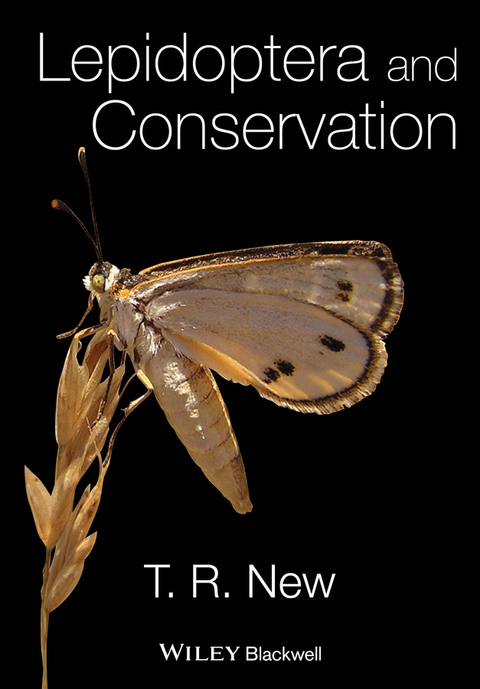
Lepidoptera and Conservation (eBook)
John Wiley & Sons (Verlag)
978-1-118-40923-7 (ISBN)
Much of the foundation of insect conservation has been built on concerns for Lepidoptera, particularly butterflies as the most popular and best studied of all insect groups. The long-accepted worth of butterflies for conservation has led to elucidation of much of the current rationale of insect species conservation, and to definition and management of their critical resources, with attention to the intensively documented British fauna ‘leading the world’ in this endeavour.
In Lepidoptera and Conservation, various themes are treated through relevant examples and case histories, and sufficient background given to enable non-specialist access. Intended for not only entomologists but conservation managers and naturalists due to its readable approach to the subject.
Tim New is Emeritus Professor in the Department of Zoology, La Trobe University, Melbourne. He has written extensively on insectconservation, including volumes on Hymenoptera (2012) and beetles (2010) both published by Wiley-Blackwell. An entomologist with wide interests in insect conservation, systematics and ecology, he is recognised as one of the leading advocates for the importance of insects in conservation.
The third in a trilogy of global overviews of conservation of diverse and ecologically important insect groups. The first two were Beetles in Conservation (2010) and Hymenoptera and Conservation (2012). Each has different priorities and emphases that collectively summarise much of the progress and purpose of invertebrate conservation. Much of the foundation of insect conservation has been built on concerns for Lepidoptera, particularly butterflies as the most popular and best studied of all insect groups. The long-accepted worth of butterflies for conservation has led to elucidation of much of the current rationale of insect species conservation, and to definition and management of their critical resources, with attention to the intensively documented British fauna leading the world in this endeavour. In Lepidoptera and Conservation, various themes are treated through relevant examples and case histories, and sufficient background given to enable non-specialist access. Intended for not only entomologists but conservation managers and naturalists due to its readable approach to the subject.
Tim New is Emeritus Professor in the Department of Zoology, La Trobe University, Melbourne. He has written extensively on insectconservation, including volumes on Hymenoptera (2012) and beetles (2010) both published by Wiley-Blackwell. An entomologist with wide interests in insect conservation, systematics and ecology, he is recognised as one of the leading advocates for the importance of insects in conservation.
Preface viii
Acknowledgements xiii
1 Lepidoptera and Invertebrate Conservation 1
Introduction 1
Biological background 3
Sources of information 11
2 The Diversity of Lepidoptera 16
Introduction 16
Distinguishing taxa 19
Drivers of diversity 28
3 Causes for Concern 32
Introduction: Historical background 32
Extinctions and declines 33
4 Support for Flagship Taxa 40
Introduction 40
Community endeavour 41
Flagships 44
5 Studying and Sampling Lepidoptera for Conservation
48
Introduction 48
Sampling methods 50
Interpretation for conservation 64
Priorities amongst species 66
Priority for conservation 71
Species to areas 76
Critical faunas 82
Related approaches 85
6 Population Structures and Dynamics 94
Introduction: Distinguishing populations 94
Metapopulation biology 97
Vulnerability 108
7 Understanding Habitats 117
Introduction: The meaning of 'habitat' 117
Habitat loss 123
8 Communities and Assemblages 142
Introduction: Expanding the context 142
'Vulnerable groups' 144
Habitats and landscapes 147
Assessing changes 152
Forests 152
Agriculture 153
Urbanisation 155
9 Single Species Studies: Benefits and Limitations
161
Introduction 161
Some case histories 168
The Large blue butterfly, Maculinea arion, in England 169
The Large copper butterfly, Lycaena dispar, in England 170
The Brenton blue butterfly, Orachrysops niobe, in South Africa
172
The Richmond birdwing butterfly, Ornithoptera richmondia, in
Australia 173
The Golden sun-moth, Synemon plana, in south-eastern Australia
174
The New Forest burnet moth, Zygaena viciae, in Scotland 175
The Essex emerald moth, Thetidia smaragdaria maritima, in
England 176
The Fabulous green sphinx of Kaua'i, Tinostoma
smaragditis, in Hawai'i 177
Blackburn's sphinx moth, Manduca blackburni, in
Hawai'i 177
Variety of contexts 179
10 Ex Situ Conservation 183
Introduction: Contexts and needs 183
Lepidoptera in captivity 187
Inbreeding 188
Pathogens 189
Translocations and quality control 190
Assisted colonisation 192
11 Lepidoptera and Protective Legislation 197
Introduction 197
Prohibition of collecting 201
12 Defining and Alleviating Threats: Recovery Planning
206
Introduction: The variety of threats to Lepidoptera 206
Alien species 207
Diseases 209
Climate change 210
Exploitation for human need 214
Light pollution 217
Pesticides 218
Habitat manipulation and management 219
Grazing 225
Mowing 228
Coppicing 229
Burning 229
13 Assessing Conservation Progress, Outcomes and Prospects
241
Introduction 241
Monitoring conservation progress 242
Indicators 246
Future priorities and needs 255
Index 260
"For this reason, it will serve as an important introduction to Lepidoptera conservation for graduate students and biologists, as well as a reference for conservation practitioners." (The Quarterly Review of Biology, 1 December 2015)
"As with New's previous books, this is well written, easy-to-understand, comprehensive, and highly organized, providing a valuable overview of the challenges and goals associated with conservation efforts. Summing Up: Highly recommended. Upper-division undergraduates and above; general readers." (Choice, 1 October 2014)
| Erscheint lt. Verlag | 13.9.2013 |
|---|---|
| Sprache | englisch |
| Themenwelt | Naturwissenschaften ► Biologie ► Ökologie / Naturschutz |
| Naturwissenschaften ► Biologie ► Zoologie | |
| Naturwissenschaften ► Geowissenschaften ► Geologie | |
| Technik | |
| Schlagworte | Advancing • Aesthetic • Agriculture • Attraction • Biowissenschaften • Collectors • conservation • Conservation Science • cumulative • declines • Diversity • Ecological • Entomologie • Entomology • FlagShip • Group • hemisphere • Historical • Information • insect • intricate • Landwirtschaft • largest • leading • Life Sciences • Naturschutzbiologie • Northern • numerous • Orders • People • Pests, Diseases & Weeds • Record • Schädlinge, Krankheiten u. Unkräuter • Schädlinge, Krankheiten u. Unkräuter • Unique |
| ISBN-10 | 1-118-40923-X / 111840923X |
| ISBN-13 | 978-1-118-40923-7 / 9781118409237 |
| Informationen gemäß Produktsicherheitsverordnung (GPSR) | |
| Haben Sie eine Frage zum Produkt? |
 EPUB (Adobe DRM)
Größe: 2,6 MB
Kopierschutz: Adobe-DRM
Adobe-DRM ist ein Kopierschutz, der das eBook vor Mißbrauch schützen soll. Dabei wird das eBook bereits beim Download auf Ihre persönliche Adobe-ID autorisiert. Lesen können Sie das eBook dann nur auf den Geräten, welche ebenfalls auf Ihre Adobe-ID registriert sind.
Details zum Adobe-DRM
Dateiformat: EPUB (Electronic Publication)
EPUB ist ein offener Standard für eBooks und eignet sich besonders zur Darstellung von Belletristik und Sachbüchern. Der Fließtext wird dynamisch an die Display- und Schriftgröße angepasst. Auch für mobile Lesegeräte ist EPUB daher gut geeignet.
Systemvoraussetzungen:
PC/Mac: Mit einem PC oder Mac können Sie dieses eBook lesen. Sie benötigen eine
eReader: Dieses eBook kann mit (fast) allen eBook-Readern gelesen werden. Mit dem amazon-Kindle ist es aber nicht kompatibel.
Smartphone/Tablet: Egal ob Apple oder Android, dieses eBook können Sie lesen. Sie benötigen eine
Geräteliste und zusätzliche Hinweise
Zusätzliches Feature: Online Lesen
Dieses eBook können Sie zusätzlich zum Download auch online im Webbrowser lesen.
Buying eBooks from abroad
For tax law reasons we can sell eBooks just within Germany and Switzerland. Regrettably we cannot fulfill eBook-orders from other countries.
 PDF (Adobe DRM)
Kopierschutz: Adobe-DRM
Adobe-DRM ist ein Kopierschutz, der das eBook vor Mißbrauch schützen soll. Dabei wird das eBook bereits beim Download auf Ihre persönliche Adobe-ID autorisiert. Lesen können Sie das eBook dann nur auf den Geräten, welche ebenfalls auf Ihre Adobe-ID registriert sind.
Details zum Adobe-DRM
Dateiformat: PDF (Portable Document Format)
Mit einem festen Seitenlayout eignet sich die PDF besonders für Fachbücher mit Spalten, Tabellen und Abbildungen. Eine PDF kann auf fast allen Geräten angezeigt werden, ist aber für kleine Displays (Smartphone, eReader) nur eingeschränkt geeignet.
Systemvoraussetzungen:
PC/Mac: Mit einem PC oder Mac können Sie dieses eBook lesen. Sie benötigen eine
eReader: Dieses eBook kann mit (fast) allen eBook-Readern gelesen werden. Mit dem amazon-Kindle ist es aber nicht kompatibel.
Smartphone/Tablet: Egal ob Apple oder Android, dieses eBook können Sie lesen. Sie benötigen eine
Geräteliste und zusätzliche Hinweise
Buying eBooks from abroad
For tax law reasons we can sell eBooks just within Germany and Switzerland. Regrettably we cannot fulfill eBook-orders from other countries.
aus dem Bereich