


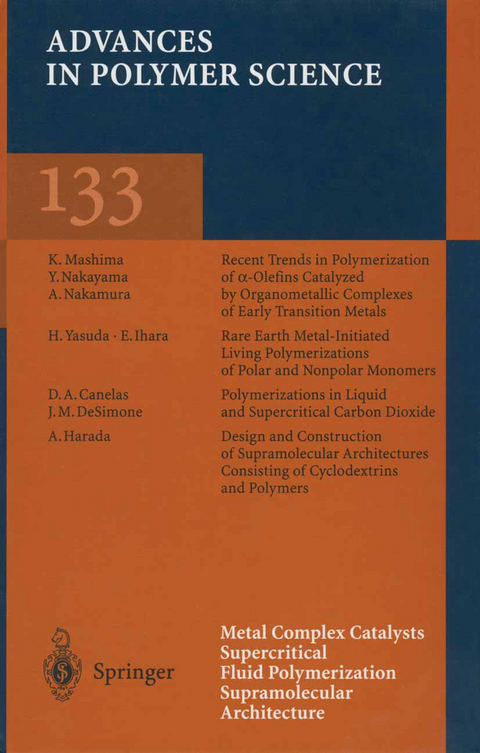
Metal Complex Catalysts Supercritical Fluid Polymerization Supramolecular Architecture
Seiten
2013
Springer Berlin (Verlag)
978-3-662-14793-1 (ISBN)
Springer Berlin (Verlag)
978-3-662-14793-1 (ISBN)
Thepolymerizationofole nsanddi-ole nsisoneofthemostimportanttargets inpolymerscience.Thisreviewarticledescribesrecentprogressinthis eldand deals with organo-transition metal complexes as polymerization catalysts. - cent developments in organometallic chemistry have prompted us to nd a precise description of the mechanism of propagation, chain transfer, and terminationstepsinthehomogeneouslymetal-assistedpolymerizationofole ns anddiole ns.Thus,thisdevelopmentprovidesanideafordesigninganycatalyst systems that are of interest in industry. Recently,the agostic interactionofalkylgroup(s)ontransitionmetalshas emerged as highly basic and new concept and is found to be important in understandingthemechanismofthemetal-catalyzedhomogeneousoligomer- ation and polymerization of a-ole ns. Early transition metal alkyl complexes generallyhavepartiallyionicM C bondsandshowa-agostichydrogeninter- tion that somewhat stabilizes the catalytically active species by providing el- tronsatavacantsite onthe metal.Thisisinsharp contrasttothefactthatlate transition metal alkyl complexes show mainly b-agostic hydrogen interaction that causes the hydrogen transfer easily through b-hydrogen elimination and reductive elimination, and that gives rise to the oligomerization of ole ns. Organometalliccomplexesoftheearlyandlatetransitionmetalshavebeenused as catalysts for ole n oligomerization and polymerization. The mechanism involved in these catalyst systems depends very much upon the kind of metal centersaswellastheirco-ligands,andthusthedi?erentmechanismswhichcan bedistinguishedbydetailedinvestigationsshouldbeassumedforearlyandlate transition metal catalysts. In this contribution, we review the mechanism of polymerization and oligomerization involving early transition metals, taking as our basis recent resultsinadvancedorganometallicchemistry.Firstofall,somerecentexamples of the previous reviews concerning the Ziegler-Natta polymerization are cited [1 10]. Then, relevant new reports are surveyed in a systematic fashion.
Recent Trends in the Polymerization of ?-Olefins Catalyzed by Organometallic Complexes of Early Transition Metals.- Rare Earth Metal-Initiated Living Polymerizations of Polar and Nonpolar Monomers.- Polymerizations in Liquid and Supercritical Carbon Dioxide.- Design and Construction of Supramolecular Architectures Consisting of Cyclodextrins and Polymers.
| Erscheint lt. Verlag | 3.10.2013 |
|---|---|
| Reihe/Serie | Advances in Polymer Science |
| Co-Autor | D.A. Canelas, J.M. DeSimone, A. Harada, E. Ihara, K. Mashima, A. Nakamura, Y. Nakayama, H. Yasuda |
| Zusatzinfo | VII, 207 p. 15 illus., 1 illus. in color. |
| Verlagsort | Berlin |
| Sprache | englisch |
| Maße | 155 x 235 mm |
| Gewicht | 338 g |
| Themenwelt | Naturwissenschaften ► Chemie ► Organische Chemie |
| Naturwissenschaften ► Physik / Astronomie ► Festkörperphysik | |
| Naturwissenschaften ► Physik / Astronomie ► Thermodynamik | |
| Technik ► Maschinenbau | |
| Schlagworte | Analytical Chemistry • Analytische Chemie • Macromolecules • Makromoleküle • Polymer • Polymere • Polymers |
| ISBN-10 | 3-662-14793-9 / 3662147939 |
| ISBN-13 | 978-3-662-14793-1 / 9783662147931 |
| Zustand | Neuware |
| Informationen gemäß Produktsicherheitsverordnung (GPSR) | |
| Haben Sie eine Frage zum Produkt? |
Mehr entdecken
aus dem Bereich

aus dem Bereich


