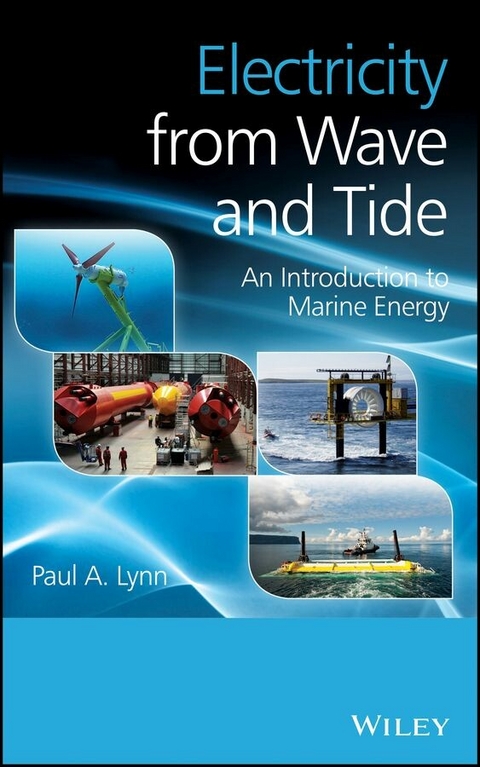
Electricity from Wave and Tide (eBook)
280 Seiten
Wiley (Verlag)
978-1-118-70183-6 (ISBN)
A concise yet technically authoritative overview of modern marine energy devices with the goal of sustainable electricity generation
With 165 full-colour illustrations and photographs of devices at an advanced stage, the book provides inspiring case studies of today’s most promising marine energy devices and developments, including full-scale grid-connected prototypes tested in sea conditions. It also covers the European Marine Energy Centre (EMEC) in Orkney, Scotland, where many of the devices are assessed.
Topics discussed:
- global resources – drawing energy from the World’s waves and tides
- history of wave and tidal stream systems
- theoretical background to modern developments
- conversion of marine energy into grid electricity
- modern wave energy converters and tidal stream energy converters
This book is aimed at a wide readership including professionals, policy makers and employees in the energy sector needing an introduction to marine energy. Its descriptive style and technical level will also appeal to students of renewable energy, and the growing number of people who wish to understand how marine devices can contribute to carbon-free electricity generation in the 21st century.
Dr Paul A. Lynn, Consultant, UK
Paul Lynn was Founding Managing Editor of the successful and highly prestigious Wiley journal, Progress in Photovoltaics,from 1993 until 2006. He was formally Assistant Lecturer at Imperial College London and Lecturer and Reader in Electrical and Electronic Engineering at the University of Bristol from 1969 until 1984.
As a retired academic, Paul Lynn’s continued interest in renewable energy includes designing and building solar-powered boats. He designed and constructed the catamaran that completed the first ever solar-powered voyage along the non-Tidal Thames in 2003. He was awarded 1st and 2nd prizes in the Sustainable Transport section at the Royal Bath & West show in 2008 for two more recent solar catamarans.
Paul Lynn has written six technical books to date and is author of over 50 technical papers and articles.
PAUL A. LYNN obtained his B.Sc.(Eng) and Ph.D. degrees from Imperial College London, UK. After several years in the electrical/electronics industry, he lectured at Imperial College and the University of Bristol. As a retired academic, Dr. Lynn's long-term interest in renewable energy has led to a trilogy of Wiley books (including this one), and three solar-powered boats. He is the author of ten other books and numerous technical papers and articles.
Preface ix
Acknowledgements xi
1. Introduction 1
1.1 Marine energy and Planet Earth 1
1.2 Marine resources 5
1.2.1 Waves of the world 5
1.2.2 Tides of the world 11
1.3 A piece of history 18
1.3.1 Working with waves 18
1.3.2 Tapping tides 23
1.4 Power, energy and performance 27
1.5 Into the future 34
References 37
2. Capturing marine energy 39
2.1 Ocean waves 39
2.1.1 Linear waves 39
2.1.2 Random waves 43
2.1.3 Wave spectra48
2.1.4 Wave modification 52
2.1.5 Wave measurement 56
2.2 Wave energy conversion 59
2.2.1 Introductory 59
2.2.2 Types of wave energy converter 60
2.2.3 Principles of wave energy capture 62
2.2.3.1 Floating devices 62
2.2.3.2 Tuning and damping 64
2.2.3.3 When waves meet WECs 68
2.3 Tidal streams 71
2.3.1 Hydrodynamics 71
2.3.2 Tidal harmonics 76
2.3.3 Predicting tidal streams 83
2.4 Tidal stream energy conversion 86
2.4.1 Introductory 86
2.4.2 Tidal stream turbines 89
2.4.2.1 Turbine sizes and power ratings 89
2.4.2.2 Extracting energy: the Betz Limit 93
2.4.2.3 Lift and drag 96
2.4.2.4 Rotor speed and power coefficient 102
2.4.3 Turbine siting 105
2.5 Research and development 108
2.5.1 Models and test tanks 108
2.5.2 The European Marine Energy Centre (EMEC) 111
2.5.2.1 Wave and tidal test sites 111
2.5.2.2 Research activities 121
References 124
3. Generating electricity 125
3.1 Introductory 125
3.2 Power take-off 126
3.3 AC electricity 130
3.4 Generators 141
3.4.1 Introductory 141
3.4.2 Synchronous generators 147
3.4.3 Asynchronous generators 151
3.4.3.1 Squirrel-cage and wound-rotor induction machines 151
3.4.3.2 Doubly-fed induction generators 157
3.4.4 Linear motion generators 162
3.5 Connecting to the grid 166
3.5.1 Setting the scene 166
3.5.2 Grid strength and fault levels 169
3.5.3 Electrical quality 173
3.6 Large-scale renewable energy 175
3.6.1 Introductory 175
3.6.2 Intermittency and variability176
3.6.3 Capacity credit and backup generation 179
References 183
4. Case studies: Wave energy converters 185
4.1 Introductory 185
4.2 Case studies 186
4.2.1 Pelamis 186
4.2.2 Oyster 192
4.2.3 Limpet andMutriku 199
4.2.4 Wave Dragon 205
4.2.5 PowerBuoy® 211
4.2.6 Penguin 216
References 221
5. Case studies: Tidal stream energy converters 223
5.1 Introductory 223
5.2 Case studies 224
5.2.1 Andritz Hydro Hammerfest 224
5.2.2 Atlantis Resources 229
5.2.3 Marine Current Turbines 234
5.2.4 OpenHydro 240
5.2.5 Pulse Tidal 245
5.2.6 Scotrenewables Tidal Power 251
5.2.7 Tidal Generation 258
References 262
Index 263
"This thoroughly readable and attractively illustrated
volume certainly deserves a place on many a bookshelf."
(Underwater Technology, 1 March 2014)
"With 165 full-colour illustrations and photographs of
devices at an advanced stage, this book is both a valuable primer
on marine energy and an inspiring picture of today's most
promising marine energy devices and developments."
(Real Power magazine, 1 October 2013)
| Erscheint lt. Verlag | 5.9.2013 |
|---|---|
| Sprache | englisch |
| Themenwelt | Technik ► Elektrotechnik / Energietechnik |
| Schlagworte | Computer Science • Electricity from Wave and Tide: An Introduction • Energie • Energietechnik • Energy • generation and grid connection of electricity derived from marine energy • Gezeitenenergie • Informatik • marine energy devices • Parallel and Distributed Computing • Paralleles u. Verteiltes Rechnen • Paul A. Lynn • Power Technology & Power Engineering • Solarenergie u. Photovoltaik • Solar Energy & Photovoltaics • Wasserkraft • wave and tidal stream energy |
| ISBN-10 | 1-118-70183-6 / 1118701836 |
| ISBN-13 | 978-1-118-70183-6 / 9781118701836 |
| Informationen gemäß Produktsicherheitsverordnung (GPSR) | |
| Haben Sie eine Frage zum Produkt? |
 PDF (Adobe DRM)
Größe: 8,9 MB
Kopierschutz: Adobe-DRM
Adobe-DRM ist ein Kopierschutz, der das eBook vor Mißbrauch schützen soll. Dabei wird das eBook bereits beim Download auf Ihre persönliche Adobe-ID autorisiert. Lesen können Sie das eBook dann nur auf den Geräten, welche ebenfalls auf Ihre Adobe-ID registriert sind.
Details zum Adobe-DRM
Dateiformat: PDF (Portable Document Format)
Mit einem festen Seitenlayout eignet sich die PDF besonders für Fachbücher mit Spalten, Tabellen und Abbildungen. Eine PDF kann auf fast allen Geräten angezeigt werden, ist aber für kleine Displays (Smartphone, eReader) nur eingeschränkt geeignet.
Systemvoraussetzungen:
PC/Mac: Mit einem PC oder Mac können Sie dieses eBook lesen. Sie benötigen eine
eReader: Dieses eBook kann mit (fast) allen eBook-Readern gelesen werden. Mit dem amazon-Kindle ist es aber nicht kompatibel.
Smartphone/Tablet: Egal ob Apple oder Android, dieses eBook können Sie lesen. Sie benötigen eine
Geräteliste und zusätzliche Hinweise
Zusätzliches Feature: Online Lesen
Dieses eBook können Sie zusätzlich zum Download auch online im Webbrowser lesen.
Buying eBooks from abroad
For tax law reasons we can sell eBooks just within Germany and Switzerland. Regrettably we cannot fulfill eBook-orders from other countries.
 EPUB (Adobe DRM)
Kopierschutz: Adobe-DRM
Adobe-DRM ist ein Kopierschutz, der das eBook vor Mißbrauch schützen soll. Dabei wird das eBook bereits beim Download auf Ihre persönliche Adobe-ID autorisiert. Lesen können Sie das eBook dann nur auf den Geräten, welche ebenfalls auf Ihre Adobe-ID registriert sind.
Details zum Adobe-DRM
Dateiformat: EPUB (Electronic Publication)
EPUB ist ein offener Standard für eBooks und eignet sich besonders zur Darstellung von Belletristik und Sachbüchern. Der Fließtext wird dynamisch an die Display- und Schriftgröße angepasst. Auch für mobile Lesegeräte ist EPUB daher gut geeignet.
Systemvoraussetzungen:
PC/Mac: Mit einem PC oder Mac können Sie dieses eBook lesen. Sie benötigen eine
eReader: Dieses eBook kann mit (fast) allen eBook-Readern gelesen werden. Mit dem amazon-Kindle ist es aber nicht kompatibel.
Smartphone/Tablet: Egal ob Apple oder Android, dieses eBook können Sie lesen. Sie benötigen eine
Geräteliste und zusätzliche Hinweise
Buying eBooks from abroad
For tax law reasons we can sell eBooks just within Germany and Switzerland. Regrettably we cannot fulfill eBook-orders from other countries.
aus dem Bereich