


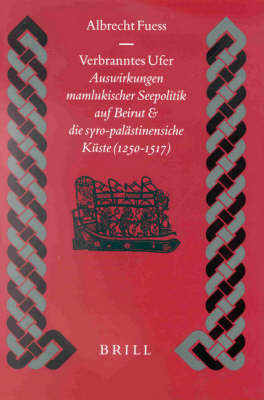
Verbranntes Ufer
Auswirkungen mamlukischer Seepolitik auf Beirut und die syro-palästinensische Küste (1250-1517)
Seiten
2001
Brill (Verlag)
978-90-04-12108-9 (ISBN)
Brill (Verlag)
978-90-04-12108-9 (ISBN)
Verbranntes Ufer zeichnet erstmals das Bild der Entwicklung der syro-palästinensischen Hafenstädte nach der Vertreibung der letzten Kreuzfahrer mit Hilfe lokaler Chroniken wie den Werken von Sāliḥ Ibn Yaḥyā und Ibn Sibāṭ. Die Mamluken zerstörten die Küstenstädte, um den Kreuzfahrern keinen potentiellen Brückenkopf für eine erneute Landung zu geben. Auf die Politik des verbrannten Ufers griffen die Mamluken zurück, weil sie keine planvolle Seepolitik betrieben. Daher besaßen sie keine Flotte, mit der sie die Küste schon auf dem Meer hätten verteidigen können. Nach einer einführenden Diskussion der Gründe, warum die Mamluken keine Flotte aufbauten, folgt im Haupteil die Beschreibung der Geschichte der syro-palästinensischen Küste. Abgeschlossen wird das Werk durch eine analytische Darstellung der Sozialgeschichte der Küste, dem administrativen Aufbau der lokalen Verwaltung und dem Handel zwischen Europa und der Levante, wozu auch Dokumente aus dem Archivio di Stato von Venedig herangezogen wurden.
Verbranntes Ufer is the first complete presentation of the history of the Syro-Palestinian coast after the expulsion of the last crusaders as it appears in the local chronicles of Sāliḥ Ibn Yaḥyā und Ibn Sibāṭ. The Mamluks destroyed the coastal towns in order to leave no bridge head for a potential return of the crusaders. They maintained a policy of burned shore because they had no systematic sea policy. Therefore they did not develop a fleet to defend the coast. After discussing the reasons, why the Mamluks never constructed a fleet the main part of the work deals with the political history of the Syro-Palestinian coast. The work ends with an analytic description of the social history of the coast, the structure of the local administration and the trade between Europe and the Mamluk Empire, which is based on documents of the Archivio di Stato in Venice.
Verbranntes Ufer is the first complete presentation of the history of the Syro-Palestinian coast after the expulsion of the last crusaders as it appears in the local chronicles of Sāliḥ Ibn Yaḥyā und Ibn Sibāṭ. The Mamluks destroyed the coastal towns in order to leave no bridge head for a potential return of the crusaders. They maintained a policy of burned shore because they had no systematic sea policy. Therefore they did not develop a fleet to defend the coast. After discussing the reasons, why the Mamluks never constructed a fleet the main part of the work deals with the political history of the Syro-Palestinian coast. The work ends with an analytic description of the social history of the coast, the structure of the local administration and the trade between Europe and the Mamluk Empire, which is based on documents of the Archivio di Stato in Venice.
Albrecht Fuess, Ph.D. (2000) in Islamic History, University of Cologne, Germany, has studied in Cologne and Cairo. During the work on his dissertation he was visiting fellow at the Orient-Institut, Beirut and the School of Oriental and African Studies, London.
| Erscheint lt. Verlag | 28.9.2001 |
|---|---|
| Reihe/Serie | Islamic History and Civilization ; 39 |
| Verlagsort | Leiden |
| Sprache | deutsch |
| Maße | 155 x 235 mm |
| Gewicht | 1085 g |
| Themenwelt | Geisteswissenschaften ► Geschichte ► Regional- / Ländergeschichte |
| Geschichte ► Teilgebiete der Geschichte ► Kulturgeschichte | |
| Geisteswissenschaften ► Religion / Theologie ► Islam | |
| Technik ► Architektur | |
| ISBN-10 | 90-04-12108-0 / 9004121080 |
| ISBN-13 | 978-90-04-12108-9 / 9789004121089 |
| Zustand | Neuware |
| Informationen gemäß Produktsicherheitsverordnung (GPSR) | |
| Haben Sie eine Frage zum Produkt? |
Mehr entdecken
aus dem Bereich



aus dem Bereich
Die Revolution des Gemeinen Mannes
Buch | Softcover (2024)
C.H.Beck (Verlag)
CHF 16,80
Eine Geschichte des Geschmacks
Buch | Hardcover (2025)
C.H.Beck (Verlag)
CHF 49,95
vom Mittelalter bis zur Gegenwart
Buch | Softcover (2024)
C.H.Beck (Verlag)
CHF 16,80


