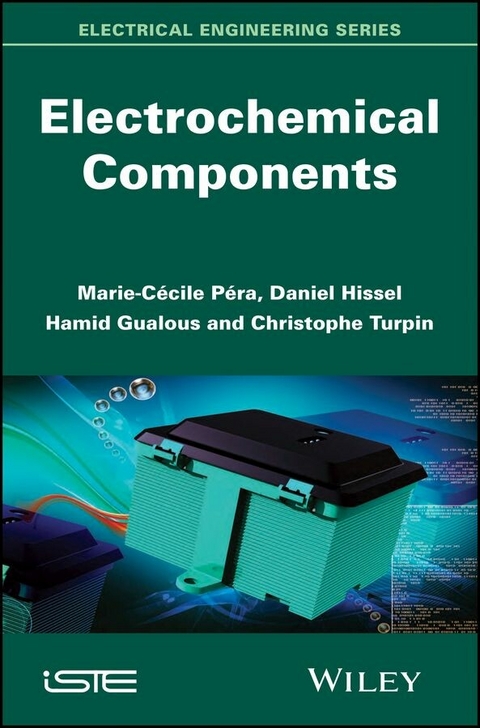
Electrochemical Components (eBook)
John Wiley & Sons (Verlag)
978-1-118-57691-5 (ISBN)
This book focuses on the methods of storage commonly used in hybrid systems.
After an introductory chapter reviewing the basics of electrochemistry, Chapter 2 is given over to the storage of electricity in the form of hydrogen. Once hydrogen has been made, we have to be able to convert it back into electricity on demand. This can be done with another energy converter: a fuel cell, the subject of Chapter 3. Such a system is unable to deliver significant dynamics in terms of storage and release of electricity and needs to be supplemented with another solution: a detailed study of supercapacitors is provided in Chapter 4.While the storage systems touched upon in the previous three chapters (hydrogen batteries and supercapacitors) both exhibit advantageous characteristics, at present they are still relatively costly. Thus, the days of the electrochemical accumulator by no means appear to be numbered just yet. This will therefore be the topic of Chapter 5. Finally, on the basis of the elements laid down in the previous chapters, Chapter 6 will focus on electrical hybridization of these storage systems, with a view to enhancing the performance (in terms of energy, lifetime, cost, etc.) of the newly formed system.
Aimed at an audience of researchers, industrialists, academics, teachers and students, many exercises, along with corrected solutions, are provided throughout the book.
Contents
1. Basic Concepts of Electrochemistry used in Electrical Engineering.
2. Water Electrolyzers.
3. Fuel Cells.
4. Electrical Energy Storage by Supercapacitors.
5. Electrochemical Accumulators.
6. Hybrid Electrical System.
About the Authors
Marie-Cécile Péra is a Full Professor at the University of Franche-Comte in France and Deputy Director of the FEMTO-ST Institute (CNRS). Her research activities include modeling, control and diagnosis of electric power generation systems (fuel cells – PEMFC and SOFC, supercapacities, batteries) for transportation and stationary applications. She has contributed to more than 180 articles in international journals and conferences.
Daniel Hissel is Full Professor at the University of Franche-Comte in France and Director of the Fuel Cell Lab Research Federation (CNRS). He also leads a research team devoted to hybrid electrical systems in the FEMTO-ST Institute (CNRS). He has published more than 250 research papers on modeling, control, diagnostics and prognostics of hybrid electrical systems.
Hamid Gualous is Full Professor at the University of Caen Lower Normandy in France and director of the LUSAC laboratory. His current research interests include power electronics, electric energy storage, power and energy systems and energy management.
Christophe Turpin is Full Researcher at the CNRS (French National Center for Scientific Research). He is responsible for hydrogen activities within the Laboratory LAPLACE, Toulouse, France. His research activities include the characterization and modeling of fuel cells and electrolyzers, the state of health of these components, and their hybridization with other electrochemical components (ultracapacitors, batteries) within optimized energy systems for stationary and aeronautical applications.
This book focuses on the methods of storage commonly used in hybrid systems. After an introductory chapter reviewing the basics of electrochemistry, Chapter 2 is given over to the storage of electricity in the form of hydrogen. Once hydrogen has been made, we have to be able to convert it back into electricity on demand. This can be done with another energy converter: a fuel cell, the subject of Chapter 3. Such a system is unable to deliver significant dynamics in terms of storage and release of electricity and needs to be supplemented with another solution: a detailed study of supercapacitors is provided in Chapter 4.While the storage systems touched upon in the previous three chapters (hydrogen batteries and supercapacitors) both exhibit advantageous characteristics, at present they are still relatively costly. Thus, the days of the electrochemical accumulator by no means appear to be numbered just yet. This will therefore be the topic of Chapter 5. Finally, on the basis of the elements laid down in the previous chapters, Chapter 6 will focus on electrical hybridization of these storage systems, with a view to enhancing the performance (in terms of energy, lifetime, cost, etc.) of the newly formed system. Aimed at an audience of researchers, industrialists, academics, teachers and students, many exercises, along with corrected solutions, are provided throughout the book.
Marie-Cécile Péra is Full Professor at the University of Franche-Comte in France and Deputy Director of the FEMTO-ST Institute (CNRS). Her research activities include modeling, control and diagnosis of electrical power generation systems (fuel cells - PEMFC and SOFC, supercapacities, batteries) for transportation and stationary applications. Daniel Hissel is Full Professor at the University of Franche-Comte in France and Director of the Fuel Cell Lab Research Federation (CNRS). He also leads a research team devoted to hybrid electrical systems in the FEMTO-ST Institute (CNRS). Hamid Gualous is Full Professor at the University of Caen Lower Normandy in France and director of the LUSAC laboratory. His current research interests include power electronics, electric energy storage, power and energy systems and energy management. Christophe Turpin is Full Researcher at the CNRS. He is responsible for hydrogen activities within the Laboratory LAPLACE, Toulouse, France. His research activities include the characterization and modeling of fuel cells and electrolyzers, the state of health of these components and their hybridization with other electrochemical components (ultracapacitators, batteries) within optimized energy systems for stationary and aeronautical applications.
1. Basic concepts of electrochemistry for electrical engineering.
2. Water electrolyzers.
3. Fuel cells.
4. Electrical energy storage through ultracapacitors.
5. Electrochemical cells.
6. Hybrid electrical system.
| Erscheint lt. Verlag | 2.8.2013 |
|---|---|
| Sprache | englisch |
| Themenwelt | Technik ► Elektrotechnik / Energietechnik |
| Schlagworte | Basic concepts of electrochemistry for electrical engineering • Christophe Turpin • Components & Devices • Daniel Hissel • Electrical & Electronics Engineering • Electrical energy storage through ultracapacitors • Electrochemical cells • Electrochemical Components • Elektrotechnik u. Elektronik • Fuel cells • Hamid Gualous • Hybrid electrical system • Komponenten u. Bauelemente • Marie-Cécile Pera • Water electrolyzes |
| ISBN-10 | 1-118-57691-8 / 1118576918 |
| ISBN-13 | 978-1-118-57691-5 / 9781118576915 |
| Informationen gemäß Produktsicherheitsverordnung (GPSR) | |
| Haben Sie eine Frage zum Produkt? |
 EPUB (Adobe DRM)
Größe: 12,4 MB
Kopierschutz: Adobe-DRM
Adobe-DRM ist ein Kopierschutz, der das eBook vor Mißbrauch schützen soll. Dabei wird das eBook bereits beim Download auf Ihre persönliche Adobe-ID autorisiert. Lesen können Sie das eBook dann nur auf den Geräten, welche ebenfalls auf Ihre Adobe-ID registriert sind.
Details zum Adobe-DRM
Dateiformat: EPUB (Electronic Publication)
EPUB ist ein offener Standard für eBooks und eignet sich besonders zur Darstellung von Belletristik und Sachbüchern. Der Fließtext wird dynamisch an die Display- und Schriftgröße angepasst. Auch für mobile Lesegeräte ist EPUB daher gut geeignet.
Systemvoraussetzungen:
PC/Mac: Mit einem PC oder Mac können Sie dieses eBook lesen. Sie benötigen eine
eReader: Dieses eBook kann mit (fast) allen eBook-Readern gelesen werden. Mit dem amazon-Kindle ist es aber nicht kompatibel.
Smartphone/Tablet: Egal ob Apple oder Android, dieses eBook können Sie lesen. Sie benötigen eine
Geräteliste und zusätzliche Hinweise
Zusätzliches Feature: Online Lesen
Dieses eBook können Sie zusätzlich zum Download auch online im Webbrowser lesen.
Buying eBooks from abroad
For tax law reasons we can sell eBooks just within Germany and Switzerland. Regrettably we cannot fulfill eBook-orders from other countries.
 PDF (Adobe DRM)
Kopierschutz: Adobe-DRM
Adobe-DRM ist ein Kopierschutz, der das eBook vor Mißbrauch schützen soll. Dabei wird das eBook bereits beim Download auf Ihre persönliche Adobe-ID autorisiert. Lesen können Sie das eBook dann nur auf den Geräten, welche ebenfalls auf Ihre Adobe-ID registriert sind.
Details zum Adobe-DRM
Dateiformat: PDF (Portable Document Format)
Mit einem festen Seitenlayout eignet sich die PDF besonders für Fachbücher mit Spalten, Tabellen und Abbildungen. Eine PDF kann auf fast allen Geräten angezeigt werden, ist aber für kleine Displays (Smartphone, eReader) nur eingeschränkt geeignet.
Systemvoraussetzungen:
PC/Mac: Mit einem PC oder Mac können Sie dieses eBook lesen. Sie benötigen eine
eReader: Dieses eBook kann mit (fast) allen eBook-Readern gelesen werden. Mit dem amazon-Kindle ist es aber nicht kompatibel.
Smartphone/Tablet: Egal ob Apple oder Android, dieses eBook können Sie lesen. Sie benötigen eine
Geräteliste und zusätzliche Hinweise
Buying eBooks from abroad
For tax law reasons we can sell eBooks just within Germany and Switzerland. Regrettably we cannot fulfill eBook-orders from other countries.
aus dem Bereich