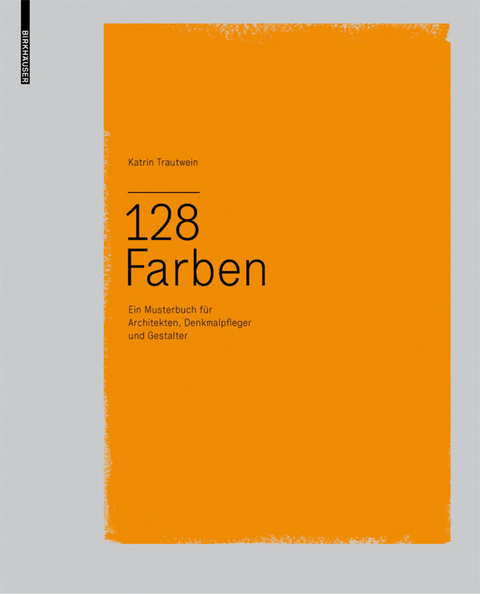
128 Farben (eBook)
296 Seiten
Birkhäuser (Verlag)
978-3-0346-1169-5 (ISBN)
Ein neues Instrument für eine überzeugende Auswahl von Farben
Starting with A. Rüegg's book Polychromie Architecturale, the American-born chemist studied the recipes of all sixty-three shads that Le Corbusier developed for Salubra between 1931 and 1959. In 1998 she founded the pigment company kt.color in Uster, near Zurich. In 2000 she received an exclusive license from the Fondation Le Corbusier to produce the sixty-three colors as artists' colors and wall paints (interior and exterior) and to distribute them worldwide. Since then, she has been expanding production, assembling additional color recipes (more than 900 in all), developing a comprehensive palette of whites, working with historically important colors that the industry has neglected (e.g., Yves Klein's ultramarine blue and Semper's Pompeian red) but whose use still makes sense today, not only for aesthetic reasons but also economic and ecological reasons. In addition to producing pigments, Katrin Trautwein is a consultant to architects and developers and is asked for second opinions; she also offers regular seminars for architects, interior designers, house painters, and so on, on the subjects such as crafts; color design; pigment colors; principles of materials; the color concepts behind Le Corbusier's palette; light and shadow colors; new objects, new color concepts, and so on. She is called in for restoration projects to determine colors and provide materials (Le Corbuser's Maison Blanche, Lux Guyer's Saffa-Haus, and others); she gives lectures throughout Europe and in the United States.
lt;P>Ausgehend von der Publikation „Polychromie Architecturale" (A. Rüegg) unternahm die aus den USA stammende Chemikerin die Erforschung der Rezepte aller 63 Farbtöne, die Le Corbusier zwischen 1931 und 1959 für die Firma Salubra entwickelt hat.
1998 gründete sie die Farbenmanufaktur kt.color in Uster bei Zürich. 2000 erhielt sie die exklusive Lizenz der Fondation Le Corbusier, die 63 Farben als Künstlerfarben und als Wandfarben (für innen und außen) herzustellen und weltweit vertreiben zu dürfen.
Seitdem baute sie ihre Manufaktur weiter aus, stellte weitere Farbrezepturen zusammen (insgesamt über 900), entwickelte eine umfassende Weißpalette, beschäftigte sich mit historisch bedeutsamen Farben, die von der Industrie vernachlässigt worden sind (z.B. das Ultramarinblau von Yves Klein oder das Pompeijanischrot von Semper u.a.) und die im heutigen Einsatz sinnvoll sind, und zwar sowohl unter ästhetischen als auch wirtschaftlichen und ökologischen Aspekten.
Neben der Herstellung von Farben wird Katrin Trautwein von Architekten und Bauherren zu Beratung und second opinion herangezogen, außerdem bietet sie regelmäßig Fachseminare für Architekten, Innenarchitekten, Flächenmaler usw. zu den Themen Handwerk; Farbgestaltung; Pigmentfarben; Materialgrundlagen; Farbkonzepte mit Le Corbusiers Palette; Licht- und Schattenfarben; Neue Objekte, neue Farbkonzepte usw. an.
Bei restauratorischen Projekten wird sie zur Farbbestimmung und Materialbeschaffung hinzugezogen (LC: Maison Blanche, Lux Guyer: Saffa-Haus u.a.); sie hält europaweit und in den USA Vorträge.
Starting with A. Rüegg’s book Polychromie Architecturale, the American-born chemist studied the recipes of all sixty-three shads that Le Corbusier developed for Salubra between 1931 and 1959. In 1998 she founded the pigment company kt.color in Uster, near Zurich. In 2000 she received an exclusive license from the Fondation Le Corbusier to produce the sixty-three colors as artists’ colors and wall paints (interior and exterior) and to distribute them worldwide. Since then, she has been expanding production, assembling additional color recipes (more than 900 in all), developing a comprehensive palette of whites, working with historically important colors that the industry has neglected (e.g., Yves Klein’s ultramarine blue and Semper’s Pompeian red) but whose use still makes sense today, not only for aesthetic reasons but also economic and ecological reasons. In addition to producing pigments, Katrin Trautwein is a consultant to architects and developers and is asked for second opinions; she also offers regular seminars for architects, interior designers, house painters, and so on, on the subjects such as crafts; color design; pigment colors; principles of materials; the color concepts behind Le Corbusier’s palette; light and shadow colors; new objects, new color concepts, and so on. She is called in for restoration projects to determine colors and provide materials (Le Corbuser’s Maison Blanche, Lux Guyer’s Saffa-Haus, and others); she gives lectures throughout Europe and in the United States.
Einleitung 6
Kapitel 1. Weiße Farben 17
Kapitel 2. Graue und schwarze Farben 53
Kapitel 3. Umbren 77
Kapitel 4. Bronzen und Metallics 103
Kapitel 5. Gelbe Farben 113
Kapitel 6. Ocker 127
Kapitel 7. Orange Farben 147
Kapitel 8. Rote Farben 163
Kapitel 9. Rote Ocker und braune Farben 181
Kapitel 10. Karmin, Violett und Purpur 201
Kapitel 11. Blaue Farben 225
Kapitel 12. Grüne Farben 263
| Erscheint lt. Verlag | 13.12.2012 |
|---|---|
| Zusatzinfo | 128 col. ill. |
| Verlagsort | Basel/Berlin/Boston |
| Sprache | deutsch |
| Themenwelt | Technik ► Architektur |
| Schlagworte | Farbdesign • Farbmaterial • Farbsystem • Farbwahrnehmung • Farbzusammenstellung |
| ISBN-10 | 3-0346-1169-2 / 3034611692 |
| ISBN-13 | 978-3-0346-1169-5 / 9783034611695 |
| Informationen gemäß Produktsicherheitsverordnung (GPSR) | |
| Haben Sie eine Frage zum Produkt? |
 PDF (Wasserzeichen)
Größe: 1,2 MB
DRM: Digitales Wasserzeichen
Dieses eBook enthält ein digitales Wasserzeichen und ist damit für Sie personalisiert. Bei einer missbräuchlichen Weitergabe des eBooks an Dritte ist eine Rückverfolgung an die Quelle möglich.
Dateiformat: PDF (Portable Document Format)
Mit einem festen Seitenlayout eignet sich die PDF besonders für Fachbücher mit Spalten, Tabellen und Abbildungen. Eine PDF kann auf fast allen Geräten angezeigt werden, ist aber für kleine Displays (Smartphone, eReader) nur eingeschränkt geeignet.
Systemvoraussetzungen:
PC/Mac: Mit einem PC oder Mac können Sie dieses eBook lesen. Sie benötigen dafür einen PDF-Viewer - z.B. den Adobe Reader oder Adobe Digital Editions.
eReader: Dieses eBook kann mit (fast) allen eBook-Readern gelesen werden. Mit dem amazon-Kindle ist es aber nicht kompatibel.
Smartphone/Tablet: Egal ob Apple oder Android, dieses eBook können Sie lesen. Sie benötigen dafür einen PDF-Viewer - z.B. die kostenlose Adobe Digital Editions-App.
Buying eBooks from abroad
For tax law reasons we can sell eBooks just within Germany and Switzerland. Regrettably we cannot fulfill eBook-orders from other countries.
aus dem Bereich