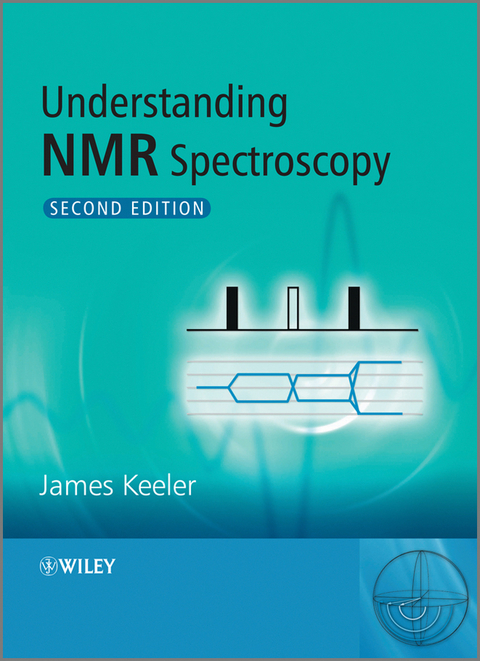
Understanding NMR Spectroscopy (eBook)
John Wiley & Sons (Verlag)
978-1-118-72334-0 (ISBN)
- How product operators can be extended to describe experiments in AX2 and AX3 spin systems, thus making it possible to discuss the important APT, INEPT and DEPT experiments often used in carbon-13 NMR.
- Spin system analysis i.e. how shifts and couplings can be extracted from strongly-coupled (second-order) spectra.
- How the presence of chemically equivalent spins leads to spectral features which are somewhat unusual and possibly misleading, even at high magnetic fields.
- A discussion of chemical exchange effects has been introduced in order to help with the explanation of transverse relaxation.
- The double-quantum spectroscopy of a three-spin system is now considered in more detail.
Reviews of the First Edition
'For anyone wishing to know what really goes on in their NMR experiments, I would highly recommend this book' - Chemistry World
'...I warmly recommend for budding NMR spectroscopists, or others who wish to deepen their understanding of elementary NMR theory or theoretical tools' - Magnetic Resonance in Chemistry
Dr James Keeler is a Senior Lecturer in Chemistry at the University of Cambridge, and a Fellow of Selwyn College. In addition to being actively involved in the development of new NMR techniques, he is also responsible for the undergraduate chemistry course, and is Editor-In-chief of Magnetic Resonance in Chemistry. Dr Keeler is well-known for his clear and accessible exposition of NMR spectroscopy.
This text is aimed at people who have some familiarity with high-resolution NMR and who wish to deepen their understanding of how NMR experiments actually work . This revised and updated edition takes the same approach as the highly-acclaimed first edition. The text concentrates on the description of commonly-used experiments and explains in detail the theory behind how such experiments work. The quantum mechanical tools needed to analyse pulse sequences are introduced set by step, but the approach is relatively informal with the emphasis on obtaining a good understanding of how the experiments actually work. The use of two-colour printing and a new larger format improves the readability of the text. In addition, a number of new topics have been introduced: How product operators can be extended to describe experiments in AX2 and AX3 spin systems, thus making it possible to discuss the important APT, INEPT and DEPT experiments often used in carbon-13 NMR. Spin system analysis i.e. how shifts and couplings can be extracted from strongly-coupled (second-order) spectra. How the presence of chemically equivalent spins leads to spectral features which are somewhat unusual and possibly misleading, even at high magnetic fields. A discussion of chemical exchange effects has been introduced in order to help with the explanation of transverse relaxation. The double-quantum spectroscopy of a three-spin system is now considered in more detail. Reviews of the First Edition For anyone wishing to know what really goes on in their NMR experiments, I would highly recommend this book Chemistry World I warmly recommend for budding NMR spectroscopists, or others who wish to deepen their understanding of elementary NMR theory or theoretical tools Magnetic Resonance in Chemistry
Dr James Keeler is a Senior Lecturer in Chemistry at the University of Cambridge, and a Fellow of Selwyn College. In addition to being actively involved in the development of new NMR techniques, he is also responsible for the undergraduate chemistry course, and is Editor-In-chief of Magnetic Resonance in Chemistry. Dr Keeler is well-known for his clear and accessible exposition of NMR spectroscopy.
Cover 1
Title Page 5
Contents 11
Preface 7
Preface to the first edition 8
1 What this book is about and who should read it 17
1.1 How this book is organized 18
1.2 Scope and limitations 19
1.3 Context and further reading 19
1.4 On-line resources 20
1.5 Abbreviations and acronyms 20
2 Setting the scene 21
2.1 NMR frequencies and chemical shifts 21
2.2 Linewidths, lineshapes and integrals 25
2.3 Scalar coupling 26
2.4 The basic NMR experiment 29
2.5 Frequency, oscillations and rotations 31
2.6 Photons 36
2.7 Moving on 37
2.8 Further reading 37
2.9 Exercises 38
3 Energy levels and NMR spectra 39
3.1 The problem with the energy level approach 40
3.2 Introducing quantum mechanics 42
3.3 The spectrum from one spin 47
3.4 Writing the Hamiltonian in frequency units 50
3.5 The energy levels for two coupled spins 51
3.6 The spectrum from two coupled spins 54
3.7 Three spins 56
3.8 Summary 60
3.9 Further reading 60
3.10 Exercises 61
4 The vector model 63
4.1 The bulk magnetization 63
4.2 Larmor precession 66
4.3 Detection 67
4.4 Pulses 68
4.5 On-resonance pulses 73
4.6 Detection in the rotating frame 76
4.7 The basic pulse–acquire experiment 76
4.8 Pulse calibration 77
4.9 The spin echo 79
4.10 Pulses of different phases 82
4.11 Off-resonance effects and soft pulses 83
4.12 Moving on 87
4.13 Further reading 87
4.14 Exercises 88
5 Fourier transformation and data processing 93
5.1 How the Fourier transform works 94
5.2 Representing the FID 98
5.3 Lineshapes and phase 99
5.4 Manipulating the FID and the spectrum 106
5.5 Zero filling 115
5.6 Truncation 116
5.7 Further reading 117
5.8 Exercises 118
6 The quantum mechanics of one spin 121
6.1 Introduction 121
6.2 Superposition states 122
6.3 Some quantum mechanical tools 123
6.4 Computing the bulk magnetization 128
6.5 Summary 133
6.6 Time evolution 134
6.7 RF pulses 139
6.8 Making faster progress: the density operator 142
6.9 Coherence 150
6.10 Further reading 151
6.11 Exercises 152
7 Product operators 155
7.1 Operators for one spin 155
7.2 Analysis of pulse sequences for a one-spin system 159
7.3 Speeding things up 162
7.4 Operators for two spins 165
7.5 In-phase and anti-phase terms 168
7.6 Hamiltonians for two spins 173
7.7 Notation for heteronuclear spin systems 173
7.8 Spin echoes and J-modulation 174
7.9 Coherence transfer 182
7.10 The INEPT experiment 183
7.11 Selective COSY 187
7.12 Coherence order and multiple-quantum coherences 189
7.13 Summary 194
7.14 Further reading 195
7.15 Exercises 196
8 Two-dimensional NMR 199
8.1 The general scheme for two-dimensional NMR 200
8.2 Modulation and lineshapes 203
8.3 COSY 206
8.4 DQF COSY 216
8.5 Double-quantum spectroscopy 219
8.6 Heteronuclear correlation spectra 224
8.7 HSQC 225
8.8 HMQC 228
8.9 Long-range correlation: HMBC 231
8.10 HETCOR 236
8.11 TOCSY 237
8.12 Frequency discrimination and lineshapes 242
8.13 Further reading 252
8.14 Exercises 254
9 Relaxation and the NOE 257
9.1 The origin of relaxation 258
9.2 Relaxation mechanisms 265
9.3 Describing random motion – the correlation time 267
9.4 Populations 274
9.5 Longitudinal relaxation behaviour of isolated spins 279
9.6 Longitudinal dipolar relaxation of two spins 283
9.7 The NOE 290
9.8 Transverse relaxation 302
9.9 Homogeneous and inhomogeneous broadening 316
9.10 Relaxation due to chemical shift anisotropy 320
9.11 Cross correlation 322
9.12 Summary 327
9.13 Further reading 327
9.14 Exercises 329
10Advanced topics in two-dimensional NMR 335
10.1 Product operators for three spins 336
10.2 COSY for three spins 341
10.3 Reduced multiplets in COSY spectra 346
10.4 Polarization operators 353
10.5 ZCOSY 361
10.6 HMBC 363
10.7 Sensitivity-enhanced experiments 365
10.8 Constant time experiments 369
10.9 TROSY 374
10.10 Double-quantum spectroscopy of a three-spin system 382
10.11 Further reading 390
10.12 Exercises 392
11Coherence selection: phase cycling and field gradient pulses 397
11.1 Coherence order 398
11.2 Coherence transfer pathways 403
11.3 Frequency discrimination and lineshapes 405
11.4 The receiver phase 407
11.5 Introducing phase cycling 411
11.6 Some phase cycling ‘tricks’ 417
11.7 Axial peak suppression 419
11.8 CYCLOPS 419
11.9 Examples of practical phase cycles 420
11.10 Concluding remarks about phase cycling 424
11.11 Introducing field gradient pulses 425
11.12 Features of selection using gradients 432
11.13 Examples of using gradient pulses 437
11.14 Advantages and disadvantages of coherence selection with gradients 442
11.15 Suppression of zero-quantum coherence 442
11.16 Selective excitation with the aid of gradients 448
11.17 Further reading 451
11.18 Exercises 452
12 Equivalent spins and spin system analysis 457
12.1 Strong coupling in a two-spin system 458
12.2 Chemical and magnetic equivalence 462
12.3 Product operators for AXn (InS) spin systems 466
12.4 Spin echoes in InS spin systems 471
12.5 INEPT in InS spin systems 474
12.6 DEPT 478
12.7 Spin system analysis 484
12.8 Further reading 493
12.9 Exercises 494
13 How the spectrometer works 499
13.1 The magnet 499
13.2 The probe 501
13.3 The transmitter 502
13.4 The receiver 504
13.5 Digitizing the signal 505
13.6 Quadrature detection 507
13.7 The pulse programmer 509
13.8 Further reading 509
13.9 Exercises 510
ASome mathematical topics 511
A.1 The exponential function and logarithms 511
A.2 Complex numbers 513
A.3 Trigonometric identities 515
A.4 Further reading 516
Index 517
| Erscheint lt. Verlag | 21.5.2013 |
|---|---|
| Sprache | englisch |
| Themenwelt | Naturwissenschaften ► Chemie ► Analytische Chemie |
| Naturwissenschaften ► Physik / Astronomie | |
| Technik | |
| Schlagworte | analyse pulse • Analytical Chemistry • Analytische Chemie • Approach • Chemie • Chemistry • commonlyused • concentrates • Description • Detail • Edition • experiments • Familiarity • First • highlyacclaimed • Highresolution • Mechanical • NMR • NMR Spectroscopy / MRI / Imaging • NMR-Spektroskopie • NMR-Spektroskopie / MRT / Bildgebende Verfahren • People • sequences • SET • spectroscopy • Spektroskopie • STEP • theory • Tools • Understanding • Work |
| ISBN-10 | 1-118-72334-1 / 1118723341 |
| ISBN-13 | 978-1-118-72334-0 / 9781118723340 |
| Informationen gemäß Produktsicherheitsverordnung (GPSR) | |
| Haben Sie eine Frage zum Produkt? |
 PDF (Adobe DRM)
Kopierschutz: Adobe-DRM
Adobe-DRM ist ein Kopierschutz, der das eBook vor Mißbrauch schützen soll. Dabei wird das eBook bereits beim Download auf Ihre persönliche Adobe-ID autorisiert. Lesen können Sie das eBook dann nur auf den Geräten, welche ebenfalls auf Ihre Adobe-ID registriert sind.
Details zum Adobe-DRM
Dateiformat: PDF (Portable Document Format)
Mit einem festen Seitenlayout eignet sich die PDF besonders für Fachbücher mit Spalten, Tabellen und Abbildungen. Eine PDF kann auf fast allen Geräten angezeigt werden, ist aber für kleine Displays (Smartphone, eReader) nur eingeschränkt geeignet.
Systemvoraussetzungen:
PC/Mac: Mit einem PC oder Mac können Sie dieses eBook lesen. Sie benötigen eine
eReader: Dieses eBook kann mit (fast) allen eBook-Readern gelesen werden. Mit dem amazon-Kindle ist es aber nicht kompatibel.
Smartphone/Tablet: Egal ob Apple oder Android, dieses eBook können Sie lesen. Sie benötigen eine
Geräteliste und zusätzliche Hinweise
Buying eBooks from abroad
For tax law reasons we can sell eBooks just within Germany and Switzerland. Regrettably we cannot fulfill eBook-orders from other countries.
aus dem Bereich