Enables chemical engineering students to bridge theory and practice
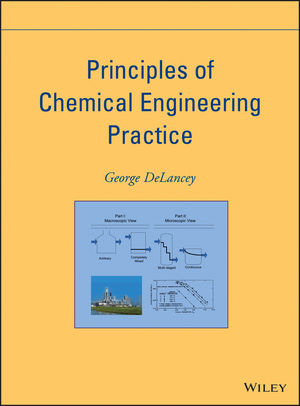
Integrating scientific principles with practical engineering experience, this text enables readers to master the fundamentals of chemical processing and apply their knowledge of such topics as material and energy balances, transport phenomena, reactor design, and separations across a broad range of chemical industries. The author skillfully guides readers step by step through the execution of both chemical process analysis and equipment design.
Principles of Chemical Engineering Practice is divided into two sections: the Macroscopic View and the Microscopic View. The Macroscopic View examines equipment design and behavior from the vantage point of inlet and outlet conditions. The Microscopic View is focused on the equipment interior resulting from conditions prevailing at the equipment boundaries. As readers progress through the text, they'll learn to master such chemical engineering operations and equipment as:
- Separators to divide a mixture into parts with desirable concentrations
- Reactors to produce chemicals with needed properties
- Pressure changers to create favorable equilibrium and rate conditions
- Temperature changers and heat exchangers to regulate and change the temperature of process streams
Throughout the book, the author sets forth examples that refer to a detailed simulation of a process for the manufacture of acrylic acid that provides a unifying thread for equipment sizing in context. The manufacture of hexyl glucoside provides a thread for process design and synthesis.
Presenting basic thermodynamics, Principles of Chemical Engineering Practice enables students in chemical engineering and related disciplines to master and apply the fundamentals and to proceed to more advanced studies in chemical engineering.
GEORGE DeLANCEY, PhD, is Professor Emeritus in the Department of Chemical Engineering and Materials Science at Stevens Institute of Technology. He has more than forty years experience in chemical engineering education, having taught process analysis and process control in the undergraduate school. He has twice been the recipient of the Outstanding Teacher Award at Stevens. He has served as Senior Academic Advisor to the International Programs Office at Stevens with curriculum development responsibilities in gas and plastics engineering and technology programs at the Algerian Petroleum Institute. Dr. DeLancey has more than thirty publications in the areas of multicomponent mass and energy transfer with chemical reaction, interfacial mass and energy transfer in gas–liquid systems, and chemical engineering education and assessment.
Enables chemical engineering students to bridge theory and practice Integrating scientific principles with practical engineering experience, this text enables readers to master the fundamentals of chemical processing and apply their knowledge of such topics as material and energy balances, transport phenomena, reactor design, and separations across a broad range of chemical industries. The author skillfully guides readers step by step through the execution of both chemical process analysis and equipment design. Principles of Chemical Engineering Practice is divided into two sections: the Macroscopic View and the Microscopic View. The Macroscopic View examines equipment design and behavior from the vantage point of inlet and outlet conditions. The Microscopic View is focused on the equipment interior resulting from conditions prevailing at the equipment boundaries. As readers progress through the text, they'll learn to master such chemical engineering operations and equipment as: Separators to divide a mixture into parts with desirable concentrations Reactors to produce chemicals with needed properties Pressure changers to create favorable equilibrium and rate conditions Temperature changers and heat exchangers to regulate and change the temperature of process streams Throughout the book, the author sets forth examples that refer to a detailed simulation of a process for the manufacture of acrylic acid that provides a unifying thread for equipment sizing in context. The manufacture of hexyl glucoside provides a thread for process design and synthesis. Presenting basic thermodynamics, Principles of Chemical Engineering Practice enables students in chemical engineering and related disciplines to master and apply the fundamentals and to proceed to more advanced studies in chemical engineering.
GEORGE DeLANCEY, PhD, is Professor Emeritus in the Department of Chemical Engineering and Materials Science at Stevens Institute of Technology. He has more than forty years experience in chemical engineering education, having taught process analysis and process control in the undergraduate school. He has twice been the recipient of the Outstanding Teacher Award at Stevens. He has served as Senior Academic Advisor to the International Programs Office at Stevens with curriculum development responsibilities in gas and plastics engineering and technology programs at the Algerian Petroleum Institute. Dr. DeLancey has more than thirty publications in the areas of multicomponent mass and energy transfer with chemical reaction, interfacial mass and energy transfer in gas-liquid systems, and chemical engineering education and assessment.
"The author, a professor emeritus of chemical engineering
at Stevens Institute of Technology, guides readers step by step
through the execution of both chemical process analysis and
equipment design, allowing readers to master such chemical
engineering operations and equipment as separators, reactors, heat
exchangers, and more." (Chemical Engineering
Progress, 1 September 2013)
| Erscheint lt. Verlag | 22.5.2013 |
|---|---|
| Sprache | englisch |
| Themenwelt | Naturwissenschaften ► Chemie ► Technische Chemie |
| Technik ► Maschinenbau | |
| Technik ► Umwelttechnik / Biotechnologie | |
| Schlagworte | chemical engineering • chemical engineering, degrees of freedom analysis, practical plant design, momentum transport, mass transfer, process analysis, plant design, reactor design, second law efficiency calculations • Chemie • Chemische Verfahrenstechnik • Chemistry • Industrial Chemistry • Maschinenbau • mechanical engineering • Technische u. Industrielle Chemie |
| ISBN-13 | 9781118612781 / 9781118612781 |
| Informationen gemäß Produktsicherheitsverordnung (GPSR) | |
| Haben Sie eine Frage zum Produkt? |
 EPUB (Adobe DRM)
Kopierschutz: Adobe-DRM
Adobe-DRM ist ein Kopierschutz, der das eBook vor Mißbrauch schützen soll. Dabei wird das eBook bereits beim Download auf Ihre persönliche Adobe-ID autorisiert. Lesen können Sie das eBook dann nur auf den Geräten, welche ebenfalls auf Ihre Adobe-ID registriert sind.
Details zum Adobe-DRM
Dateiformat: EPUB (Electronic Publication)
EPUB ist ein offener Standard für eBooks und eignet sich besonders zur Darstellung von Belletristik und Sachbüchern. Der Fließtext wird dynamisch an die Display- und Schriftgröße angepasst. Auch für mobile Lesegeräte ist EPUB daher gut geeignet.
Systemvoraussetzungen:
PC/Mac: Mit einem PC oder Mac können Sie dieses eBook lesen. Sie benötigen eine
eReader: Dieses eBook kann mit (fast) allen eBook-Readern gelesen werden. Mit dem amazon-Kindle ist es aber nicht kompatibel.
Smartphone/Tablet: Egal ob Apple oder Android, dieses eBook können Sie lesen. Sie benötigen eine
Geräteliste und zusätzliche Hinweise
Buying eBooks from abroad
For tax law reasons we can sell eBooks just within Germany and Switzerland. Regrettably we cannot fulfill eBook-orders from other countries.
aus dem Bereich