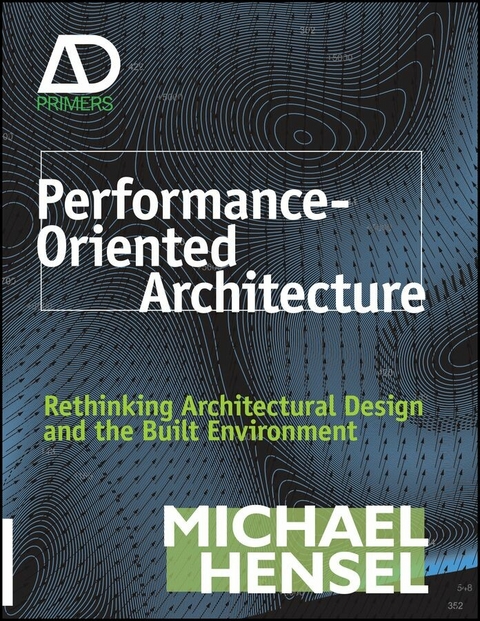
Performance-Oriented Architecture (eBook)
John Wiley & Sons (Verlag)
978-1-118-57013-5 (ISBN)
Architecture is on the brink. It is a discipline in crisis. Over the last two decades, architectural debate has diversified to the point of fragmentation and exhaustion. What is called for is an overarching argument or set of criteria on which to approach the design and construction of the built environment. Here, the internationally renowned architect and educator Michael Hensel advocates an entirely different way of thinking about architecture. By favouring a new focus on performance, he rejects longstanding conventions in design and the built environment. This not only bridges the gap between academia and practice, but, even more significantly, the treatment of form and function in design. It also has a far-reaching impact on knowledge production and development, placing an important emphasis on design research in architecture and the value of an interdisciplinary approach.
Though ‘performance’ first evolved as a concept in the humanities in the 1940s and 1950s, it has never previously been systematically applied in architecture in an inclusive manner. Here Michael Hensel offers Performance-Orientated Architecture as an integrative approach to architectural design, the built environment and questions of sustainability. He highlights how core concepts and specific traits, such as climate, material performance and settlement patterns, can put architecture in the service of the natural environment. A wide range of examples are cited to support his argument, from traditional sustainable buildings, such as the Kahju Bridge in Isfahan and the Topkapí Palace in Istanbul to more contemporary works by Cloud 9, Foreign Office Architects, Steven Holl and OCEAN.
Michael Hensel is an architect, researcher, educator and writer. He is Professor of Architecture at the Oslo School of Architecture and Design where he directs the Research Center for Architecture and Tectonics. He cofounded OCEAN in 1994, and is founding and current chairman of the OCEAN Design Research Association and the Sustainable Environment Association, as well as an editorial board member of Architectural Design (AD). He has co-guest-edited five titles of AD, including seminal issues on emergence and the architecture of Turkey and Iran. He is currently writing The Handbook for Traditional Sustainable Buildings for John Wiley & Sons.
Architecture is on the brink. It is a discipline in crisis. Over the last two decades, architectural debate has diversified to the point of fragmentation and exhaustion. What is called for is an overarching argument or set of criteria on which to approach the design and construction of the built environment. Here, the internationally renowned architect and educator Michael Hensel advocates an entirely different way of thinking about architecture. By favouring a new focus on performance, he rejects longstanding conventions in design and the built environment. This not only bridges the gap between academia and practice, but, even more significantly, the treatment of form and function in design. It also has a far-reaching impact on knowledge production and development, placing an important emphasis on design research in architecture and the value of an interdisciplinary approach. Though performance first evolved as a concept in the humanities in the 1940s and 1950s, it has never previously been systematically applied in architecture in an inclusive manner. Here Michael Hensel offers Performance-Orientated Architecture as an integrative approach to architectural design, the built environment and questions of sustainability. He highlights how core concepts and specific traits, such as climate, material performance and settlement patterns, can put architecture in the service of the natural environment. A wide range of examples are cited to support his argument, from traditional sustainable buildings, such as the Kahju Bridge in Isfahan and the Topkap Palace in Istanbul to more contemporary works by Cloud 9, Foreign Office Architects, Steven Holl and OCEAN.
Michael Hensel is an architect, researcher, educator and writer. He is Professor of Architecture at the Oslo School of Architecture and Design where he directs the Research Center for Architecture and Tectonics. He cofounded OCEAN in 1994, and is founding and current chairman of the OCEAN Design Research Association and the Sustainable Environment Association, as well as an editorial board member of Architectural Design (AD). He has co-guest-edited five titles of AD, including seminal issues on emergence and the architecture of Turkey and Iran. He is currently writing The Handbook for Traditional Sustainable Buildings for John Wiley & Sons.
Dedication 005
Acknowledgements 005
Foreword by David Leatherbarrow 009
Introduction: The Task at Hand 015
Chapter 1: A Brief History of the Notion of Performance 017
Chapter 2: A Brief History of the Notion of Performance in Architecture 023
Chapter 3: Non-Discrete Architectures 031
Chapter 4: Non-Anthropocentric Architectures 045
Chapter 5: Traits of Performance-Oriented Architecture 053
Local Climate and Microclimate 057
Material Performance 059
The Active Boundary, the Articulated Envelope and Heterogeneous Environments 067
The Extended Threshold 082
Second-Degree Auxiliarity: Supplementary Architectures 095
First-Degree Auxiliarity: Embedded Architectures 109
Multiple Grounds and Settlement Patterns 116
Chapter 6: The Road(s) Ahead 133
Select Bibliography 143
Index 148
Picture Credits 152
| Erscheint lt. Verlag | 20.5.2013 |
|---|---|
| Reihe/Serie | Architectural Design Primer |
| Architectural Design Primer | Architectural Design Primer |
| Sprache | englisch |
| Themenwelt | Technik ► Architektur |
| Schlagworte | Architecture • Architecture Special Topics • Architektur • brink • built • called • conventions • Crisis • Criteria • Debate • Design • Discipline • entirely different way • Environment • focus • internationally • Last • longstanding • New • overarching argument • Performance • Point • Spezialthemen Architektur • two |
| ISBN-10 | 1-118-57013-8 / 1118570138 |
| ISBN-13 | 978-1-118-57013-5 / 9781118570135 |
| Informationen gemäß Produktsicherheitsverordnung (GPSR) | |
| Haben Sie eine Frage zum Produkt? |
 PDF (Adobe DRM)
Größe: 37,2 MB
Kopierschutz: Adobe-DRM
Adobe-DRM ist ein Kopierschutz, der das eBook vor Mißbrauch schützen soll. Dabei wird das eBook bereits beim Download auf Ihre persönliche Adobe-ID autorisiert. Lesen können Sie das eBook dann nur auf den Geräten, welche ebenfalls auf Ihre Adobe-ID registriert sind.
Details zum Adobe-DRM
Dateiformat: PDF (Portable Document Format)
Mit einem festen Seitenlayout eignet sich die PDF besonders für Fachbücher mit Spalten, Tabellen und Abbildungen. Eine PDF kann auf fast allen Geräten angezeigt werden, ist aber für kleine Displays (Smartphone, eReader) nur eingeschränkt geeignet.
Systemvoraussetzungen:
PC/Mac: Mit einem PC oder Mac können Sie dieses eBook lesen. Sie benötigen eine
eReader: Dieses eBook kann mit (fast) allen eBook-Readern gelesen werden. Mit dem amazon-Kindle ist es aber nicht kompatibel.
Smartphone/Tablet: Egal ob Apple oder Android, dieses eBook können Sie lesen. Sie benötigen eine
Geräteliste und zusätzliche Hinweise
Zusätzliches Feature: Online Lesen
Dieses eBook können Sie zusätzlich zum Download auch online im Webbrowser lesen.
Buying eBooks from abroad
For tax law reasons we can sell eBooks just within Germany and Switzerland. Regrettably we cannot fulfill eBook-orders from other countries.
 EPUB (Adobe DRM)
Kopierschutz: Adobe-DRM
Adobe-DRM ist ein Kopierschutz, der das eBook vor Mißbrauch schützen soll. Dabei wird das eBook bereits beim Download auf Ihre persönliche Adobe-ID autorisiert. Lesen können Sie das eBook dann nur auf den Geräten, welche ebenfalls auf Ihre Adobe-ID registriert sind.
Details zum Adobe-DRM
Dateiformat: EPUB (Electronic Publication)
EPUB ist ein offener Standard für eBooks und eignet sich besonders zur Darstellung von Belletristik und Sachbüchern. Der Fließtext wird dynamisch an die Display- und Schriftgröße angepasst. Auch für mobile Lesegeräte ist EPUB daher gut geeignet.
Systemvoraussetzungen:
PC/Mac: Mit einem PC oder Mac können Sie dieses eBook lesen. Sie benötigen eine
eReader: Dieses eBook kann mit (fast) allen eBook-Readern gelesen werden. Mit dem amazon-Kindle ist es aber nicht kompatibel.
Smartphone/Tablet: Egal ob Apple oder Android, dieses eBook können Sie lesen. Sie benötigen eine
Geräteliste und zusätzliche Hinweise
Buying eBooks from abroad
For tax law reasons we can sell eBooks just within Germany and Switzerland. Regrettably we cannot fulfill eBook-orders from other countries.
aus dem Bereich