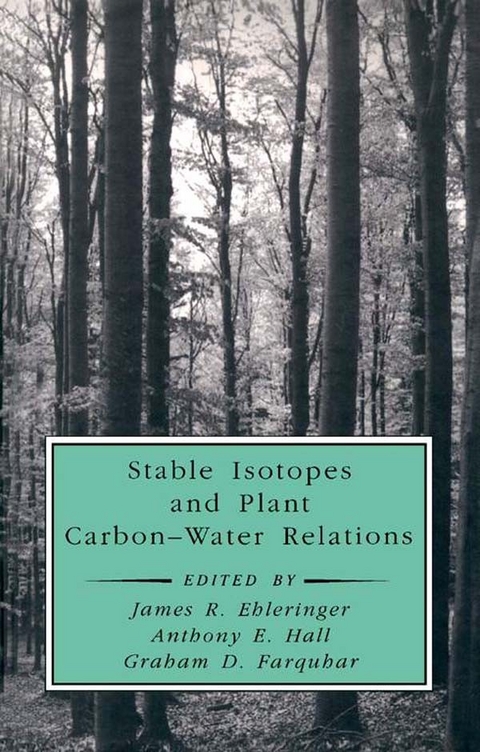
Stable Isotopes and Plant Carbon-Water Relations (eBook)
555 Seiten
Elsevier Science (Verlag)
978-0-08-091801-3 (ISBN)
This 33-chapter volume presents a critical examination of the importance of stable isotopes in understanding key plant metabolic processes. - Carbon isotope analyses for estimates of plant water use and metabolism- Integrated estimates of stress impacts and life history in ecological systems- Hydrogen and oxygen isotope analyses for evaluating water sources and transpiration- Use of stable isotopes in scaling from leaf to global levels- Sections include: History and Theoretical Considerations, Ecological Aspects of Carbon Isotope Variation, Agricultural Aspects of Carbon Isotope Variation, Genetics and Isotopic Variation, Water Relations and Isotopic Composition
Contributors
Numbers in parentheses indicate the pages on which the authors’ contributions begin.
Edmundo Acevedo(399), International Maize and Wheat Improvement Center, (CIMMYT), Wheat Program, 06600 Mexico, D.F., Mexico
Kay H. Asay(269), U.S. Department of Agriculture, Agricultural Research Service, Forage and Range Research Laboratory, Utah State University, Logan, Utah 84322-6300
David Barnhart(419), Department of Botany and Plant Sciences, University of California, Riverside, Riverside, California 92521
Joseph A. Berry(529), Department of Plant Biology, Carnegie Institution of Washington, Stanford, California 94305
Thomas W. Boutton(297), Department of Rangeland Ecology and Management, Texas A&M University, College Station, Texas 77843
Mark S.J. Broadmeadow(109), Department of Agricultural and Environmental Science, University of Newcastle upon Tyne, Newcastle NE1 7RU, United Kingdom
Enrico Brugnoli(93), CNR, Istituto per l’Agroselvicoltura, via Marconi 2, Porano (TR), 05010 Italy
Jaime Cavelier(131), Departamento de Biologia, Universidad de Los Andes, Bogota, Apdo Aereo 4976, Colombia
Anthony G. Condon(435, 451), Commonwealth Scientific Industrial Research Organization, Division of Plant Industry, Canberra, ACT 2601, Australia
Todd E. Dawson(465), Section of Ecology and Systematics, Cornell University, Ithaca, New York 14853
Bahman Ehdaie(419), Department of Botany and Plant Sciences, University of California, Riverside, Riverside, California 92521
James R. Ehleringer(9, 155, 201, 297), Stable Isotope Ratio Facility for Environmental Research and Department of Biology, University of Utah, Salt Lake City, Utah 84112
Christine G. Elsik(227), Department of Forest Science, Texas Agricultural Experiment Station, Texas A&M University, College Station, Texas 77843
Graham D. Farquhar(47, 247, 371), Research School of Biological Sciences, Institute of Advanced Studies, Australian National University, Canberra, ACT 2601, Australia
Richard B. Flagler(227, 297), Department of Forest Science, Texas A&M University, College Station, Texas 77843
Lawrence B. Flanagan(71), Department of Biology, Carleton University, Ottawa, Ontario, Canada K1S 5B6
Qingnong A. Fu1(297), Department of Rangeland Ecology and Management, Texas A&M University, College Station, Texas 77843
Ann Gibson(311), Department of Forestry, Australian National University, Canberra, ACT 2601, Australia
Larry Giles(529), Botany Department, Duke University, Durham, North Carolina 27706
David A. Grantz(327), University of California, Kearney Agricultural Center, Parlier, California 93648
Howard Griffiths(109), Department of Agricultural and Environmental Science, University of Newcastle upon Tyne, Newcastle NE1 7RU, United Kingdom
Anthony E. Hall(349), Department of Botany and Plant Sciences, University of California, Riverside, Riverside, California 92521
Noel M. Holbrook(131), Department of Biological Sciences, Stanford University, Stanford, California 94305
Kerry T. Hubick(247, 311), Exploitable Science and Technology, Department of Industry, Technology, and Commerce, Canberra, ACT 2601, Australia
Abdelbagi M. Ismail(349), Department of Botany and Plant Sciences, University of California, Riverside, Riverside, California 92521
Paula C. Jackson(131), Department of Biology and Laboratory of Biomedical and Environmental Sciences, University of California, Los Angeles, Los Angeles, California 90024
Douglas A. Johnson(269), U.S. Department of Agriculture, Agricultural Research Service, Forage and Range Research Laboratory, Utah State University, Logan, Utah 84322-6300
Richard C. Johnson(281), U.S. Department of Agriculture, Agricultural Research Service, Western Regional Plant Introduction Station, Pullman, Washington 99164
Marco Lauteri(93), CNR, Istituto per l’Agroselvicoltura, via Marconi 2, Porano (TR), 05010 Italy
Guanghui Lin(497), Department of Biology, University of Miami, Coral Gables, Florida 33124
Nigel J. Livingston(141), Department of Biology, University of Victoria, Victoria, British Columbia, Canada V8W 2Y2
Jon Lloyd(47), Plant Environmental Biology Group, Research School of Biological Sciences, Institute of Advanced Studies, Australian National University, Canberra, ACT 2601, Australia
Christina Máguas(201), Botanical Department, Ecology Section, Lisbon University, 1700 Lisbon, Portugal
John D. Marshall(187), Department of Forest Resources, University of Idaho, Moscow, Idaho 83843
Josette Masle(371), Research School of Biological Sciences, Institute of Advanced Studies, Australian National University, GPO Box 475, Canberra, ACT 2601, Australia
Cristina M. Menendez(349), Department of Botany and Plant Sciences, University of California, Riverside, Riverside, California 92521
Marion H. O’Leary(19), Department of Biochemistry, University of Nebraska at Lincoln, Lincoln, Nebraska 68583
C. Barry Osmond(529), Botany Department, Duke University, Durham, North Carolina 27706
Mark T. Patterson(213), Laboratory of Biomedical and Environmental Sciences, and Department of Biology, University of California, Los Angeles, Los Angeles, California 90024
Fermin Rada(131), Departamento de Biologia, Universidad de Los Andes, Merida 5101 Venezuela
R. C. Nageswara Rao(247), Legumes Program, International Crop Research Institute for the Semi-Arid Tropics, Hyderabad, India
John J. Read(269), U.S. Department of Agriculture, Agricultural Research...
| Erscheint lt. Verlag | 2.12.2012 |
|---|---|
| Mitarbeit |
Herausgeber (Serie): Bernard Saugier |
| Sprache | englisch |
| Themenwelt | Naturwissenschaften ► Biologie ► Botanik |
| Naturwissenschaften ► Biologie ► Evolution | |
| Naturwissenschaften ► Biologie ► Ökologie / Naturschutz | |
| Technik | |
| ISBN-10 | 0-08-091801-8 / 0080918018 |
| ISBN-13 | 978-0-08-091801-3 / 9780080918013 |
| Informationen gemäß Produktsicherheitsverordnung (GPSR) | |
| Haben Sie eine Frage zum Produkt? |
 EPUB (Adobe DRM)
Kopierschutz: Adobe-DRM
Adobe-DRM ist ein Kopierschutz, der das eBook vor Mißbrauch schützen soll. Dabei wird das eBook bereits beim Download auf Ihre persönliche Adobe-ID autorisiert. Lesen können Sie das eBook dann nur auf den Geräten, welche ebenfalls auf Ihre Adobe-ID registriert sind.
Details zum Adobe-DRM
Dateiformat: EPUB (Electronic Publication)
EPUB ist ein offener Standard für eBooks und eignet sich besonders zur Darstellung von Belletristik und Sachbüchern. Der Fließtext wird dynamisch an die Display- und Schriftgröße angepasst. Auch für mobile Lesegeräte ist EPUB daher gut geeignet.
Systemvoraussetzungen:
PC/Mac: Mit einem PC oder Mac können Sie dieses eBook lesen. Sie benötigen eine
eReader: Dieses eBook kann mit (fast) allen eBook-Readern gelesen werden. Mit dem amazon-Kindle ist es aber nicht kompatibel.
Smartphone/Tablet: Egal ob Apple oder Android, dieses eBook können Sie lesen. Sie benötigen eine
Geräteliste und zusätzliche Hinweise
Buying eBooks from abroad
For tax law reasons we can sell eBooks just within Germany and Switzerland. Regrettably we cannot fulfill eBook-orders from other countries.
aus dem Bereich