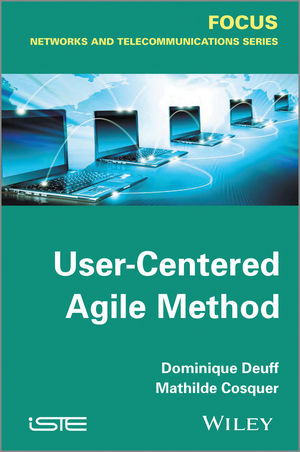
User-Centered Agile Method (eBook)
128 Seiten
John Wiley & Sons (Verlag)
9781118574799 (ISBN)
However, it was not until the early 2000s that they began to be
widely used in industry. This growth was often due to the advent of
Internet services requiring faster cycles of development in order
to heighten the rate at which an ever-greater number of
functionalities were made available. In parallel, user-centered
design (UCD) methods were also becoming more and more widely used:
hence, user-centered design and agile methods were bound to cross
paths, at least in the telecoms industry! During this period, in
the field of telecommunications, the explosion in the number of
connected terminals, Web applications, new use environments
(particularly in a domestic setting), etc., meant it was crucial to
gain a fuller understanding of users' requirements and better
evaluate the relevance and acceptance of services' attempts
to cater for these requirements. Thus the user-centered agile
method, as proposed in this book, aims to mutually integrate two
existing methods: user-centered design - as used by
ergonomists - and the agile Scrum method - as used by
developers. The user testing method is also covered. Analyzing work
on this subject spanning the past 10 years, the authors also
provide an assessment of the feedback on the user-centered agile
method. The method described in this book has been based on all
these sources. It is a framework relying on the logic introduced by
Scrum, i.e. a framework based on project management. The method
proposed is seen as an extension of Scrum which is "centered
on humans" because of the integration of user-centered design
and user-testing. Therefore the description of the user-centered
agile method is based on the basics of the agile Scrum method and
uses its terminology and elements. As well as descriptive elements
of the user-centered agile method, practical examples of how to
implement it are also provided.
Contents
1. Introduction.
2. Intrioduction to the Methods Employed.
3. Sources for this Work.
4. Description of The User-Centered Agile Method.
5. Case Studies.
About the Authors
Dominique Deuff worked at the National Institute of Informatics
in Japan for 2½ years before coming back to France in June
2006 and joining Orange Labs France Telecom as a developer in a
Scrum team. In 2008, she graduated with a Master's degree in
ergonomics and has since then been applying her new skills to
various projects at Orange Labs Lannion.
Mathilde Cosquer joined Orange Labs as an ergonomist after
completing her PhD on the question of transparency of technical
devices from the user's point of view. She has taken part in
the design and evaluation of numerous innovating services, but over
the past four years, she has been more particularly involved in
projects of interpersonal communication services.
Dominique Deuff worked at the National Institute of Informatics in Japan for 2? years before coming back to France in June 2006 and joining Orange Labs France Telecom as a developer in a Scrum team. In 2008, she graduated with a Master's degree in ergonomics and has since then been applying her new skills to various projects at Orange Labs Lannion. Mathilde Cosquer joined Orange Labs as an ergonomist after completing her PhD on the question of transparency of technical devices from the user's point of view. She has taken part in the design and evaluation of numerous innovating services, but over the past four years, she has been more particularly involved in projects of interpersonal communication services.
FOREWORD vii
Jean-Michel PORTUGAL and Claude DALOZ
CHAPTER 1. INTRODUCTION 1
CHAPTER 2. INTRODUCTION TO THE METHODS
EMPLOYED 5
2.1. The agile method - Scrum 5
2.1.1. Fundamental elements of agile methods 5
2.1.2. Scrum method 7
2.1.3. Scrum method as a framework for the User-Centered Agile
method 12
2.2. User-Centered Design method 14
2.3. User testing method 17
CHAPTER 3. SOURCES FOR THIS WORK 21
3.1. State of the art 21
3.1.1. Existing models 23
3.1.2. Recurring elements between feedback reports 29
3.2. Feedback on application of the first version of the UCA
method 36
3.3. Elements retained for the construction of the UCA
method 38
CHAPTER 4. DESCRIPTION OF THE USER-CENTERED AGILE METHOD
41
4.1. Roles present 42
4.2. Ceremonies 43
4.3. Artifacts 44
4.4. Progression of the method 48
4.4.1. Phase 1: design of a global view of the product 48
4.4.2. Phase 2: development 58
4.4.3. Phase 3: validation 79
4.5. Implication of the method in terms of workload 80
4.5.1. Phase 1: design of a global view of the product 80
4.5.2. Phase 2: development 81
4.5.3. Phase 3: validation 82
CHAPTER 5. CASE STUDIES 85
5.1. Application of the User-Centered Agile method on the
Cat's Eyes project 85
5.1.1. Overview of the project 85
5.1.2. Actors involved in the project and their
roles 87
5.1.3. Description of the progression of the project 88
5.1.4. Feedback relating to the method 93
5.2. Application of the User-Centered Agile method on the Bind
project 95
5.2.1. Overview of the project 95
5.2.2. Actors involved in the project and their
roles 97
5.2.3. Description of the progression of the project 98
5.2.4. Feedback relating to the method 102
5.3. Balanced evaluation of the case studies 104
CONCLUSION 107
BIBLIOGRAPHY 109
INDEX 115
| Erscheint lt. Verlag | 6.5.2013 |
|---|---|
| Sprache | englisch |
| Themenwelt | Technik ► Elektrotechnik / Energietechnik |
| Technik ► Nachrichtentechnik | |
| Schlagworte | Communication Technology - Networks • Electrical & Electronics Engineering • Elektrotechnik u. Elektronik • Kommunikationsnetz • Kommunikationsnetze |
| ISBN-13 | 9781118574799 / 9781118574799 |
| Informationen gemäß Produktsicherheitsverordnung (GPSR) | |
| Haben Sie eine Frage zum Produkt? |
 PDF (Adobe DRM)
Kopierschutz: Adobe-DRM
Adobe-DRM ist ein Kopierschutz, der das eBook vor Mißbrauch schützen soll. Dabei wird das eBook bereits beim Download auf Ihre persönliche Adobe-ID autorisiert. Lesen können Sie das eBook dann nur auf den Geräten, welche ebenfalls auf Ihre Adobe-ID registriert sind.
Details zum Adobe-DRM
Dateiformat: PDF (Portable Document Format)
Mit einem festen Seitenlayout eignet sich die PDF besonders für Fachbücher mit Spalten, Tabellen und Abbildungen. Eine PDF kann auf fast allen Geräten angezeigt werden, ist aber für kleine Displays (Smartphone, eReader) nur eingeschränkt geeignet.
Systemvoraussetzungen:
PC/Mac: Mit einem PC oder Mac können Sie dieses eBook lesen. Sie benötigen eine
eReader: Dieses eBook kann mit (fast) allen eBook-Readern gelesen werden. Mit dem amazon-Kindle ist es aber nicht kompatibel.
Smartphone/Tablet: Egal ob Apple oder Android, dieses eBook können Sie lesen. Sie benötigen eine
Geräteliste und zusätzliche Hinweise
Buying eBooks from abroad
For tax law reasons we can sell eBooks just within Germany and Switzerland. Regrettably we cannot fulfill eBook-orders from other countries.
aus dem Bereich