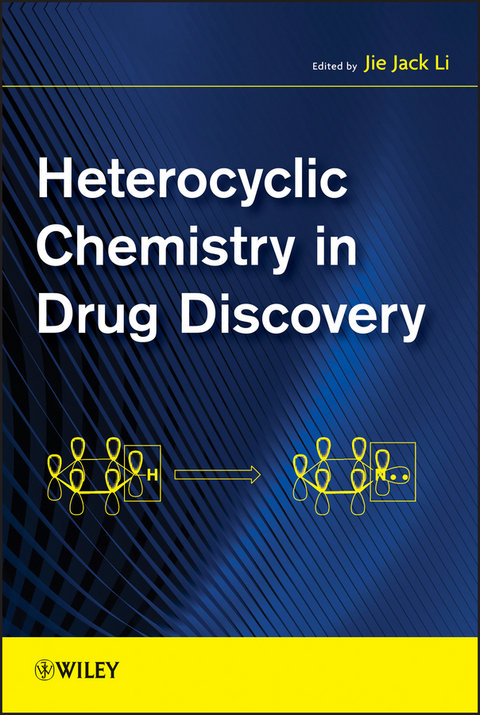
Heterocyclic Chemistry in Drug Discovery (eBook)
John Wiley & Sons (Verlag)
978-1-118-35443-8 (ISBN)
Enables researchers to fully realize the potential to discover new pharmaceuticals among heterocyclic compounds
Integrating heterocyclic chemistry and drug discovery, this innovative text enables readers to understand how and why these two fields go hand in hand in the effective practice of medicinal chemistry. Contributions from international leaders in the field review more than 100 years of findings, explaining their relevance to contemporary drug discovery practice. Moreover, these authors have provided plenty of practical guidance and tips based on their own academic and industrial laboratory experience, helping readers avoid common pitfalls.
Heterocyclic Chemistry in Drug Discovery is ideal for readers who want to fully realize the almost limitless potential to discover new and effective pharmaceuticals among heterocyclic compounds, the largest and most varied family of organic compounds. The book features:
- Several case studies illustrating the role and application of 3, 4, 5, and 6+ heterocyclic ring systems in drug discovery
- Step-by-step descriptions of synthetic methods and practical techniques
- Examination of the physical properties for each heterocycle, including NMR data and quantum calculations
- Detailed explanations of the complexity and intricacies of reactivity and stability for each class of heterocycles
Heterocyclic Chemistry in Drug Discovery is recommended as a textbook for organic and medicinal chemistry courses, particularly those emphasizing heterocyclic chemistry. The text also serves as a guide for medicinal and process chemists in the pharmaceutical industry, offering them new insights and new paths to explore for effective drug discovery.
JIE JACK LI, PhD, is a chemist at Bristol-Myers Squibb Company. He has authored or edited several books published by Wiley, including Name Reactions in Heterocyclic Chemistry, Name Reactions for Functional Group Transformations, Name Reactions for Homologations (Part I and Part ll ), Name Reactions for Carbocyclic Ring Formations, Contemporary Drug Synthesis, The Art of Drug Synthesis, and Modern Drug Synthesis.
Enables researchers to fully realize the potential to discover new pharmaceuticals among heterocyclic compounds Integrating heterocyclic chemistry and drug discovery, this innovative text enables readers to understand how and why these two fields go hand in hand in the effective practice of medicinal chemistry. Contributions from international leaders in the field review more than 100 years of findings, explaining their relevance to contemporary drug discovery practice. Moreover, these authors have provided plenty of practical guidance and tips based on their own academic and industrial laboratory experience, helping readers avoid common pitfalls. Heterocyclic Chemistry in Drug Discovery is ideal for readers who want to fully realize the almost limitless potential to discover new and effective pharmaceuticals among heterocyclic compounds, the largest and most varied family of organic compounds. The book features: Several case studies illustrating the role and application of 3, 4, 5, and 6+ heterocyclic ring systems in drug discovery Step-by-step descriptions of synthetic methods and practical techniques Examination of the physical properties for each heterocycle, including NMR data and quantum calculations Detailed explanations of the complexity and intricacies of reactivity and stability for each class of heterocycles Heterocyclic Chemistry in Drug Discovery is recommended as a textbook for organic and medicinal chemistry courses, particularly those emphasizing heterocyclic chemistry. The text also serves as a guide for medicinal and process chemists in the pharmaceutical industry, offering them new insights and new paths to explore for effective drug discovery.
JIE JACK LI, PhD, is a chemist at Bristol-Myers Squibb Company. He has authored or edited several books published by Wiley, including Name Reactions in Heterocyclic Chemistry, Name Reactions for Functional Group Transformations, Name Reactions for Homologations (Part I and Part ll ), Name Reactions for Carbocyclic Ring Formations, Contemporary Drug Synthesis, The Art of Drug Synthesis, and Modern Drug Synthesis.
"The book can also serve as a textbook for undergraduates
and graduates, which is highlighted by the inclusion of interesting
problem sets." (Angew. Chem. Int. Ed, 1 February
2014)
"In summary, both students and experts in the field would
find useful information in this book."
(ChemMedChem, 1 January 2014)
"[Li] has assembled a team of 20 contributing authors from
academia and the industry to write this book, which ... comes
across as a successful fusion of heterocyclic chemistry and drug
discovery, from which intending medicinal chemists will derive much
benefit, or as Li puts it, a 'jump-start' on the
competition!." (Chemistry in Australia, 1 July
2013)
Chapter 1
Introduction
Jie Jack Li
1.1 Nomenclature of Heterocycles
What’s in a name? That which we call rose by any other name would smell as sweet. [William Shakespeare, Romeo and Juliet (II, ii, 1–2)].
Contrary to Shakespeare’s exclamation, naming heterocycles is an integral part of our learning of heterocyclic chemistry. They are the professional jargon that we routinely use to communicate with our peers.
Heterocycles, as the name suggests, are cyclic compounds containing one or more heteroatoms such as N, O, S, P, Si, B, Se, and Se. They may be further divided into aromatic heterocycles and saturated heterocycles. This book will focus largely on aromatic heterocycles. Saturated heterocycles represent a smaller portion of drugs. Another way of naming heterocycles is using the size of the heterocyclic rings. Therefore, they may be classified as three-, four-, five-, six-, and seven-membered heterocycles, and so on.
Three-membered heterocycles are important reaction intermediates in organic chemistry and in preparing medicines. But they usually do not exist in final drugs because they are reactive in physiological environments. Exceptions are found in cancer drugs such as epothilone A and mitomycin C (see Section 1.4, page 9), where their reactivities are taken advantage of for therapeutic purposes.
The most frequently encountered three-membered heterocycles are oxirane, thiirane, aziridine, and azirine.
Four-membered heterocycles include oxetane, 2H-oxete, thietane, 2H-thiete, azetidine, and azete. In the field of drug discovery, oxetanes and azetidines are more and more incorporated into drugs for modulating biological and physical properties as well as for expanding intellectual properties space.
Five- and six-membered heterocycles are of utmost importance to both life and drug discovery. The most common five-membered heterocycles with one heteroatom are pyrrole, furan, and thiophene.
Popular five-membered heterocycles with two heteroatoms include pyrazole, imidazole, oxazole, isoxazole, thiazole, and isothiazole.
All these aromatic heterocycles have their counterparts in the corresponding saturated heterocycles. Among those, pyrrolidines, tetrahydrofurans, and oxazolidines are more frequently encountered in drug discovery.
Some of the important benzene-fused five-membered heterocycles are indole, benzofuran, benzothiophene, benzimidazole, benzoxazole, and benzothiazole. The numbering of these heterocycles is shown below:
Chief among the six-membered heterocycles, pyridine and its benzene-fused derivative quinoline are most ubiquitous. Pyrazine and its benzene-fused analogue, quinoxaline, also play an important role in heterocyclic chemistry.
Their corresponding saturated derivatives often encountered in drug discovery are piperidine and piperazine.
1.2 Aromaticity of Heterocycles
The major thrust of this book is aromatic heterocycles. According to Hückel’s rule of aromaticity, a cyclic ring molecule is aromatic when the number of its π-electrons equals 4n + 2, where n is zero or any positive integer. The most common aromatic compound is benzene, which has 4 + 2 = 6 π-electrons. Pyridine, an electron-deficient aromatic heterocycle, also has 6 π-electrons. In comparison with benzene, pyridine has an additional lone pair of electrons at the nitrogen atom after it contributes a pair of two electrons to make up the 6 π-electrons for aromaticity. These lone pair electrons are responsible for much of pyridine’s unique physical and chemical properties. On the other hand, furan, an electron-excessive aromatic heterocycle also with 6 π-electrons, is different from both benzene and pyridine. The oxygen atom has two lone pairs of electrons, one of which contributes to the 6 π-electrons to achieve the aromaticity. The second pair of electrons is located in an sp2 hybrid orbital in the plane of the furan ring. Thiophene is similar to furan in its aromaticity although thiophene is more “aromatic” because the S atom is larger than the O atom.
The relative aromaticity of common heterocycles is shown below:
Pyrrole, also an aromatic heterocycle with 6 π-electrons, is probably the most unique of all among the aromatic heterocycles. Different from furan and thiophene, the nitrogen atom on the pyrrole ring only has one lone pair of electrons, which both contributed to the 6 π-electrons to achieve the aromaticity. As a consequence, although pyrrole is also an electron-excessive aromatic heterocycle, just like furan and thiophene, pyrrole has many of its own characteristics. For instance, it is probably the most reactive as a nucleophile among all aromatic heterocycles (see Chapter 2). In addition, pyrrole’s conjugation effect outweighs the nitrogen’s inductuve effect in the contributing dipole moment, with the partial positive charge resting at the nitrogen atom.
1.3 Importance of Heterocycles in Life
The importance of heterocycles in life was recognized as the nascent stage of organic chemistry two centuries ago with isolation of alkaloids such as morphine from poppy seeds, quinine from cinchona barks, and camptothecin from the Chinese joy tree. Today, heterocycles are found in numerous fields of biochemical and physiological such as photosynthesis, amino acids, DNA bases, vitamins, endogenous neurotransmitters, and so on.
To begin with, chlorophyll is porphyrin (a tetramer of pyrrole) surrounding a magnesium atom. It is the molecule that absorbs sunlight and uses its energy to synthesize carbohydrates from CO2 and water. This process, known as photosynthesis, is the basis for sustaining the life processes of all plants.
On the other hand, the heme consists of a porphyrin ring surrounding an iron atom. The ring contains a large number of conjugated double bonds, which allows the molecule to absorb light in the visible part of the spectrum. The iron atom and the attached protein chain modify the wavelength of the absorption and give hemoglobin its characteristic color.
Several amino acids, the building block of life, are made of heterocycles. Histidine has an imidazole; tryptophan has an indole; yet proline has a pyrrolidine.
Heterocycles also play an important role as endogenous neurotransmitters. Chief among them are serotonin and histamine, which are of paramount importance in modulating the body’s physiological and biochemical processes.
Melatonin regulates circadian rhythms, most noticeably sleep, whereas tryptamine is closely related to melatonin and the amino acid tryptophan.
The double helix of DNA, the code of life, comprises two base pairs: adenine/thymine (A/T) and cytosine/guanine (C/G).
By adding the ubiquitous sugar fragments, we are left with nucleic acids contaning pyrimidine bases, including cytosine, thymine, and uracil and purine bases such as adenine and guanine.
Thiazoles also play a prominent role in nature. For example, the thiazolium ring present in vitamin B1 serves as an electron sink and its coenzyme form is important for the decarboxylation of α-keto-acids. The left-hand fragment of vitamin B1 is an aminopyrimidine.
Vitamin B5 (nicotinic acid amide) and vitamin B6 (pyridoxal) are pyridine-based molecules, whereas vitamin B7 (biotin) is a bi-heterocycle fusing reduced imidazole and thiophene.
1.4 Importance of Heterocycles in Drug Discovery
It will be evident from the ensuing chapters that heterocycles play an extremely important role in drug discovery, in general, and in medicinal chemistry, in particular. Heterocycle-containing drugs are found in all therapeutic areas including cardiovascular and metabolic diseases, central nervous system (CNS), anti-cancer, anti-inflammatory, anti-ulcer, anti-infective drugs, and so on.
1.4.1 Five-Membered Heterocycles with One Heteroatom
Three-membered heterocycles are usually not fragments of drugs because they are reactive toward nucleophiles in physiological environments. Cancer drags such as epothilone and mitomycin are exceptions rather than the rules. The epothilones have shown their eminent cytotoxic activity against tumor cells, taxol-like mitose inhibition and toxicity against multiple drug-resistant tumor cell lines. On the other hand, mitomycin C is isolated from a strain of bacteria called Streptomyces lavendulae. It is a chemotherapy agent because of its anti-tumor properties. It is indicated as a useful therapeutic agent in combination with other anticancer drugs for the treatment of disseminated adenocarcinoma of the pancreas and the stomach.
Not many drugs contain four-membered heterocycles either. The best-known drug containing an azetidine-ring is Schering-Plough’s ezetimibe (Zetia). Launched in 2002 as a cholesterol absorption inhibitor, its mechanism of action is the inhibition of the Nieman–Pick C1-like 1 (NPC1L1) protein.
Just as in life, five-membered heterocycles are of utmost importance to drug discovery. The most conspicuous of all is probably atorvastatin (Lipitor), an HMG-CoA inhibitor. Another bioactive pyrrole shown below is an antipsychotic agent.
Many drugs contain the indole-ring as their core structures. Fluvastatin sodium (Lescol) is an HMG-CoA reductase inhibitor.
In...
| Erscheint lt. Verlag | 26.4.2013 |
|---|---|
| Sprache | englisch |
| Themenwelt | Naturwissenschaften ► Chemie ► Organische Chemie |
| Technik | |
| Schlagworte | Chemie • Chemistry • Drug Discovery & Development • Heterocyclic Chemistry in Drug Discovery, Jie Jack Li, NMR data and quantum calculations, drug discovery, medicinal chemistry • Heterocyclische Verbindungen • Medical Science • Medizin • Organic Chemistry • Organische Chemie • Pharmacology & Pharmaceutical Medicine • Pharmakologie u. Pharmazeutische Medizin • Wirkstoffforschung • Wirkstoffforschung u. -entwicklung |
| ISBN-10 | 1-118-35443-5 / 1118354435 |
| ISBN-13 | 978-1-118-35443-8 / 9781118354438 |
| Informationen gemäß Produktsicherheitsverordnung (GPSR) | |
| Haben Sie eine Frage zum Produkt? |
 EPUB (Adobe DRM)
Kopierschutz: Adobe-DRM
Adobe-DRM ist ein Kopierschutz, der das eBook vor Mißbrauch schützen soll. Dabei wird das eBook bereits beim Download auf Ihre persönliche Adobe-ID autorisiert. Lesen können Sie das eBook dann nur auf den Geräten, welche ebenfalls auf Ihre Adobe-ID registriert sind.
Details zum Adobe-DRM
Dateiformat: EPUB (Electronic Publication)
EPUB ist ein offener Standard für eBooks und eignet sich besonders zur Darstellung von Belletristik und Sachbüchern. Der Fließtext wird dynamisch an die Display- und Schriftgröße angepasst. Auch für mobile Lesegeräte ist EPUB daher gut geeignet.
Systemvoraussetzungen:
PC/Mac: Mit einem PC oder Mac können Sie dieses eBook lesen. Sie benötigen eine
eReader: Dieses eBook kann mit (fast) allen eBook-Readern gelesen werden. Mit dem amazon-Kindle ist es aber nicht kompatibel.
Smartphone/Tablet: Egal ob Apple oder Android, dieses eBook können Sie lesen. Sie benötigen eine
Geräteliste und zusätzliche Hinweise
Buying eBooks from abroad
For tax law reasons we can sell eBooks just within Germany and Switzerland. Regrettably we cannot fulfill eBook-orders from other countries.
aus dem Bereich