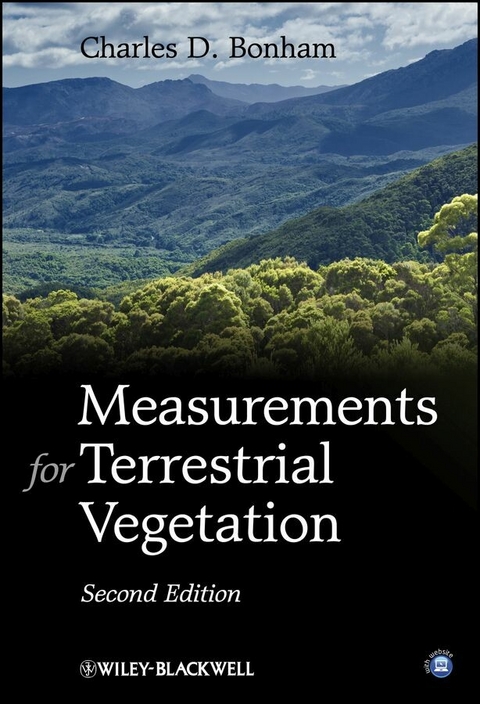
Measurements for Terrestrial Vegetation (eBook)
John Wiley & Sons (Verlag)
978-1-118-53453-3 (ISBN)
Measurements for Terrestrial Vegetation, 2nd Edition presents up-to-date methods for analyzing species frequency, plant cover, density and biomass data. Each method is presented in detail with a full discussion of its strengths and weaknesses from field applications through statistical characteristics of bias and use of the correct probability distribution to describe and analyze data. This practical book also covers the use of satellite imagery to obtain measurement data on cover, density and biomass. Field data collection includes current applications of statistical sampling and analysis designs that should be used to obtain and analyze these data.
This new and thoroughly updated edition of a classic text will be essential reading for everyone involved in measuring and assessing vegetation and plant biomass, including researchers and practitioners in vegetation science, plant ecology, forestry, global change scientists and conservation scientists.
- Provides a comprehensive catalogue of sampling, surveying and measuring techniques in vegetation science
- Updated to include new technologies and developments in the field
- New coverage of prediction models for large areas, including satellite mapping and remote sensing techniques
- Includes up-to-date applications of statistical sampling and analysis designs used to obtain and analyse data Reviews the strengths and weaknesses of each technique, allowing an informed choice of alternative approaches
- Clear diagrams to explain best-practice in methodology
The companion website for this book can be found at www.wiley.com/go/bonham/measurements
Charles D. Bonham is Professor Emeritus of Rangeland Science, Colorado State University, USA.
Measurements for Terrestrial Vegetation, 2nd Edition presents up-to-date methods for analyzing species frequency, plant cover, density and biomass data. Each method is presented in detail with a full discussion of its strengths and weaknesses from field applications through statistical characteristics of bias and use of the correct probability distribution to describe and analyze data. This practical book also covers the use of satellite imagery to obtain measurement data on cover, density and biomass. Field data collection includes current applications of statistical sampling and analysis designs that should be used to obtain and analyze these data. This new and thoroughly updated edition of a classic text will be essential reading for everyone involved in measuring and assessing vegetation and plant biomass, including researchers and practitioners in vegetation science, plant ecology, forestry, global change scientists and conservation scientists. Provides a comprehensive catalogue of sampling, surveying and measuring techniques in vegetation science Updated to include new technologies and developments in the field New coverage of prediction models for large areas, including satellite mapping and remote sensing techniques Includes up-to-date applications of statistical sampling and analysis designs used to obtain and analyse data Reviews the strengths and weaknesses of each technique, allowing an informed choice of alternative approaches Clear diagrams to explain best-practice in methodology The companion website for this book can be found at www.wiley.com/go/bonham/measurements
Charles D. Bonham is Professor Emeritus of Rangeland Science, Colorado State University, USA.
"In summary, this book is excellent for describing the methods for measuring vegetative attributes (frequency, cover, density, and biomass) and the sampling design that will provide unbiased estimates for the attribute measured." (Photogrammetric Engineering and Remote Sensing, 1 November 2014
"Summing Up: Recommended. Upper-division undergraduates through professionals." (Choice, 1 February 2014)
| Erscheint lt. Verlag | 16.4.2013 |
|---|---|
| Sprache | englisch |
| Themenwelt | Naturwissenschaften ► Biologie ► Botanik |
| Naturwissenschaften ► Biologie ► Ökologie / Naturschutz | |
| Technik | |
| Schlagworte | Ãkologie / Methoden, Statistik • Ãkologie / Pflanzen • Applications • Biowissenschaften • Botanik • Collection • Cover • Data • Detail • discussion • Field • Frequency • full • Life Sciences • measurements • Method • Methods • Methods & Statistics in Ecology • Ökologie / Methoden, Statistik • Ökologie / Pflanzen • Pflanzenökologie • Pflanzenökologie • plant ecology • plant science • Practical Book • presents uptodate • Satellite Imagery • species • Statistical • Strengths • terrestrial vegetation • use • weaknesses |
| ISBN-10 | 1-118-53453-0 / 1118534530 |
| ISBN-13 | 978-1-118-53453-3 / 9781118534533 |
| Informationen gemäß Produktsicherheitsverordnung (GPSR) | |
| Haben Sie eine Frage zum Produkt? |
 PDF (Adobe DRM)
Kopierschutz: Adobe-DRM
Adobe-DRM ist ein Kopierschutz, der das eBook vor Mißbrauch schützen soll. Dabei wird das eBook bereits beim Download auf Ihre persönliche Adobe-ID autorisiert. Lesen können Sie das eBook dann nur auf den Geräten, welche ebenfalls auf Ihre Adobe-ID registriert sind.
Details zum Adobe-DRM
Dateiformat: PDF (Portable Document Format)
Mit einem festen Seitenlayout eignet sich die PDF besonders für Fachbücher mit Spalten, Tabellen und Abbildungen. Eine PDF kann auf fast allen Geräten angezeigt werden, ist aber für kleine Displays (Smartphone, eReader) nur eingeschränkt geeignet.
Systemvoraussetzungen:
PC/Mac: Mit einem PC oder Mac können Sie dieses eBook lesen. Sie benötigen eine
eReader: Dieses eBook kann mit (fast) allen eBook-Readern gelesen werden. Mit dem amazon-Kindle ist es aber nicht kompatibel.
Smartphone/Tablet: Egal ob Apple oder Android, dieses eBook können Sie lesen. Sie benötigen eine
Geräteliste und zusätzliche Hinweise
Buying eBooks from abroad
For tax law reasons we can sell eBooks just within Germany and Switzerland. Regrettably we cannot fulfill eBook-orders from other countries.
aus dem Bereich