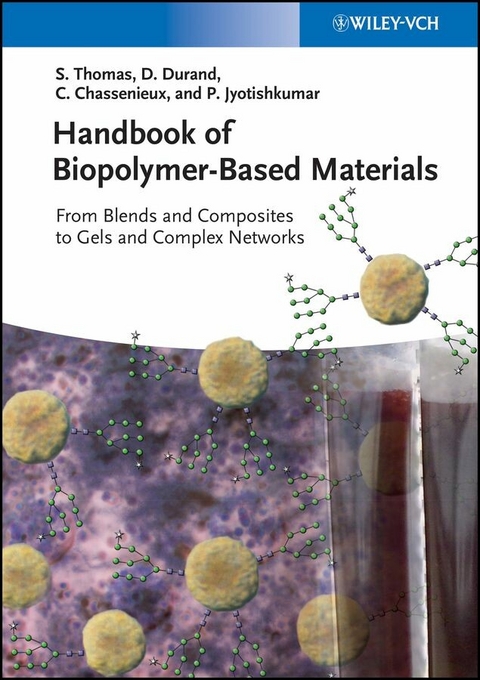
Handbook of Biopolymer-Based Materials (eBook)
Selected leading researchers from industry, academia, government and private research institutions around the globe comprehensively review recent accomplishments in the field. They examine the current state of the art, new challenges, and opportunities, discussing all
the synthetic routes to the generation of both micro- and nano-morphologies, as well as the synthesis, characterization and application of porous biopolymers.
An outstanding resource for anyone involved in the fi eld of eco-friendly biomaterials for advanced technologies.
Sabu Thomas is a Professor of Polymer Science and Engineering at Mahatma Gandhi University (India) and Director of the 'School of Chemical Sciences' and of the 'Center for Nanoscience and Nanotechnology' of the same university. He has published over 500 research papers in peer reviewed international journals on polymer composites, nanocomposites, membrane separation, polymer blends and
alloys, and polymer recycling, has an h-index of 57 and has edited 23 books. Professor Thomas is also a Fellow of the Royal Society of Chemistry and a Fellow of the New York Academy of Sciences. His work has been awarded with the Professor Sukumar Maithy Award, the Bronze Medal of the Chemical Research Society of India (CRSI) and the Materials Research Society of India (MRSI) award, among others.
Dominique Durand is a Research Director Emeritus at the CNRS and former Director of the Polymers, Colloids and Interfaces Laboratory at the University of Maine, Le Mans (France). His research focuses on experimental studies and modeling of static and dynamic properties of complex systems, such as covalent networks, associating polymers and biopolymer gels. He is the author or co-author of over 210 research papers, reviews, and book chapters.
Christophe Chassenieux is a Professor at the University of Maine, Le Mans (France) since 2005, after being an Assistant Professor at the University Pierre et Marie Curie, Paris. His research interests encompass properties of polymer gels and self-assemblies of amphiphilic polymers. He is the co-author of 50 research articles, book chapters and patents.
Parameswaranpillai Jyotishkumar is DST INSPIRE Faculty at the Department of Polymer Science and Rubber Technology, Kerala (India). He has completed his PhD from Mahatma Gandhi University, Kottayam. Dr. Jyotishkumar's research focuses on polymer blends, nanocomposites, and bio-nanocomposites. He is the author or co-author of 30 research articles and book chapters.
Sabu Thomas is a Professor of Polymer Science and Engineering at Mahatma Gandhi University (India) and Director of the 'School of Chemical Sciences' and of the 'Center for Nanoscience and Nanotechnology' of the same university. He has published over 500 research papers in peer reviewed international journals on polymer composites, nanocomposites, membrane separation, polymer blends and alloys, and polymer recycling, has an h-index of 57 and has edited 23 books. Professor Thomas is also a Fellow of the Royal Society of Chemistry and a Fellow of the New York Academy of Sciences. His work has been awarded with the Professor Sukumar Maithy Award, the Bronze Medal of the Chemical Research Society of India (CRSI) and the Materials Research Society of India (MRSI) award, among others. Dominique Durand is a Research Director Emeritus at the CNRS and former Director of the Polymers, Colloids and Interfaces Laboratory at the University of Maine, Le Mans (France). His research focuses on experimental studies and modeling of static and dynamic properties of complex systems, such as covalent networks, associating polymers and biopolymer gels. He is the author or co-author of over 210 research papers, reviews, and book chapters. Christophe Chassenieux is a Professor at the University of Maine, Le Mans (France) since 2005, after being an Assistant Professor at the University Pierre et Marie Curie, Paris. His research interests encompass properties of polymer gels and self-assemblies of amphiphilic polymers. He is the co-author of 50 research articles, book chapters and patents. Parameswaranpillai Jyotishkumar is DST INSPIRE Faculty at the Department of Polymer Science and Rubber Technology, Kerala (India). He has completed his PhD from Mahatma Gandhi University, Kottayam. Dr. Jyotishkumar's research focuses on polymer blends, nanocomposites, and bio-nanocomposites. He is the author or co-author of 30 research articles and book chapters.
VOLUME 1
BIOPOLYMERS: STATE OF THE ART, NEW CHALLENGES, AND OPPORTUNITIES
Introduction
Biopolymers: A Niche For Fundamental Research in Soft Matter Physics
Biopolymers: An Endless Source of Applications
Topics Covered by the Book
Conclusions
GENERAL OVERVIEW OF BIOPOLYMERS: STRUCTURE, PROPERTIES, AND APPLICATIONS
Introduction
Plant Cell Wall Polysaccharides
Biocomposites
Future Outlook
BIOPOLYMERS FROM PLANTS
Introduction
Lipid and Phenolic Biopolymers
Carbohydrate Biopolymers: Polysaccharides
Isoprene Biopolymers: Natural Rubber
Concluding Remarks
BACTERIAL BIOPOLYMERS AND GENETICALLY ENGINEERED BIOPOLYMERS FOR GEL SYSTEMS APPLICATION
Introduction
Microbial Polysaccharides as Biopolymers
Microbial Biopolymers as Drug Delivery Vehicle
Polyanhydrides
Recombinant Protein Polymer Production
Recombinant Genetically Engineered Biopolymer : Elastin
Collagen as an Ideal Biopolymer
Biopolymers for Gel System
Hydrogels of Biopolymers for Regenerative Medicine
Supermacroporous Cryogel Matrix from Biopolymers
Biopolymers Impact on Environment
Conclusion
BIOPOLYMERS FROM ANIMALS
Introduction
Chitin and Hyaluronic Acid in the Living World
Milestones in Chitin History
From Trehalose to Chitin
Chitin Synthase
Regulation of Chitin Synthesis in Fungi
Organization of Chitin in the Fungal Cell Wall
Organization of Chitin in the Arthropod Cuticle
Chitin-Organizing Factors
Secretion and Cuticle Formation
Transcriptional Regulation of Cuticle Production
Chitin Synthesis Inhibitors
Noncuticular Chitin in Insects
Chitin as a Structural Element
Application of Chitin
Conclusion
POLYMERIC BLENDS WITH BIOPOLYMERS
Introduction
Starch-Based Blends
Blends with Chitosan (One Amino Group Too Much . . . )
Future Perspectives
MACRO-, MICRO-, AND NANOCOMPOSITES BASED ON BIODEGRADABLE POLYMERS
Introduction
Biodegradable Polymers
Biocomposites
Nanobiocomposites
IPNS DERIVED FROM BIOPOLYMERS
Introduction
Types of IPNs
IPNs Derived from Biopolymers
Manufacture of IPNs
Characterization of IPNs
Applications of IPNs
Conclusions
ASSOCIATING BIOPOLYMER SYSTEMS AND HYALURONATE BIOMATERIALS
Introduction
Synthesis and Self-Association of Hydrophobically Modified Derivatives of Chitosan and Hyaluronic Acid in Aqueous Solution
Design of Novel Biomaterials Based on Chemically Modified Derivatives of Hyaluronic Acid
Conclusions
POLYMER GELS FROM BIOPOLYMERS
Introduction
Experimental Methods
Polymerization and Gelation Kinetics
Sol - Gel Transition and Universality Discussion
Imprinting the Gels
Heterogeneity of Hydrogels
Ionic p-Type and n-Type Semiconducting Gels
Conclusions
CONFORMATION AND RHEOLOGY OF MICROBIAL EXOPOLYSACCHARIDES
Introduction
Conformation of Polysaccharides
Secondary Solid-State Structures for Microbial Polysaccharides
Conformation in Solution: Solution Properties and Applications
Gelling Properties in the Presence of Salts
Conclusions
SULFATED POLYSACCHARIDES IN THE CELL WALL OF RED MICROALGAE
Introduction
Sulfated Polysaccharides from Red Microalgae - General Overview
Sulfated Polysaccharides of Red Microalgal Cell Walls: Chemical Aspects
Proteins in the Cell Wall of Red Microalgae
Rheology of Red Microalgal Polysaccharide Solutions
Modifications of the Sulfated Polysaccharides
Red Microalgal Sulfated Polysaccharide Bioactivities
VOLUME 2
DIELECTRIC SPECTROSCOPY AND THERMALLY STIMULATED CURRENT ANALYSIS OF BIOPOLYMER SYSTEMS
SOLID-STATE NMR SPECTROSCOPY OF BIOPOLYMERS
EPR SPECTROSCOPY OF BIOPOLYMERS
X-RAY PHOTOELECTRON SPECTROSCOPY: A TOOL FOR STUDYING BIOPOLYMERS
LIGHT-SCATTERING STUDIES OF BIOPOLYMER SYSTEMS
X-RAY SCATTERING AND DIFFRACTION OF BIOPOLYMERS
LARGE-SCALE STRUCTURAL CHARACTERIZATION OF BIOPOLYMER SYSTEMS BY SMALL-ANGLE NEUTRON SCATTERING
MICROSCOPY OF BIOPOLYMER SYSTEMS
RHEO-OPTICAL CHARACTERIZATION OF BIOPOLYMER SYSTEMS
RHEOLOGICAL BEHAVIOR OF BIOPOLYMER SYSTEMS
PHYSICAL GELS OF BIOPOLYMERS: STRUCTURE, RHEOLOGICAL AND GELATION PROPE VOLUME 1
BIOPOLYMERS: STATE OF THE ART, NEW CHALLENGES, AND OPPORTUNITIES
Introduction
Biopolymers: A Niche For Fundamental Research in Soft Matter Physics
Biopolymers: An Endless Source of Applications
Topics Covered by the Book
Conclusions
GENERAL OVERVIEW OF BIOPOLYMERS: STRUCTURE, PROPERTIES, AND APPLICATIONS
Introduction
Plant Cell Wall Polysaccharides
Biocomposites
Future Outlook
BIOPOLYMERS FROM PLANTS
Introduction
Lipid and Phenolic Biopolymers
Carbohydrate Biopolymers: Polysaccharides
Isoprene Biopolymers: Natural Rubber
Concluding Remarks
BACTERIAL BIOPOLYMERS AND GENETICALLY ENGINEERED BIOPOLYMERS FOR GEL SYSTEMS APPLICATION
Introduction
Microbial Polysaccharides as Biopolymers
Microbial Biopolymers as Drug Delivery Vehicle
Polyanhydrides
Recombinant Protein Polymer Production
Recombinant Genetically Engineered Biopolymer : Elastin
Collagen as an Ideal Biopolymer
Biopolymers for Gel System
Hydrogels of Biopolymers for Regenerative Medicine
Supermacroporous Cryogel Matrix from Biopolymers
Biopolymers Impact on Environment
Conclusion
BIOPOLYMERS FROM ANIMALS
Introduction
Chitin and Hyaluronic Acid in the Living World
Milestones in Chitin History
From Trehalose to Chitin
Chitin Synthase
Regulation of Chitin Synthesis in Fungi
Organization of Chitin in the Fungal Cell Wall
Organization of Chitin in the Arthropod Cuticle
Chitin-Organizing Factors
Secretion and Cuticle Formation
Transcriptional Regulation of Cuticle Production
Chitin Synthesis Inhibitors
Noncuticular Chitin in Insects
Chitin as a Structural Element
Application of Chitin
Conclusion
POLYMERIC BLENDS WITH BIOPOLYMERS
Introduction
Starch-Based Blends
Blends with Chitosan (One Amino Group Too Much . . . )
Future Perspectives
MACRO-, MICRO-, AND NANOCOMPOSITES BASED ON BIODEGRADABLE
POLYMERS
Introduction
Biodegradable Polymers
Biocomposites
Nanobiocomposites
IPNS DERIVED FROM BIOPOLYMERS
Introduction
Types of IPNs
IPNs Derived from Biopolymers
Manufacture of IPNs
Characterization of IPNs
Applications of IPNs
Conclusions
ASSOCIATING BIOPOLYMER SYSTEMS AND HYALURONATE BIOMATERIALS
Introduction
Synthesis and Self-Association of Hydrophobically Modified Derivatives of Chitosan and Hyaluronic Acid in Aqueous Solution
Design of Novel Biomaterials Based on Chemically Modified Derivatives of Hyaluronic Acid
Conclusions
POLYMER GELS FROM BIOPOLYMERS
Introduction
Experimental Methods
Polymerization and Gelation Kinetics
Sol?Gel Transition and Universality Discussion
Imprinting the Gels
Heterogeneity of Hydrogels
Ionic p-Type and n-Type Semiconducting Gels
Conclusions
CONFORMATION AND RHEOLOGY OF MICROBIAL EXOPOLYSACCHARIDES
Introduction
Conformation of Polysaccharides
Secondary Solid-State Structures for Microbial Polysaccharides
Conformation in Solution: Solution Properties and Applications
Gelling Properties in the Presence of Salts
Conclusions
SULFATED POLYSACCHARIDES IN THE CELL WALL OF RED MICROALGAE
Introduction
Sulfated Polysaccharides from Red Microalgae ? General Overview
Sulfated Polysaccharides of Red Microalgal Cell Walls: Chemical Aspects
Proteins in the Cell Wall of Red Microalgae
Rheology of Red Microalgal Polysaccharide Solutions
Modifications of the Sulfated Polysaccharides
Red Microalgal Sulfated Polysaccharide Bioactivities
VOLUME 2
DIELECTRIC SPECTROSCOPY AND THERMALLY STIMULATED CURRENT ANALYSIS OF BIOPOLYMER SYSTEMS
SOLID-STATE NMR SPECTROSCOPY OF BIOPOLYMERS
EPR SPECTROSCOPY OF BIOPOLYMERS
X-RAY PHOTOELECTRON SPECTROSCOPY: A TOOL FOR STUDYING BIOPOLYMERS
LIGHT-SCATTERING STUDIES OF BIOPOLYMER SYSTEMS
X-RAY SCATTERING AND DIFFRACTION OF BIOPOLYMERS
LARGE-SCALE STRUCTURAL CHARACTERIZATION OF BIOPOLYMER SYSTEMS BY SMALL-ANGLE NEUTRON SCATTERING
MICROSCOPY OF BIOPOLYMER SYSTEMS
RHEO-OPTICAL CHARACTERIZATION OF BIOPOLYMER SYSTEMS
RHEOLOGICAL BEHAVIOR OF BIOPOLYMER SYSTEMS
PHYSICAL GELS OF BIOPOLYMERS: STRUCTURE, RHEOLOGICAL AND GELATION PROPERTIE
List of Contributors
Esra Alveroglu
Istanbul Technical University
Department of Physics
Maslak
34469 Istanbul
Turkey
Shoshana (Malis) Arad
Ben-Gurion University of the Negev
Department of Biotechnology Engineering
POB 653 Beer-Sheva 84105
Israel
Robin Augustine
Mahatma Gandhi University
Centre for Nanoscience and Nanotechnology
Priyadarshini Hills
Kottayam 686560
Kerala
India
Rachel Auzély-Velty
Université Joseph Fourier
Centre de Recherches sur les Macromolécules Végétales (CERMAV-CNRS)
601 rue de la Chimie
38041 Grenoble
France
Luc Avérous
Université de Strasbourg
BioTeam/ICPEES-ECPM, UMR 7515
25 rue Becquerel
67087 Strasbourg Cedex 2
France
Deepa Bhanumathy Amma
Bishop Moore College
Department of Chemistry
Mavelikara 690110
Kerala
India
Deborah Blanchard
Université Joseph Fourier
Centre de Recherches sur les Macromolécules Végétales (CERMAV-CNRS)
601 rue de la Chimie
38041 Grenoble
France
Ana Maria Botelho do Rego
Technical University of Lisbon
Institute of Nanoscience and Nanotechnology
Centro de Química-Física Molecular
Av. Rovisco Pais
1049-001 Lisboa
Portugal
Sami Boufi
University of Sfax
Faculté des Sciences de Sfax
Laboratoire des Sciences des
Matériaux et Environnement
BP 1171-3000 Sfax
Tunisia
Denis Bouyer
Université de Montpellier
Institut Européen des Membranes
2, Place Eugene Bataillon
34967 Montpellier
Cedex 2
France
Christophe Chassenieux
LUNAM Université du Maine
IMMM UMR CNRS 6283
Dept. Polymères, Colloïdes, Interfaces
1 Avenue Olivier Messiaen
72085 Le Mans Cedex 9
France
Mindong Chen
Nanjing University of Information Science & Technology
Department of Chemistry
Nanjing 210044
China
Wenguo Cui
The First Affiliated Hospital of Soochow University
Department of Orthopedics
188 Shizi Street
Suzhou, Jiangsu 215006
China
and
Soochow University
Orthopedic Institute
708 Renmin Road
Suzhou, Jiangsu 215007
China
Uro Cvelbar
Joef Stefan Institute
F4 Plasma Laboratory
Jamova 39
1000 Ljubljana
Slovenia
Jany Dandurand
Université Paul Sabatier
CIRIMAT UMR CNRS 5085
Physique des Polymères 3R1B2
118 route de Narbonne
31062 Toulouse cedex 02
France
Jacques Desbrieres
Université de Pau et des Pays de l'Adour
IPREM
Helioparc Pau Pyrenees
2 Avenue P. Angot
64053 Pau Cedex 09
France
Marli Miriam de Souza Lima
Universidade Estadual de Maringa
Pharmacy Departement LAFITEC
Av. Colombo, 5790 - Zona 07
CEP 87020-900 Maringa
Parana, Brasil
Dominique Durand
LUNAM Université du Maine
IMMM UMR CNRS 6283
Dept. Polymères, Colloïdes, Interfaces
1 Avenue Olivier Messiaen
72085 Le Mans Cedex 9
France
Tao Feng
Shanghai Institute of Technology
Department of Food Science and Technology
School of Perfume and Aroma Technology
120 Caobao Road
Shanghai 200235
China
Ana Maria Ferraria
Technical University of Lisbon
Institute of Nanoscience and Nanotechnology
Centro de Química-Física Molecular
Av. Rovisco Pais
1049-001 Lisboa
Portugal
Chris Ford
University of Southampton
School of Biological Sciences
Highfield Campus
Southampton SO17 1BJ
UK
Tim J. Foster
University of Nottingham
School of Biosciences
Division of Food Sciences
Sutton Bonington Campus
Loughborough Leicestershire LE12 5RD
UK
Ali Gelir
Istanbul Technical University
Department of Physics
Maslak
34469 Istanbul
Turkey
Anne George
Medical College Kottayam
Department of Anatomy
Gandhinagar
Kottayam 686008
Kerala
India
and
Center of Excellence for Polymer Materials and Technologies
Tehnoloski Park 24
1000 Ljubljana
Slovenia
Hero Jan Heeres
University of Groningen
Department of Chemical Engineering
Nijenborgh 4
9747 Groningen
The Netherlands
Antonio Heredia
Facultad de Ciencias
Departamento de Biología Molecular y Bioquímica
Campus de Teatinos, s/n
29071 Málaga
Spain
Ferenc Horkay
National Institute of Child Health and Human Development NICHD
13 South Dr Room 3W16, MSC 5772
Bethesda Md 20892-5772
USA
Changmin Hu
Shanghai Jiao Tong University
School of Biomedical Engineering and Med-X Research Institute
1954 Hua Shan Road
Shanghai 200030
China
Parameswaranpillai Jyotishkumar
INSPIRE Faculty
Department of Polymer Science and Rubber Technology
Cochin University of Science and Technology, Kochi-682022
Vassilis Kiosseoglou
Aristotle University of Thessaloniki
School of Chemistry
Laboratory of Food Chemistry and Technology
54124 Thessaloniki
Greece
Vanja Kokol
University of Maribor
Faculty of Mechanical Engineering
Institute for Engineering Materials and Design
Smetanova ul. 17
2000 Maribor
Slovenia
Ashok Kumar
Indian Institute of Technology Kanpur
Department of Biological Sciences and Bioengineering
Kanpur 208016
Uttar Pradesh
India
Rakesh Kumar
Birla Institute of Technology, Mesra.
Patna Campus
Department of Applied Chemistry
P.O. - B. V. College, Patna - 800014, Bihar
India
Colette Lacabanne
Université Paul Sabatier
CIRIMAT UMR CNRS 5085
Physique des Polymères 3R1B2
118 route de Narbonne
31062 Toulouse cedex 02
France
Oshrat Levy-Ontman
Sami Shamoon College of Engineering
Department of Chemical Engineering
Beer-Sheva 84100
POB 950
Israel
Dagang Liu
Nanjing University of Information Science & Technology
Department of Chemistry
Nanjing 210044
Ningliu Rd 219
China
Fei Lu
Nanjing University of Information Science & Technology
Department of Chemistry
Nanjing 210044
China
Phedra Marius
University of Southampton
School of Biological Sciences
Highfield Campus
Southampton SO17 1BJ
UK
Siji K. Mary
Bishop Moore College
Department of Chemistry
Mavelikara 690110
Kerala
India
Camille Michon
AgroParisTech
UMR1145 Ingénierie Procédés Aliments
Agro
Paristech/Inra/Cnam
1 avenue des Olympiades
91300 MASSY
France
Bernard Moussian
University of Tübingen
Interfaculty Institute for Cell Biology
Department of Animal Genetics
Auf der Morgenstelle 28
72076 Tübingen
Germany
Miran Mozeti
Joef Stefan Institute
F4 Plasma Laboratory
Jamova 39
1000 Ljubljana
Slovenia
and
Center of Excellence for Polymer Materials and Technologies
Tehnoloski Park 24
1000 Ljubljana
Slovenia
Taco Nicolai
LUNAM Université du Maine
IMMM UMR CNRS 6283
Dept. Polymères, Colloïdes, Interfaces
1 Avenue Olivier Messiaen
72085 Le Mans Cedex 9
France
Yoshiharu Nishiyama
Centre de Recherches sur les Macromolécules Végétales (CERMAV-CNRS), BP53, 38041 Grenoble cedex 9,
France
Adamantini Paraskevopoulou
Aristotle University of Thessaloniki
School of Chemistry
Laboratory of Food Chemistry and Technology
54124 Thessaloniki
Greece
Francesco Picchioni
University of Groningen
Department of Chemical Engineering
Nijenborgh 4
9747 Groningen
The Netherlands
Eric Pollet
Université de Strasbourg
LIPHT-ECPM, EAc (CNRS) 4379
25 rue Becquerel
67087 Strasbourg Cedex 2
France
Laly A. Pothen
Bishop Moore College
Department of Chemistry
Mavelikara 690110
Kerala
India
Rajakumari Rajendran
Mahatma Gandhi University
Centre for Nanoscience and...
| Erscheint lt. Verlag | 16.4.2013 |
|---|---|
| Sprache | englisch |
| Themenwelt | Naturwissenschaften ► Chemie ► Organische Chemie |
| Technik | |
| Schlagworte | accomplishments • Applications • area • Biomaterial • Biomaterialien • biomaterials • biomedical engineering • Biomedizintechnik • Biopolymer • Biopolymere • biopolymers • Blends • Chemie • Chemistry • Field • first systematic • Globe • important • Industrial Chemistry • Industry • Institutions • Materials Science • Materialwissenschaften • micro • Morphology • Nanomaterialien • nanomaterials • nanostructured • Nanotechnologie • nanotechnology • Polymer Science & Technology • Polymerwissenschaft u. -technologie • private • Properties • Reference • Researchers • Scientific • Systems • Technische u. Industrielle Chemie • two |
| ISBN-13 | 9783527652471 / 9783527652471 |
| Informationen gemäß Produktsicherheitsverordnung (GPSR) | |
| Haben Sie eine Frage zum Produkt? |
 EPUB (Adobe DRM)
Kopierschutz: Adobe-DRM
Adobe-DRM ist ein Kopierschutz, der das eBook vor Mißbrauch schützen soll. Dabei wird das eBook bereits beim Download auf Ihre persönliche Adobe-ID autorisiert. Lesen können Sie das eBook dann nur auf den Geräten, welche ebenfalls auf Ihre Adobe-ID registriert sind.
Details zum Adobe-DRM
Dateiformat: EPUB (Electronic Publication)
EPUB ist ein offener Standard für eBooks und eignet sich besonders zur Darstellung von Belletristik und Sachbüchern. Der Fließtext wird dynamisch an die Display- und Schriftgröße angepasst. Auch für mobile Lesegeräte ist EPUB daher gut geeignet.
Systemvoraussetzungen:
PC/Mac: Mit einem PC oder Mac können Sie dieses eBook lesen. Sie benötigen eine
eReader: Dieses eBook kann mit (fast) allen eBook-Readern gelesen werden. Mit dem amazon-Kindle ist es aber nicht kompatibel.
Smartphone/Tablet: Egal ob Apple oder Android, dieses eBook können Sie lesen. Sie benötigen eine
Geräteliste und zusätzliche Hinweise
Buying eBooks from abroad
For tax law reasons we can sell eBooks just within Germany and Switzerland. Regrettably we cannot fulfill eBook-orders from other countries.
aus dem Bereich