


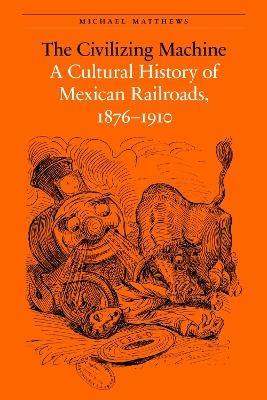
The Civilizing Machine
A Cultural History of Mexican Railroads, 1876-1910
Seiten
2014
University of Nebraska Press (Verlag)
978-0-8032-4380-4 (ISBN)
University of Nebraska Press (Verlag)
978-0-8032-4380-4 (ISBN)
Explores the ideological and cultural milieu that shaped the Mexican people's understanding of technology. Intrinsically tied to the Porfiriato, the booming railroad network represented material progress in a country seeking its place in the modern world. Matthews discloses how the railroad's development represented the crowning achievement of the regime.
In late nineteenth-century Mexico the Mexican populace was fascinated with the country's booming railroad network. Newspapers and periodicals were filled with art, poetry, literature, and social commentaries exploring the symbolic power of the railroad. As a symbol of economic, political, and industrial modernization, the locomotive served to demarcate a nation's status in the world. However, the dangers of locomotive travel, complicated by the fact that Mexico's railroads were foreign owned and operated, meant that the railroad could also symbolize disorder, death, and foreign domination.
In The Civilizing Machine Michael Matthews explores the ideological and cultural milieu that shaped the Mexican people's understanding of technology. Intrinsically tied to the Porfiriato, the thirty-five-year dictatorship of Gen. Porfirio Díaz, the booming railroad network represented material progress in a country seeking its place in the modern world. Matthews discloses how the railroad's development represented the crowning achievement of the regime and the material incarnation of its mantra, "order and progress." The Porfirian administration evoked the railroad in legitimizing and justifying its own reign, while political opponents employed the same rhetorical themes embodied by the railroads to challenge the manner in which that regime achieved economic development and modernization. As Matthews illustrates, the multiple symbols of the locomotive reflected deepening social divisions and foreshadowed the conflicts that eventually brought about the Mexican Revolution.
In late nineteenth-century Mexico the Mexican populace was fascinated with the country's booming railroad network. Newspapers and periodicals were filled with art, poetry, literature, and social commentaries exploring the symbolic power of the railroad. As a symbol of economic, political, and industrial modernization, the locomotive served to demarcate a nation's status in the world. However, the dangers of locomotive travel, complicated by the fact that Mexico's railroads were foreign owned and operated, meant that the railroad could also symbolize disorder, death, and foreign domination.
In The Civilizing Machine Michael Matthews explores the ideological and cultural milieu that shaped the Mexican people's understanding of technology. Intrinsically tied to the Porfiriato, the thirty-five-year dictatorship of Gen. Porfirio Díaz, the booming railroad network represented material progress in a country seeking its place in the modern world. Matthews discloses how the railroad's development represented the crowning achievement of the regime and the material incarnation of its mantra, "order and progress." The Porfirian administration evoked the railroad in legitimizing and justifying its own reign, while political opponents employed the same rhetorical themes embodied by the railroads to challenge the manner in which that regime achieved economic development and modernization. As Matthews illustrates, the multiple symbols of the locomotive reflected deepening social divisions and foreshadowed the conflicts that eventually brought about the Mexican Revolution.
Michael Matthews is an assistant professor of history at Elon University.
Introduction Chapter 1. The Discourse of Development: The Railway Debate of the Early Porfiriato Chapter 2. De Viaje: Elite Views of Modernity and the Railway Boom Chapter 3. Festivals of Progress: The Railway Ceremony Chapter 4. The Price of Progress: Popular Perceptions of the Railway Accident Chapter 5. La Loco-Matona: The Railway in the Popular and Opposition Press Conclusion
| Reihe/Serie | The Mexican Experience |
|---|---|
| Zusatzinfo | 25 illustrations. 2 tables |
| Verlagsort | Lincoln |
| Sprache | englisch |
| Maße | 152 x 229 mm |
| Themenwelt | Geisteswissenschaften ► Geschichte ► Regional- / Ländergeschichte |
| Sozialwissenschaften ► Soziologie ► Spezielle Soziologien | |
| Technik ► Fahrzeugbau / Schiffbau | |
| ISBN-10 | 0-8032-4380-4 / 0803243804 |
| ISBN-13 | 978-0-8032-4380-4 / 9780803243804 |
| Zustand | Neuware |
| Informationen gemäß Produktsicherheitsverordnung (GPSR) | |
| Haben Sie eine Frage zum Produkt? |
Mehr entdecken
aus dem Bereich



aus dem Bereich
die Geschichte meiner Urgroßmutter
Buch | Hardcover (2025)
C.H.Beck (Verlag)
CHF 32,15
Träume und Macht : eine Biografie
Buch | Hardcover (2025)
C.H.Beck (Verlag)
CHF 61,60


