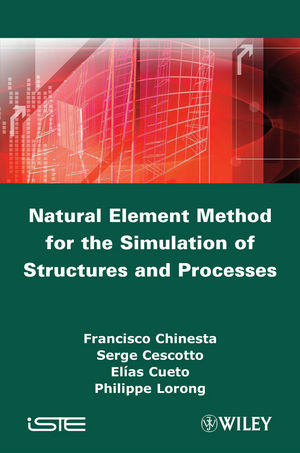
Natural Element Method for the Simulation of Structures and Processes (eBook)
242 Seiten
John Wiley & Sons (Verlag)
978-1-118-61692-5 (ISBN)
computational methods to study phenomena governed by the principles
of mechanics. Before the emergence of computational science (also
called scientific computing) as a "third way" besides theoretical
and experimental sciences, computational mechanics was widely
considered to be a sub-discipline of applied mechanics. It is now
considered to be a sub-discipline within computational
science.
This book presents a recent state of the art on the foundations
and applications of the meshless natural element method in
computational mechanics, including structural mechanics and
material forming processes involving solids and Newtonian and
non-Newtonian fluids.
Francisco Chinesta, born in 1966 in Valencia (Spain), obtained his M.S. in Mechanical Engineering (1990) and later his Ph.D. degree supervised at the ENS Cachan in France. He is currently Professor of Computational Mechanics at the Ecole Centrale of Nantes (France) and titular of the EADS Corporate Foundation International Chair on Advanced Modeling of Composites Manufacturing Processes.
Foreword ix
Acknowledgements xi
Chapter 1. Introduction 1
1.1. SPH method 3
1.2. RKPM method 5
1.3. MLS based approximations 10
1.4. Final note 11
Chapter 2. Basics of the Natural Element Method 13
2.1. Introduction 13
2.2. Natural neighbor Galerkin methods 14
2.3. Exact imposition of the essential boundary conditions 22
2.4. Mixed approximations of natural neighbor type 27
2.5. High order natural neighbor interpolants 40
Chapter 3. Numerical Aspects 49
3.1. Searching for natural neighbors 49
3.2. Calculation of NEM shape functions of the Sibson type 52
3.3. Numerical integration 71
3.4. NEM on an octree structure 80
Chapter 4. Applications in the Mechanics of Structures and Processes 93
4.1. Two- and three-dimensional elasticity 93
4.2. Indicators and estimators of error: adaptivity 96
4.3. Metal extrusion 107
4.4. Friction stir welding 113
4.5. Models and numerical treatment of the phase transition: foundry and treatment of surfaces 123
4.6. Adiabatic shearing, cutting, and high speed blanking 136
Chapter 5. A Mixed Approach to the Natural Elements 159
5.1. Introduction 159
5.2. The Fraeijs de Veubeke variational principle for linear elastic problems 161
5.3. Field decomposition 164
5.4. Discretization 166
5.5. Discretized equations 170
5.6. Matrix solution for linear elastic problems 172
5.7. Numerical integration 176
5.8. Linear elastic patch tests 178
5.9. Application 1: pure bending of a linear elastic beam 182
5.10. Application 2: square domain with circular hole 185
5.11. Mixed approach to nonlinear problems 187
5.12. Step-by-step solution of the discretized nonlinear equations 192
5.13. Example of an elastoplastic material 195
5.14. Application: pure bending of an elastoplastic beam 196
5.15. Conclusion 199
Chapter 6. Flow Models 201
6.1. Natural element method in fluid mechanics: updated Lagrangian approach 201
6.2. Free and moving surfaces 202
6.3. Short-fiber suspensions flow 206
6.4. Breaking dam problem 208
6.5. Multi-scale approaches 209
Chapter 7. Conclusion 225
Bibliography 227
Index 239
| Erscheint lt. Verlag | 4.3.2013 |
|---|---|
| Sprache | englisch |
| Themenwelt | Mathematik / Informatik ► Mathematik |
| Technik | |
| Schlagworte | Applied Mathematics in Engineering • Applied Mathmatics in Engineering • Mathematics • Mathematik • Mathematik in den Ingenieurwissenschaften • Numerical Methods • Numerische Mathematik • numerische Methoden |
| ISBN-10 | 1-118-61692-8 / 1118616928 |
| ISBN-13 | 978-1-118-61692-5 / 9781118616925 |
| Informationen gemäß Produktsicherheitsverordnung (GPSR) | |
| Haben Sie eine Frage zum Produkt? |
 PDF (Adobe DRM)
Größe: 14,2 MB
Kopierschutz: Adobe-DRM
Adobe-DRM ist ein Kopierschutz, der das eBook vor Mißbrauch schützen soll. Dabei wird das eBook bereits beim Download auf Ihre persönliche Adobe-ID autorisiert. Lesen können Sie das eBook dann nur auf den Geräten, welche ebenfalls auf Ihre Adobe-ID registriert sind.
Details zum Adobe-DRM
Dateiformat: PDF (Portable Document Format)
Mit einem festen Seitenlayout eignet sich die PDF besonders für Fachbücher mit Spalten, Tabellen und Abbildungen. Eine PDF kann auf fast allen Geräten angezeigt werden, ist aber für kleine Displays (Smartphone, eReader) nur eingeschränkt geeignet.
Systemvoraussetzungen:
PC/Mac: Mit einem PC oder Mac können Sie dieses eBook lesen. Sie benötigen eine
eReader: Dieses eBook kann mit (fast) allen eBook-Readern gelesen werden. Mit dem amazon-Kindle ist es aber nicht kompatibel.
Smartphone/Tablet: Egal ob Apple oder Android, dieses eBook können Sie lesen. Sie benötigen eine
Geräteliste und zusätzliche Hinweise
Buying eBooks from abroad
For tax law reasons we can sell eBooks just within Germany and Switzerland. Regrettably we cannot fulfill eBook-orders from other countries.
 EPUB (Adobe DRM)
Kopierschutz: Adobe-DRM
Adobe-DRM ist ein Kopierschutz, der das eBook vor Mißbrauch schützen soll. Dabei wird das eBook bereits beim Download auf Ihre persönliche Adobe-ID autorisiert. Lesen können Sie das eBook dann nur auf den Geräten, welche ebenfalls auf Ihre Adobe-ID registriert sind.
Details zum Adobe-DRM
Dateiformat: EPUB (Electronic Publication)
EPUB ist ein offener Standard für eBooks und eignet sich besonders zur Darstellung von Belletristik und Sachbüchern. Der Fließtext wird dynamisch an die Display- und Schriftgröße angepasst. Auch für mobile Lesegeräte ist EPUB daher gut geeignet.
Systemvoraussetzungen:
PC/Mac: Mit einem PC oder Mac können Sie dieses eBook lesen. Sie benötigen eine
eReader: Dieses eBook kann mit (fast) allen eBook-Readern gelesen werden. Mit dem amazon-Kindle ist es aber nicht kompatibel.
Smartphone/Tablet: Egal ob Apple oder Android, dieses eBook können Sie lesen. Sie benötigen eine
Geräteliste und zusätzliche Hinweise
Buying eBooks from abroad
For tax law reasons we can sell eBooks just within Germany and Switzerland. Regrettably we cannot fulfill eBook-orders from other countries.
aus dem Bereich