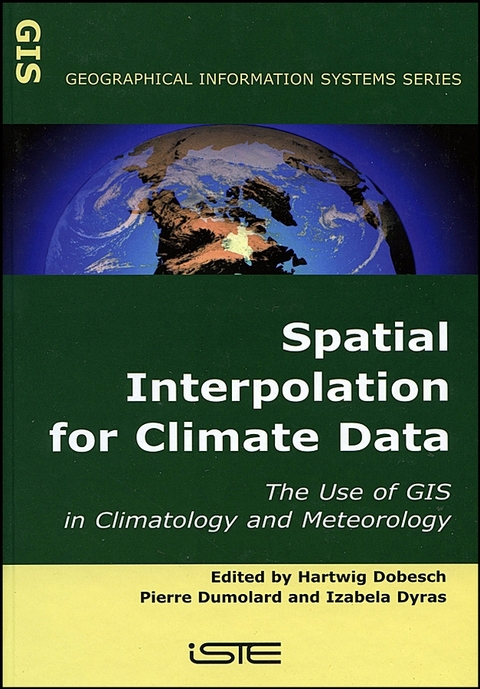
Spatial Interpolation for Climate Data (eBook)
302 Seiten
John Wiley & Sons (Verlag)
9781118614990 (ISBN)
Hartwig Dobesch is a Professor at the Institute of Meteorology and Geodynamics of Vienna, specializing in meteorology and climatology. He is also President of the COST European research program "The use of GIS in climatology and meteorology". Pierre Dumolard is a Professor at the Institute of Alpine Geography, Joseph Fourier University, Grenoble, France. Izabela Dyras is the leader of the Satellite Research Department in the Institute of Meteorology and Water Management of Krakow. She is the Vice-President of the COST European research program "The use of GIS in climatology and meteorology".
Preface.
Part 1. GIS to Manage and Distribute Climate Data.
Chapter 1. GIS, climatology and meteorology (Antonio
Perdigao).
Chapter 2. SIGMA: a Web-based GIS for environmental applications
(Carlos Frederico Angelis, Fabiano Morelli, Luiz Augusto Toledo
Machado and Cintia Pereira de Freitas).
Chapter 3. Web mapping: different solutions using GIS (Pawel
Madej, Malgorzata Barszczynska and Danuta Kubacka).
Chapter 4. Comparison of geostatistical and meteorological
interpolation methods (what is what?) (Tamás Szentimrey, Zita
Bihari and Sándor Szalai).
Chapter 5. Uncertainty from spatial sampling: a case study
in the French Alps (Pierre Dumolard).
Part 2. Spatial Interpolation of Climate Data.
Chapter 6. The Developments in spatialization of meteorological
and climatological elements (Ole Einar Tveito).
Chapter 7. The spatial analysis of the selected meteorological
fields in the example of Poland (Izabela Dyras and Zbigniew
Ustrnul).
Chapter 8. Optimizing the interpolation of temperatures by GIS:
a space analysis approach (Jean-Christophe Loubier).
Chapter 9. Daily winter air temperature mapping in
mountainous areas (Rémi Lhotellier).
Chapter 10. Aspects concerning the spatialization of radiation
balance components (Cristian Valeriu Patriche).
Part 3. Demo Projects.
Chapter 11. The use of GIS applications in meteorology and
climatology: a need for the application of regional ecological
modeling approaches (Martin Wegehenkel).
Chapter 12. GIS application to daily fire risk mapping
(Álvaro Silva).
Chapter 13. Application of GIS technology on the comparisons of
climatological databases: an overview of winter precipitation over
Spain (M.Y. Luna, M.L. Martin, M.G. Sotillo, C. Almarza, F. Valero
and J. de la Cruz).
Chapter 14. Drought sensitivity research in Hungary and
influence of climate change on drought sensitivity (Sándor
Szalai, Szabolcs Bella and Ákos Németh).
Chapter 15. First steps towards a new temperature climatology of
the Greater Alpine Region (GAR) (Wolfgang Schöner, Ingeborg
Auer and Reinhard Böhm).
Chapter 16. XRWIS: a new GIS paradigm for winter road
maintenance (John E. Thornes, Lee Chapman and Steve White).
Part 4. Climate-related Applications.
Chapter 17. The use of GIS in climatology: challenges in fine
scale applications: examples in agrometeorological and urban
climate studies (Claude Kergomard).
Chapter 18. Climate impact on the winter land use and land cover
management in Brittany (S. Corgne, H. Quénol, O. Planchon and
T. Corpetti).
Chapter 19. A tool for the integrated use of remote sensing
with ground truth data: DEMETER Project (A. Perdigao, A.
Jochum, A. Calera, L. Pessanha, A. Chinita and J. Maia)
Chapter 20. Assessing population exposure to odorous pollution
from a landfill over complex terrain (Caroline Riesenmey, Charles
Chemel, Hervé Vaillant and Mireille Batton-Hubert).
Chapter 21. Disaggregated estimation of N2O fluxes from
agricultural soils of the Italian region by modelization in GIS
environment (Anna Carfora, Simona Castaldi, Marco Vigliotti and
Riccardo Valentini).
List of Authors.
Index.
| Erscheint lt. Verlag | 1.3.2013 |
|---|---|
| Sprache | englisch |
| Themenwelt | Mathematik / Informatik ► Mathematik |
| Naturwissenschaften ► Geowissenschaften ► Geografie / Kartografie | |
| Technik | |
| Schlagworte | Angew. Wahrscheinlichkeitsrechn. u. Statistik / Modelle • Applied Probability & Statistics - Models • Geographie • Geography • GIS, Fernerkundung u. Kartographie • GIS, Remote Sensing & Cartography • Statistics • Statistik |
| ISBN-13 | 9781118614990 / 9781118614990 |
| Informationen gemäß Produktsicherheitsverordnung (GPSR) | |
| Haben Sie eine Frage zum Produkt? |
 EPUB (Adobe DRM)
Kopierschutz: Adobe-DRM
Adobe-DRM ist ein Kopierschutz, der das eBook vor Mißbrauch schützen soll. Dabei wird das eBook bereits beim Download auf Ihre persönliche Adobe-ID autorisiert. Lesen können Sie das eBook dann nur auf den Geräten, welche ebenfalls auf Ihre Adobe-ID registriert sind.
Details zum Adobe-DRM
Dateiformat: EPUB (Electronic Publication)
EPUB ist ein offener Standard für eBooks und eignet sich besonders zur Darstellung von Belletristik und Sachbüchern. Der Fließtext wird dynamisch an die Display- und Schriftgröße angepasst. Auch für mobile Lesegeräte ist EPUB daher gut geeignet.
Systemvoraussetzungen:
PC/Mac: Mit einem PC oder Mac können Sie dieses eBook lesen. Sie benötigen eine
eReader: Dieses eBook kann mit (fast) allen eBook-Readern gelesen werden. Mit dem amazon-Kindle ist es aber nicht kompatibel.
Smartphone/Tablet: Egal ob Apple oder Android, dieses eBook können Sie lesen. Sie benötigen eine
Geräteliste und zusätzliche Hinweise
Buying eBooks from abroad
For tax law reasons we can sell eBooks just within Germany and Switzerland. Regrettably we cannot fulfill eBook-orders from other countries.
aus dem Bereich