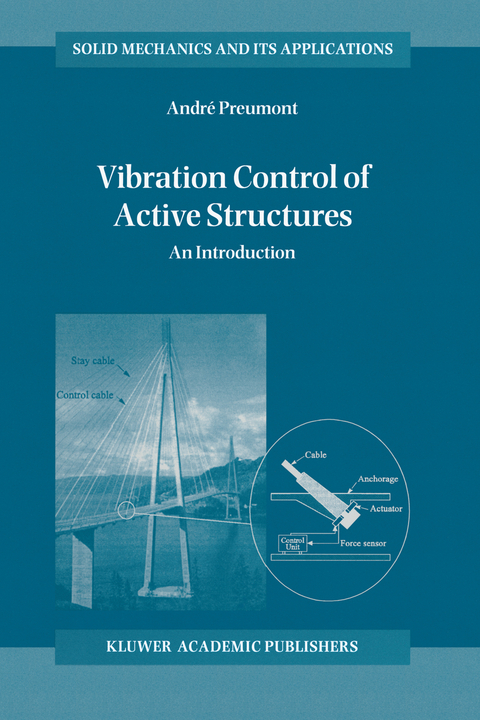
Vibration Control of Active Structures
Springer (Verlag)
978-94-010-6385-2 (ISBN)
1 Introduction.- 1.1 Active versus passive.- 1.2 Smart materials and structures.- 1.3 Control strategies.- 1.4 The various steps of the design.- 1.5 Organization of the book.- 1.6 References.- 1.7 Problems.- 2 Some concepts of structural dynamics.- 2.1 Equation of motion of a discrete system.- 2.2 Vibration modes.- 2.3 Modal decomposition.- 2.4 Transfer function of collocated systems.- 2.5 Continuous structures.- 2.6 Guyan reduction.- 2.7 References.- 2.8 Problems.- 3 Actuators, piezoelectric materials, and active structures.- 3.1 Introduction.- 3.2 Proof-mass actuator.- 3.3 Reaction wheels and gyrostabilizers.- 3.4 Piezoelectric actuators.- 3.5 Passive damping with piezoceramics.- 3.6 Active cantilever beam.- 3.7 Active truss.- 3.8 Active plate with piezo strips.- 3.9 References.- 3.10 Problems.- 4 Collocated versus non-collocated control.- 4.1 Introduction.- 4.2 Pole-zero flipping.- 4.3 Collocated control.- 4.4 Non-collocated case.- 4.5 Notch filter.- 4.6 Pole-zero flipping in the structure.- 4.7 Effect on the Bode plots.- 4.8 Relation to the mode shapes.- 4.9 The role of damping.- 4.10 References.- 4.11 Problems.- 5 Active damping with collocated pairs.- 5.1 Introduction.- 5.2 Direct Velocity Feedback.- 5.3 Acceleration feedback.- 5.4 Positive Position Feedback.- 5.5 Integral Force Feedback.- 5.6 Remarks.- 5.7 References.- 5.8 Problems.- 6 State space approach.- 6.1 Introduction.- 6.2 State space description.- 6.3 System transfer function.- 6.4 Pole placement by state feedback.- 6.5 Linear Quadratic Regulator.- 6.6 Observer design.- 6.7 Kalman Filter.- 6.8 Reduced order observer.- 6.9 Separation principle.- 6.10 Transfer function of the compensator.- 6.11 References.- 6.12 Problems.- 7 Analysis and synthesis in the frequency domain.- 7.1 Gain and phase margins.- 7.2Nyquist criterion.- 7.3 Nichols chart.- 7.4 Feedback specification for SISO systems.- 7.5 Bode gain-phase relationships.- 7.6 The Bode Ideal Cutoff.- 7.7 Non-minimum phase systems.- 7.8 Usual compensators.- 7.9 References.- 7.10 Problems.- 8 Optimal control.- 8.1 Introduction.- 8.2 Quadratic integral.- 8.3 Deterministic LQR.- 8.4 Stochastic response to a white noise.- 8.5 Stochastic LQR.- 8.6 Asymptotic behaviour of the closed-loop.- 8.7 Prescribed degree of stability.- 8.8 Gain and phase margins of the LQR.- 8.9 Full state observer.- 8.10 Kalman-Bucy Filter (KBF).- 8.11 Linear Quadratic Gaussian (LQG).- 8.12 Duality.- 8.13 Spillover.- 8.14 Loop Transfer Recovery (LTR).- 8.15 Integral control with state feedback.- 8.16 Frequency shaping.- 8.17 References.- 8.18 Problems.- 9 Controllability and Observability.- 9.1 Introduction.- 9.2 Controllability and observability matrices.- 9.3 Examples.- 9.4 State transformation.- 9.5 PBH test.- 9.6 Residues.- 9.7 Example.- 9.8 Sensitivity.- 9.9 Controllability and observability Gramians.- 9.10 Relative controllability and observability.- 9.11 Model reduction.- 9.12 References.- 9.13 Problems.- 10 Stability.- 10.1 Introduction.- 10.2 Linear systems.- 10.3 Liapunov’s direct method.- 10.4 Liapunov functions for linear systems.- 10.5 Liapunov’s indirect method.- 10.6 An application to controller design.- 10.7 Energy absorbing controls.- 10.8 References.- 10.9 Problems.- 11 Applications.- 11.1 Digital implementation.- 11.2 Active damping of a truss structure.- 11.3 Active damping of a plate.- 11.4 Active damping of a stiff beam.- 11.5 The HAC/LAC strategy.- 11.6 Tendon control of cable structures.- 11.7 References.- 11.8 Problems.
| Reihe/Serie | Solid Mechanics and Its Applications ; 50 |
|---|---|
| Zusatzinfo | XIII, 266 p. |
| Verlagsort | Dordrecht |
| Sprache | englisch |
| Maße | 160 x 240 mm |
| Themenwelt | Technik ► Bauwesen |
| Technik ► Fahrzeugbau / Schiffbau | |
| Technik ► Maschinenbau | |
| ISBN-10 | 94-010-6385-0 / 9401063850 |
| ISBN-13 | 978-94-010-6385-2 / 9789401063852 |
| Zustand | Neuware |
| Informationen gemäß Produktsicherheitsverordnung (GPSR) | |
| Haben Sie eine Frage zum Produkt? |
aus dem Bereich