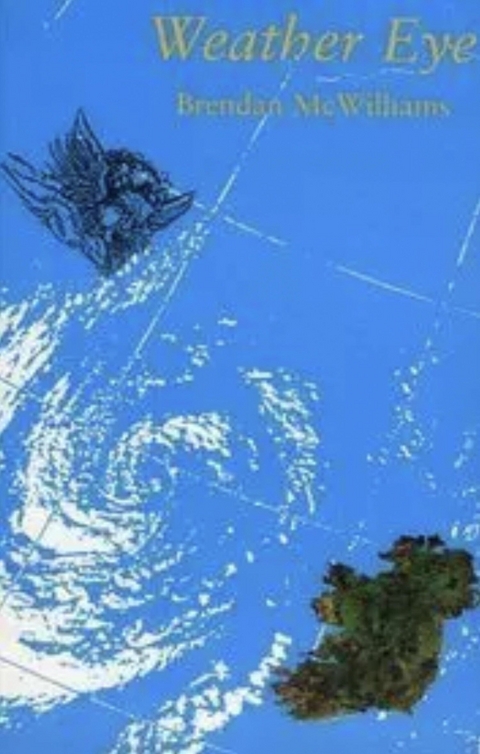
Weather Eye (eBook)
158 Seiten
The Lilliput Press (Verlag)
978-1-84351-376-6 (ISBN)
BRENDAN MCWILLIAMS, born in Dublin in 1944, spent his formative years in County Kerry where his father was in charge of Valentia Observatory. After graduating in Science from University College Dublin in 1964 he joined the Meteorological Service and worked as a weather forecaster, first at Shannon Airport, and later at the Central Analysis and Forecast Office in Dublin. During the 1970s he was a regular presenter of the daily weather forecast on RTE television. Since 1990 he has been Assistant Director of the Meteorological Service and his daily 'Weather Eye' column for The Irish Times, begun in 1988, has become one of the most popular features of that newspaper.
Weather Eye is a selection from the famous column in The Irish Times, which over the years has described and evoked all aspects of that most perennial of subjects for exchange and conversation - the lingua franca of country - and townspersons everywhere. Subjects encompassed include weather in history, weather in literature, weather in folklore, weather in mythology and weather in religion: auguries and forecasting; the science of meteorology; winds, rain, atmospheric pressure, cloud formations; macabre extremes; nomenclature; thoughts on snow, water, fog, dew, hail; thunder and lightning, rainbows and mirages; chroniclers and personalities (from Pepys to William Molyneux, Ben Franklin and Francis Beaufort, Mary Shelley and Percy French); lineaments of air and space; anomalies and optical phenomena; weathermen and weatherwomen. Weather Eye is a fascinating and authoritative compendium which will interest the serious student and delight the general reader curious about the workings of the world.
A Talent to Peruse
The forecasters of ancient Rome occupied a position of great power and influence. Unlike today’s practitioners, they were not obliged to confine themselves to predictions of the weather. The Roman augurs had a wide remit, and their pronouncements on the likely course of future events were awaited with eager anticipation at the start of any important enterprise.
It was the duty of the augurs to observe the signs – or auspices – which were sent by the gods to indicate their approval or otherwise of any proposed undertakings. The auspices took many forms. Signs from the birds – relating to their pattern and direction of flight, to the sounds they made, and to the ways in which they took their food – were of particular significance.
In general, signs from the right-hand side were considered to be good, while those which manifested themselves from the left were unlucky or sinister. Indeed they were literally so: sinister is the Latin word for ‘left’. But the most trusted sources of information for the augurs were the entrails of sacrificial animals. The liver was found to be particularly reliable in this regard, because of the subtle variations to be found in its size and shape, and in its colour and the pattern of its veins.
The operation was taken very seriously. Before taking the auspices the augur marked out the templum, or consecrated space, within which his observations were intended to be made. Anything outside the templum did not count; within its limits, the augur pitched his tent, asked the gods for signs, and waited for his answer.
Since magistrates were legally bound to take appropriate action on the advice of an augur, the office could be used by unscrupulous practitioners for personal political purposes. An unfavourable report could be used to obtain the postponement of unwanted meetings of the Senate, or to cancel the results of an election whose outcome might prove to be somewhat inconvenient. In 59 BC, for example, the augur Bibulus succeeded in holding up the entire legislative programme of Julius Caesar by merely, as he put it, ‘watching the heavens’.
For these sensitive reasons, the office of augur was bestowed only on persons of the most distinguished merit. This tradition of excellence has continued for those required to gaze into the future nowadays but the power, the influence, the flamboyant trappings of office, and indeed the talent for omniscience, have long since disappeared. O tempora, O mores!
An Early Enthusiast
‘Those whom the gods love die young’ according to the Greek play-wright Menander. Perhaps that was the case with William Molyneux, who died on 11 October 1698, at the early age of forty-two. But despite his somewhat premature demise, William Molyneux has achieved a lasting place in climatological history, he is credited with being Ireland’s very first scientific weather observer.
Molyneux was educated at Trinity College, Dublin, and later studied law in London. His interests throughout his life were wide, and he was no stranger to political controversy. Indeed only a few months before he died, he wrote ‘The Case of Ireland’s being bound by Acts of Parliament in England Stated’, a tract which attracted sufficient attention for it to be condemned by the London parliament in June of that year for being ‘of dangerous tendency to the Crown and to the people of England.’
Molyneux lived in an era of rapid development in the field of scientific instrumentation, and he quickly realized the potential of these new instruments for gaining an insight into the behaviour of the atmosphere. He was discouraged, however, by his difficulty in acquiring them: ‘I am living in a kingdom barren of all things’, he lamented in 1681, ‘but especially of ingenious artificers; I am wholly destitute of instruments on which I can rely.’
But the situation did improve. In March of 1684 Molyneux was able to begin a ‘Weather Register’, which for the first time in Ireland included readings of barometric pressure. By June 2nd of that year he had compiled enough material to present a paper to the Dublin Society on ‘The Observations of the Weather for the Month of May, with the Winds and the Heights of the Mercury in the Baroscope.’ He sent a copy of his May Register to Oxford University where it remains to this day, preserved in the Bodleian Library.
In May of the following year, Molyneux handed over the exacting task of keeping weather records for Dublin to St George Ashe, later to become Provost of Trinity College, and Ashe maintained the continuity for another year or so. This series of observations, although it only lasted for the two-year period 1684–6 and only a small fragment of it still survives, is regarded as one of the most important milestones in the history of Irish meteorology.
From Men-o’-War to Bits of Paper
Long before the invention of instruments that could measure the speed of the wind accurately, people used to guess at it – and then describe it. But for hundreds of years such descriptions were purely subjective. Who would have thought, for example, that the pirate William Dampier, writing in 1697 and describing the wind as merely ‘blowing exceeding hard’, was in the middle of a full typhoon? At other times, however, gross exaggeration was the order of the day. Admiral Sir Francis Beaufort was the first to standardize the measurement of wind, and the scale which bears his name has survived since the beginning of the last century with changes of a mere cosmetic nature.
Beaufort was born in 1774 into a family of French Huguenot origin in Co. Louth, where his father, Dr Daniel Augustus Beaufort, was rector of the local church. At the tender age of fourteen, young Francis embarked on a naval career, his family having paid the not inconsiderable sum of 100 guineas for the privilege; he was taken aboard the good ship Vansittart at Gravesend on 20 March 1789, and in due course crowned a distinguished career by becoming Hydrographer to the Royal Navy and being made a knight.
It was in 1805 that Beaufort’s scale of wind force was officially adopted. For the lower range of his thirteen-point scale, he took his cue from the descriptive terms traditionally used by sailors. Force 0 was a ‘calm’, Force 1 a ‘light air’, and Force 2 a ‘slight breeze’. For the stronger winds, he realized that he had to define his scale in terms of some well-known yardstick, just as a standard measure might be used to determine the length or weight of another object. The criterion he chose was the full-rigged battleship or ‘man-o’-war’ of his day. He described the winds by the effect they might have on such a vessel – and in particular the amount of sail it could carry in high winds without getting into trouble.
A century later, in the early 1900s, there were no longer any men-o’-war by which to learn the wind speeds, and so the descriptions had to be revised. For maritime purposes, the winds were now defined in terms of their effect on the surface of the open sea. Force 8 or Gale Force, for example, represents winds averaging slightly over 40 miles per hour, and was described by Beaufort as a wind in which ‘a well-conditioned man-o’-war might carry triple reef and courses’; the new Gale Force 8 resulted in ‘moderately high waves, where … the foam is blown in well marked streaks along the direction of the wind.’
A further change to the Beaufort Scale was necessary to cater for the vast majority of the population who, like W.S. Gilbert’s Admiral, ‘stick close to their desks and never go to sea’. They were accommodated by Sir George Simpson, who in 1906 related the Beaufort numbers to familiar homely things like loose bits of paper, umbrellas, trees and chimney pots. And this, in essence, is the Beaufort Scale of Wind Force that is still in use today.
Rear-Admiral Sir Francis Beaufort (1774–1857). (Painting by S. Pearce, 1851, National Maritime Museum, Greenwich)
Drains, Dykes and Weather-Maps
The inspection of drains appears to nurture creativity. Percy French, for example, before achieving more lasting fame as the composer of many of our best-loved Irish airs, began his career as the official inspector of drains for Co. Cavan. But far away, and a longer time ago, another member of the hydrological inspectorate carved out his own particular niche in history.
Heinrich Wilhelm Brandes was born on 30 July 1777, in the little German town of Ritzebuttel. Brandes spent the first ten years of his adult life as an Inspector of Dykes on the River Weser, and might, had his talents led in that direction, have progressed to write Teutonic gems like ‘How are things in Ritzebuttel?’ Instead, however, he became a meteorologist, and he is credited with drawing the very first weather-map.
With a growing reputation as a mathematician, Brandes was appointed Professor of Mathematics at the University of Breslau in 1811, and it was there that he developed his interest in meteorology....
| Erscheint lt. Verlag | 1.1.1994 |
|---|---|
| Verlagsort | London |
| Sprache | englisch |
| Themenwelt | Literatur ► Biografien / Erfahrungsberichte |
| Literatur ► Essays / Feuilleton | |
| Literatur ► Romane / Erzählungen | |
| Sachbuch/Ratgeber ► Natur / Technik ► Natur / Ökologie | |
| Sachbuch/Ratgeber ► Natur / Technik ► Weltraum / Astronomie | |
| Naturwissenschaften ► Geowissenschaften ► Meteorologie / Klimatologie | |
| Naturwissenschaften ► Physik / Astronomie | |
| Technik | |
| ISBN-10 | 1-84351-376-5 / 1843513765 |
| ISBN-13 | 978-1-84351-376-6 / 9781843513766 |
| Informationen gemäß Produktsicherheitsverordnung (GPSR) | |
| Haben Sie eine Frage zum Produkt? |
 EPUB (Wasserzeichen)
DRM: Digitales Wasserzeichen
Dieses eBook enthält ein digitales Wasserzeichen und ist damit für Sie personalisiert. Bei einer missbräuchlichen Weitergabe des eBooks an Dritte ist eine Rückverfolgung an die Quelle möglich.
Dateiformat: EPUB (Electronic Publication)
EPUB ist ein offener Standard für eBooks und eignet sich besonders zur Darstellung von Belletristik und Sachbüchern. Der Fließtext wird dynamisch an die Display- und Schriftgröße angepasst. Auch für mobile Lesegeräte ist EPUB daher gut geeignet.
Systemvoraussetzungen:
PC/Mac: Mit einem PC oder Mac können Sie dieses eBook lesen. Sie benötigen dafür die kostenlose Software Adobe Digital Editions.
eReader: Dieses eBook kann mit (fast) allen eBook-Readern gelesen werden. Mit dem amazon-Kindle ist es aber nicht kompatibel.
Smartphone/Tablet: Egal ob Apple oder Android, dieses eBook können Sie lesen. Sie benötigen dafür eine kostenlose App.
Geräteliste und zusätzliche Hinweise
Buying eBooks from abroad
For tax law reasons we can sell eBooks just within Germany and Switzerland. Regrettably we cannot fulfill eBook-orders from other countries.
aus dem Bereich