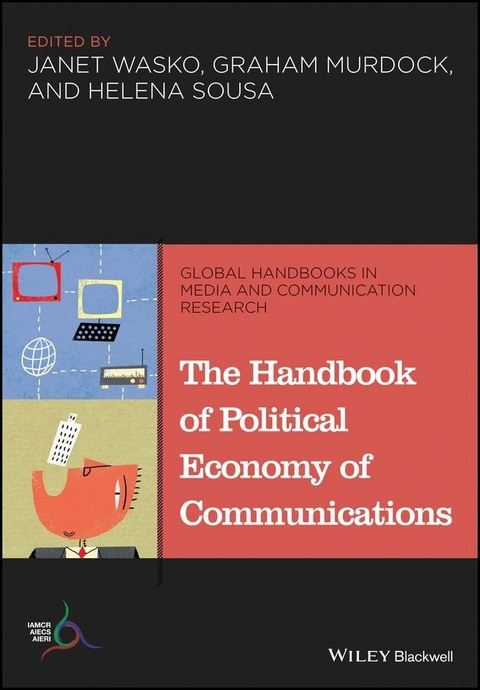
The Handbook of Political Economy of Communications (eBook)
John Wiley & Sons (Verlag)
978-1-4443-9539-6 (ISBN)
- Combines overviews of core ideas with new case study materials and the best of contemporary theorization and research
- Written many of the best known authors in the field
- Includes an international line-up of contributors, drawn from the key markets of North and Latin America, Europe, Australasia, and the Far East
Janet Wasko is Professor and Knight Chair in Communication Research at the University of Oregon (USA).
Graham Murdock is Professor of Culture and Economy at Loughborough University (UK).
Helena Sousa is Professor of Communications Sciences at the University of Minho (Portugal).
Janet Wasko is Professor and Knight Chair in Communication Research at the University of Oregon (USA). Graham Murdock is Professor of Culture and Economy at Loughborough University (UK). Helena Sousa is Professor of Communications Sciences at the University of Minho (Portugal).
About the Editors viii
Notes on Contributors ix
Series Editor's Preface xvi
Acknowledgments xvii
Introduction: The Political Economy of Communications: Core Concerns and Issues 1
Janet Wasko, Graham Murdock, and Helena Sousa
Part I Legacies and Debates 11
1 Political Economies as Moral Economies: Commodities, Gifts, and Public Goods 13
Graham Murdock
2 The Political Economy of Communication Revisited 41
Nicholas Garnham
3 Markets in Theory and Markets in Television 62
Eileen R. Meehan and Paul J. Torre
4 Theorizing the Cultural Industries: Persistent Specificities and Reconsiderations 83
Bernard Miège (translation by Chloé Salles)
5 Communication Economy Paths: A Latin American Approach 109
Martín Becerra and Guillermo Mastrini
Part II Modalities of Power: Ownership, Advertising, Government 127
6 The Media Amid Enterprises, the Public, and the State: New Challenges for Research 129
Giuseppe Richeri
7 Media Ownership, Concentration, and Control: The Evolution of Debate 140
John D. H. Downing
8 Maximizing Value: Economic and Cultural Synergies 169
Nathan Vaughan
9 Economy, Ideology, and Advertising 187
Roque Faraone
10 Branding and Culture 206
John Sinclair
11 Liberal Fictions: The Public-Private Dichotomy in Media Policy 226
Andrew Calabrese and Colleen Mihal
12 The Militarization of US Communications 264
Dan Schiller
13 Journalism Regulation: State Power and Professional Autonomy 283
Helena Sousa and Joaquim Fidalgo
Part III Conditions of Creativity: Industries, Production, Labor 305
14 The Death of Hollywood: Exaggeration or Reality? 307
Janet Wasko
15 The Political Economy of the Recorded Music Industry: Redefinitions and New Trajectories in the Digital Age 331
André Sirois and Janet Wasko
16 The Political Economy of Labor 358
Vincent Mosco
17 Toward a Political Economy of Labor in the Media Industries 381
David Hesmondhalgh and Sarah Baker
Part IV Dynamics of Consumption: Choice, Mobilization, Control 401
18 From the "Work of Consumption" to the "Work of Prosumers": New Scenarios, Problems, and Risks 403
Giovanni Cesareo
19 The Political Economy of Audiences 415
Daniel Biltereyst and Philippe Meers
20 The Political Economy of Personal Information 436
Oscar H. Gandy, Jr.
21 The Political Economy of Political Ignorance 458
Sophia Kaitatzi-Whitlock
Part V Emerging Issues and Directions 483
22 Media and Communication Studies Going Global 485
Jan Ekecrantz
23 New International Debates on Culture, Information, and Communication 501
Armand Mattelart (translation by Liz Libbrecht)
24 Global Capitalism, Temporality, and the Political Economy of Communication 521
Wayne Hope
25 Global Media Capital and Local Media Policy 541
Michael Curtin
26 The Challenge of China: Contribution to a Transcultural Political Economy of Communication for the Twenty-First Century 558
Yuezhi Zhao
Name Index 583
Subject Index 596
"Political economy has roared back into town. Terms like 'net neutrality,' 'creative labor,' 'the precariat,' and 'global capital' are in every critic's vocabulary--or should be. This Handbook's editors, all leading figures, have assembled an equally distinguished group of authors to lead the charge."
--Toby Miller, author of Makeover Nation: The United States of Reinvention
"This is an excellent book that moves from heritage sites to new destinations, and from the old standards to innovative research."
--Professor James Curran, Director, Goldsmiths Leverhulme Media Research Centre, University of London
"The power of the communications media to shape people's cultural, political and social lives is immense. We should never lose sight of the bases to their political and economic potency, and the political economy of communications is a crucial intellectual tradition in both analysing the media, and in giving sound critical foundations to challenge and intervention. In this important collection the editors have brought together an authoritative and diverse collection of original essays that reaffirm the importance of this tradition and make an irreplaceable contribution to it."
--Peter Golding, Northumbria University
"This is not only a welcome package of scholarship but also a timely reminder of the vitality of critical political economy, serving to keep the research tradition straight and wide under pressures of marketization and globalization."
--Kaarle Nordenstreng, Tampere University
Notes on Contributors
Sarah Baker is lecturer in cultural sociology at Griffith University, Australia. She has previously held research fellowships at The Open University and University of Leeds, UK, and the University of South Australia. She is the author of Creative Labour: Media Work in Three Cultural Industries (with David Hesmondhalgh, 2010).
Martín Becerra is Professor at the Social Sciences Department, Universidad Nacional de Quilmes (UNQ, Argentina). He received his PhD from the Universitat Autònoma of Barcelona, where he studied communication policies. He is Associate Researcher at the CONICET (Argentina), where he teaches courses in Political Economy of Communications and Media History. Dr Becerra also teaches postgraduate courses at the Universidad Nacional de La Plata and the Universidad de Buenos Aires (Argentine) and the Universidad Diego Portales (Chile). He has written books and articles on media policy.
Daniel Biltereyst is Professor in Film and Cultural Studies at the Department of Communication Science, Ghent University, Belgium, where he leads the Centre for Cinema and Media Studies. His research on film and screen culture as sites of public controversy has been published in many journals, readers, and collections. He is preparing a book on film censorship in Europe and with Richard Maltby and Philippe Meers, he is currently editing two books (The New Cinema History: Approaches and Case Studies, Wiley-Blackwell, 2010, and Cinema, Audiences and Modernity: European Perspectives of Film Cultures and Cinema-going, forthcoming).
Andrew Calabrese is Professor of Media Studies and Associate Dean, School of Journalism and Mass Communication, University of Colorado. His research and publishing focuses on media and citizenship, and the public policies that govern the media industries. He edits the Rowman & Littlefield and Lexington book series, “Critical Media Studies,” and the book series “Global Media Studies” (with Paula Chakravartty) for Paradigm Publishers.
Giovanni Cesareo is a member of the reference commission of the Faculty of Design, Milan Polytechnic. He is a member of Euricom, East-West European Institute of Research, the World Future Society, and the cultural committee of the Courmayeur Noir in Festival. He has acted as a consultant to the Italian Authority of Guarantee in Communication. He published La contraddizione femminile in 1979. He was editor of Ikon, a monthly review on communication processes and media, from 1978 to 1982; editor of Sapere, a science monthly review, from 1976 to 1982; and founded and edited Se, Scienza Esperienza, another science monthly, from 1982 to 1988. He was a member of the academic committee of the School of Journalism in Milan from 1985 to 1990. He also writes for the public radio and television networks.
Michael Curtin is the Duncan and Suzanne Mellichamp Professor of Global Media, and Professor of Film and Media Studies at the University of California at Santa Barbara. His books include Redeeming the Wasteland: Television Documentary and Cold War Politics, Playing to the World’s Biggest Audience: The Globalization of Chinese Film and TV, The American Television Industry (with Jane Shattuc), and Reorienting Global Communication: Indian and Chinese Media Beyond Borders (with Hemant Shah). He is coeditor (with Paul McDonald) of the “International Screen Industries” book series for the British Film Institute and coeditor (with Paul S. N. Lee) of the Chinese Journal of Communication.
John D. H. Downing is an emeritus faculty at Southern Illinois University Carbondale, where he founded the Global Media Research Center in the College of Mass Communication and Media Arts. His research interests are international communication, alternative media and social movements, and racism, ethnicity, and media. In addition to numerous publications in these areas, he is one of the Vice-Presidents of the International Association for Media and Communication Research.
Jan Ekecrantz was Professor of Media and Communication Studies at Stockholm University from the mid-1970s until his death in July 2007. His work dealt with such diverse areas as journalism’s construction of reality and the media situation in contemporary China. In later years, his primary interest was in processes of globalization.
Roque Faraone is a professor of Communication Theory at the University of the Republic of Uruguay and a founding member of the International Association for Media and Communication Research in 1957. He is also a Uruguayan lawyer, who, before going into exile in 1974, wrote the first book on the Uruguayan media. He spent 15 years in Paris as a correspondent for Agency France Press and consultant to UNESCO. He has numerous publications on the media and politics in Latin America.
Joaquim Fidalgo is Assistant Professor at the University of Minho in Braga, Portugal, working in the Social Sciences Department/Social Sciences Institute. He is also a senior researcher at the Centro de Estudos de Comunicação e Sociedade, a research center belonging to the Institute of Social Sciences of the same university. He has published several books, book chapters, and articles in scientific journals, mainly regarding the press and journalism (journalists’ professional identity, journalists’ ethics, media accountability systems and regulation). He is an active member of the International Association for Media and Communication Research, being presently the Deputy Head of its Journalism Research and Education section. He is also a member of the European Communication Research and Education Association, as well as a founding member of the Portuguese Communication Sciences Association.
Oscar H. Gandy, Jr is Professor Emeritus at the University of Pennsylvania. He was previously the Herbert I. Schiller Term Professor at the Annenberg School for Communication. His research and writing has emphasized privacy, surveillance, race, and discrimination as aspects of the political economy of communication and information. His forthcoming book, Coming to Terms with Chance, brings those elements together in a critical assessment of the ways in which statistical analysis and rational discrimination contribute to cumulative disadvantage. His previous works include The Panoptic Sort, Communication and Race, Beyond Agenda Setting, and more than 100 articles and chapters. He was a founding member of the Union for Democratic Communications, Board Chairman of the Electronic Privacy Information Center, and is currently working within the local movement for sustainability in Tucson, Arizona.
Nicholas Garnham worked as a TV filmmaker from 1962 to 1972, and then from 1972 to 2002 was Head of Communications Studies and Professor of Media Studies at the University of Westminster, UK, where he also directed the Centre for Communication and Information Studies. He was a founding editor of Media, Culture and Society. Garnham is now Emeritus Professor of Media Studies at the University of Westminster. He is the author of Samuel Fuller, The Structures of Television, Capitalism and Communication, and Emancipation, the Media and Modernity.
David Hesmondhalgh is Professor of Media and Music Industries at the University of Leeds, UK, where he is Head of the Institute of Communications Studies and Director of the Media Industries Research Centre. He is the author of The Cultural Industries (2nd edn, 2007) and Creative Labour: Media Work in Three Cultural Industries (with Sarah Baker, 2010). He has also edited a number of books including The Media and Social Theory (with Jason Toynbee, 2008), Media Production (2005) and Western Music and its Others: Difference, Appropriation and Representation in Music (with Georgina Born, 2000).
Wayne Hope is Associate Professor of Communication Studies at the Auckland University of Technology, New Zealand. His areas of research include time and globalization, New Zealand political economy and media history, public sphere analysis and sports–media relationships. He is at present writing a series of linked essays on time, temporality, and global capitalism. The most recent of these publications, for The International Journal of Communication, is entitled “Time, Communication and Financial Collapse” (2010). Within New Zealand, Associate Professor Hope is a regular media commentator who has written and spoken against virulent local manifestations of neoliberalism.
Sophia Kaitatzi-Whitlock is Professor in Politics and Communication in the School of Journalism and Mass Communication of Aristotle University of Thessaloniki, Greece. Her research interests include the interfaces between political communication, the political economy of media organizations and of communicative practices, and public policy making in this field. In 2005 she published Europe’s Political Communication Deficit, focusing on the EU’s democracy deficit and its relation to EU-wide political communication deficits. She is the author of the chapter “The Political Economy of the Media at the Root of Europe’s Democracy Deficit” (2008), in the edited volume Media, Democracy and European Culture. Her latest book Forms and Means for Political Communication, was published in 2010 (in Greek), by University Studio Press, Thessaloniki.
Guillermo Mastrini is a professor at the Communication School, National University of Quilmes, where he is...
| Erscheint lt. Verlag | 21.3.2011 |
|---|---|
| Sprache | englisch |
| Themenwelt | Sachbuch/Ratgeber ► Gesundheit / Leben / Psychologie ► Lebenshilfe / Lebensführung |
| Naturwissenschaften | |
| Sozialwissenschaften ► Kommunikation / Medien ► Allgemeines / Lexika | |
| Sozialwissenschaften ► Kommunikation / Medien ► Kommunikationswissenschaft | |
| Sozialwissenschaften ► Kommunikation / Medien ► Medienwissenschaft | |
| Sozialwissenschaften ► Politik / Verwaltung | |
| Technik ► Elektrotechnik / Energietechnik | |
| Wirtschaft ► Volkswirtschaftslehre ► Wirtschaftspolitik | |
| Schlagworte | Communication & Media Studies • Cultural Communication • Kommunikation • Kommunikation u. Medienforschung • Kulturelle Kommunikation • media studies, case studies, cultural communication, economics, mass communication, political economy, research, scholarship, IAMCR, theory, democracy, media, governance, technology, media policy, content production, access, influence, media ownership, advertising, culture, • Medienforschung |
| ISBN-10 | 1-4443-9539-4 / 1444395394 |
| ISBN-13 | 978-1-4443-9539-6 / 9781444395396 |
| Informationen gemäß Produktsicherheitsverordnung (GPSR) | |
| Haben Sie eine Frage zum Produkt? |
 EPUB (Adobe DRM)
Kopierschutz: Adobe-DRM
Adobe-DRM ist ein Kopierschutz, der das eBook vor Mißbrauch schützen soll. Dabei wird das eBook bereits beim Download auf Ihre persönliche Adobe-ID autorisiert. Lesen können Sie das eBook dann nur auf den Geräten, welche ebenfalls auf Ihre Adobe-ID registriert sind.
Details zum Adobe-DRM
Dateiformat: EPUB (Electronic Publication)
EPUB ist ein offener Standard für eBooks und eignet sich besonders zur Darstellung von Belletristik und Sachbüchern. Der Fließtext wird dynamisch an die Display- und Schriftgröße angepasst. Auch für mobile Lesegeräte ist EPUB daher gut geeignet.
Systemvoraussetzungen:
PC/Mac: Mit einem PC oder Mac können Sie dieses eBook lesen. Sie benötigen eine
eReader: Dieses eBook kann mit (fast) allen eBook-Readern gelesen werden. Mit dem amazon-Kindle ist es aber nicht kompatibel.
Smartphone/Tablet: Egal ob Apple oder Android, dieses eBook können Sie lesen. Sie benötigen eine
Geräteliste und zusätzliche Hinweise
Buying eBooks from abroad
For tax law reasons we can sell eBooks just within Germany and Switzerland. Regrettably we cannot fulfill eBook-orders from other countries.
aus dem Bereich