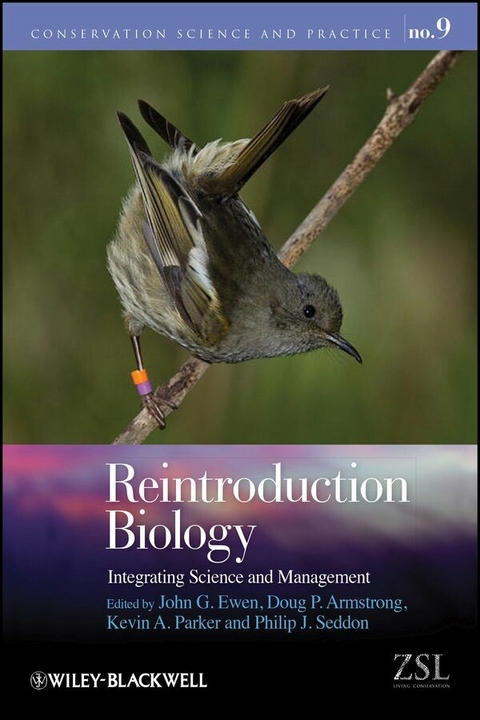
Reintroduction Biology (eBook)
520 Seiten
John Wiley & Sons (Verlag)
978-1-4443-5581-9 (ISBN)
John Ewen is a Research Fellow at the Institute of Zoology, Zoological Society of London and is supported by a Research Councils UK Academic Fellowship. He is currently co-leader of the New Zealand Department of Conservation's Hihi Recovery Group and is a member of the IUCN/SSC Reintroduction Specialist Group. Doug Armstrong is the Professor of Conservation Biology at Massey University in New Zealand. He has been involved in reintroduction since 1992, and has been the Oceania Chair of the IUCN/SSC Reintroduction Specialist Group since 1997. Kevin Parker is a post-doctoral fellow at Massey University, New Zealand. He is a member of the IUCN/SSC Reintroduction Specialist Group. Phil Seddon is an Associate Professor at the University of Otago and Director of the Department of Zoology's Postgraduate Wildlife Management Programme. Phil has been a member of the IUCN/SSC Re-introduction Specialist Group (RSG) since 1995, and RSG Bird Section Chair since 1998.
Contributors vii
Memorium of Don Merton xi
Foreword xix
Preface xxiii
1. Animal Translocations: What Are They and Why Do We Do Them? 1
Philip J. Seddon, W. Maartin Strauss and John Innes
2. A Tale of Two Islands: The Rescue and Recovery of Endemic Birds in New Zealand and Mauritius 33
Carl G. Jones and Don V. Merton
3. Selecting Suitable Habitats for Reintroductions: Variation, Change and the Role of Species Distribution Modelling 73
Patrick E. Osborne and Philip J. Seddon
4. The Theory and Practice of Catching, Holding, Moving and Releasing Animals 105
Kevin A. Parker, Molly J. Dickens, Rohan H. Clarke and Tim G. Lovegrove
5. Dispersal and Habitat Selection: Behavioural and Spatial Constraints for Animal Translocations 138
Pascaline Le Gouar, Jean-Baptiste Mihoub and François Sarrazin
6. Modelling Reintroduced Populations: The State of the Art and Future Directions 165
Doug P. Armstrong and Michelle H. Reynolds
7. Monitoring for Reintroductions 223
James D. Nichols and Doug P. Armstrong
8. Adaptive Management of Reintroduction 256
Michael A. McCarthy, Doug P. Armstrong and Michael C. Runge
9. Empirical Consideration of Parasites and Health in Reintroduction 290
John G. Ewen, Karina Acevedo-Whitehouse, Maurice R. Alley, Claudia Carraro, Anthony W. Sainsbury, Kirsty Swinnerton and Rosie Woodroffe
10. Methods of Disease Risk Analysis for Reintroduction Programmes 336
Anthony W. Sainsbury, Doug P. Armstrong and John G. Ewen
11. The Genetics of Reintroductions: Inbreeding and Genetic Drift 360
Lukas F. Keller, Iris Biebach, Steven R. Ewing and Paquita E.A. Hoeck
12. Genetic Consequences of Reintroductions and Insights from Population History 395
Jim J. Groombridge, Claire Raisin, Rachel Bristol and David S. Richardson
13. Managing Genetic Issues in Reintroduction Biology 441
Ian G. Jamieson and Robert C. Lacy
14. Summary 476
Philip J. Seddon, Doug P. Armstrong, Kevin A. Parker and John G. Ewen
Index 483
"I believe Reintroduction Biology would appeal to a wider audience and I would highly recommend this book to students (including undergraduates." (Austral Ecology, 8 December 2015)
"Overall though, Reintroduction biology: integrating science and management is well worth reading. As the authors intended, it will be a very useful reference for those actually engaged in, or in the process of planning, a wildlife translocation or reintroduction. It would also make an excellent book to organize a graduate student seminar course around, as it touches on a variety of contemporary applied and theoretical aspects of ecology. I would highly encourage colleagues to read this book for themselves. " (Ecology, 1 September 2013)
"Given the font size (same as Notornis) and with line spacing of 1.5 (1.0 in Notornis), the text format is well suited to the eyesight of the majority of the Ornithological Society of New Zealand membership! I'm sure the OSNZ library copy will get frequently borrowed and well read." (Notornis: Journal of the Ornithological Society of New Zealand, 1 May 2013)
"Provide(s) a timely review of the science of species reintroductions, examining techniques and best practices to ensure long-term survival of species returned to the wild." (British Ecological Society Bulletin, June 13)
"The book is rounded off with a concise summary chapter to outline what the intentions of the book are and to challenge the readers to improve and develop the concepts and principles presented in the book so that the overall success rate of reintroduction programmes can be improved." (Fauna & Flora International, 1 January 2013)
| Erscheint lt. Verlag | 14.12.2011 |
|---|---|
| Reihe/Serie | Conservation Science and Practice | Conservation Science and Practice |
| Sprache | englisch |
| Themenwelt | Naturwissenschaften ► Biologie ► Ökologie / Naturschutz |
| Naturwissenschaften ► Geowissenschaften ► Geologie | |
| Technik | |
| Schlagworte | Ãkologie / Tiere • Animal ecology • Biowissenschaften • Conservation Science • Life Sciences • Naturschutzbiologie • Ökologie / Tiere • Ornithologie • Ornithology |
| ISBN-10 | 1-4443-5581-3 / 1444355813 |
| ISBN-13 | 978-1-4443-5581-9 / 9781444355819 |
| Informationen gemäß Produktsicherheitsverordnung (GPSR) | |
| Haben Sie eine Frage zum Produkt? |
 EPUB (Adobe DRM)
Kopierschutz: Adobe-DRM
Adobe-DRM ist ein Kopierschutz, der das eBook vor Mißbrauch schützen soll. Dabei wird das eBook bereits beim Download auf Ihre persönliche Adobe-ID autorisiert. Lesen können Sie das eBook dann nur auf den Geräten, welche ebenfalls auf Ihre Adobe-ID registriert sind.
Details zum Adobe-DRM
Dateiformat: EPUB (Electronic Publication)
EPUB ist ein offener Standard für eBooks und eignet sich besonders zur Darstellung von Belletristik und Sachbüchern. Der Fließtext wird dynamisch an die Display- und Schriftgröße angepasst. Auch für mobile Lesegeräte ist EPUB daher gut geeignet.
Systemvoraussetzungen:
PC/Mac: Mit einem PC oder Mac können Sie dieses eBook lesen. Sie benötigen eine
eReader: Dieses eBook kann mit (fast) allen eBook-Readern gelesen werden. Mit dem amazon-Kindle ist es aber nicht kompatibel.
Smartphone/Tablet: Egal ob Apple oder Android, dieses eBook können Sie lesen. Sie benötigen eine
Geräteliste und zusätzliche Hinweise
Buying eBooks from abroad
For tax law reasons we can sell eBooks just within Germany and Switzerland. Regrettably we cannot fulfill eBook-orders from other countries.
aus dem Bereich